
This is the first in a three-article series about high-crime places. Access the second article here and the third article here.
Thinking Beyond Offenders, Victims, and Residents
A scrapyard on the edge of the rural English village of Staining generated many calls to the local constabulary. These included fights between staff and customers, theft of car parts, and arson. Residents complained that the scrapyard attracted people who stole cars and other belongings from their nearby garages, gardens, and sheds to trade at the yard.
Police intelligence gathering revealed that several chronic offenders frequented the yard; some were even employed by the yard. Police also uncovered several safety threats: a dilapidated rusty iron fence surrounding the property; vehicles piled six high in the yard, some of which had previously fallen over; and years’ worth of oil and pollutants that had been leaking into the water table and contaminating nearby marshlands.
Police ramped up patrols in the area hoping to deter offenders. Some residents started a neighborhood watch. But these efforts failed. The constabulary found that “the offenders had been reported, arrested and intelligence gathered but still they came back time and time again to cause misery to the locals and put a strain on police resources.”
Getting nowhere, a local constable decided to take a new approach. Instead of pursuing the crime problems, the constable pursued the yard’s safety problems. He contacted two agencies: the health and safety executives office and the government environmental agency. After learning of the dilapidated fence and piles of vehicles, a health and safety executive visited the yard and demanded that the business owner erect a proper fence and remove large piles of cars. After learning the yard was polluting the watercourse, the environmental agency visited the yard and demanded that the scrapyard owner remove the topsoil in the yard and install concrete flooring and modern drainage. Though the business owners initially fixed the fence and moved some vehicles, they refused to address the environmental issues the yard caused. So, the business owners closed the yard. Residents noticed an immediate improvement; crime in the village declined by 45% and there was an 87% reduction in crime within 200 meters of the scrapyard.
Three lessons can be learned from the scrapyard. First, instead of focusing on the people involved in crime, the constable focused on the place. Property owners make decisions about their places that can create or suppress crime opportunities. We call people who operate properties place managers.
Second, instead of trying to solve the auto theft and burglary problems associated with the scrapyard by arresting offenders, the constable focused on safety issues associated with the place. Properties with crime problems often have other problems, too: unpaid tax liens, building code violations, health code violations, and so on.
Third, to address the safety and environmental issues, the constable identified the relevant agencies and prompted action from them. Addressing issues other than crime can end up reducing crime. The closing of this mismanaged scrapyard not only eliminated its safety and environmental problems, but it also eliminated the opportunities for crime. Thieves no longer stole from nearby properties because they no longer had a place that would purchase stolen goods.
When looking to reduce crime, people typically focus on the offender and victim. People seldom focus on the place manager to solve the problem. But place managers are very powerful; they are the controllers of property. Research indicates that when owners act to prevent crime on their properties, they cut down crime.
But sometimes place managers are uncooperative. When this happens, are you out of luck? Fortunately, no. You just need to find a way to put pressure on place managers to change their places. We call these people or organizations super controllers.
Using Super Controllers to Motivate Action
Super controllers are institutions, organizations, or people who create incentives for place managers to prevent crime. In the scrapyard example, the health and safety executive office and the government environmental agency were both super controllers. Both put pressure on the place manager—the scrapyard owner—to address problems on the property: the dilapidated fence, stacks of cars, and toxic waste spilling into the water table. It’s important to note that super controllers do not directly change any given place. Instead, they have indirect influence over place managers; it’s the place managers who control and act upon the place, not the super controller.
As a city/county manager, you’ve probably encountered super controllers before. All businesses require valid business licenses to operate. Businesses wanting to sell alcohol have special rules they must follow to maintain their licenses. All bars, for example, are forbidden to sell alcohol to those underage. They also are not supposed to sell alcohol to individuals who are visibly intoxicated. Doing so increases the likelihood that the premises can experience problems, such as fights inside the bar and robberies on nearby streets.
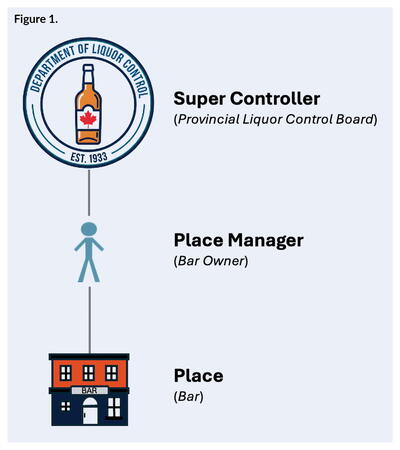
If a bar is a hotspot for crime, one possible intervention is to have the corresponding liquor control bureau conduct an audit of the premises (Figure 1). If the liquor regulation agent learns that the bar staff are over-serving or serving to minors, the agent can threaten to revoke the bar’s liquor license unless the owner makes changes. Without the license, the bar cannot serve alcohol. The threat of losing one’s license will likely motivate the place manager to change how the place functions to reduce the over-serving, fights, and underage drinking. Changes could include training employees to check identification and forbidding the sale of alcohol to minors. In this example, the liquor board agent is the super controller, the bar owner is the place manager, and the bar is the place/property. The liquor control board does not take any direct action on the place. Instead, the place manager changes the place because of the pressure from the liquor control board.
There Are Many Super Controllers at Your Disposal
Places with high crime are usually poorly managed. And poorly managed properties are often in violation of a variety of regulations; health and safety hazards, unpaid tax liens, unkept properties. To solve the crime problems at such places, it helps to involve more than just the police. You need to involve the city/county agencies that deal with health and safety hazards, unpaid taxes, and unkempt properties. Such agencies are super controllers.
For example, an Anaheim nightclub had many fights, including two homicides. The police tried dealing with the problem using traditional strategies, like increased enforcement, but this failed. The police then noticed that the nightclub owner was operating under the wrong liquor license, was allowing too many people into the nightclub, and was not following the rules of his dance-hall permit. So, the police enlisted the help of the state liquor board to investigate liquor license violations, the fire marshal to address occupancy concerns, and the treasurer to deal with violations of the dance-hall permit.
If an apartment building is generating many calls for police service, investigate who owns the building. If owners are managing their buildings themselves, see if you can convince them to apply some crime prevention strategies. But sometimes apartment owners contract property management companies to oversee daily operations. Sometimes the owner, who has placed trust in the manager, is unaware of the negligence. So, getting the owner engaged can lead to solutions. Clauses in the contract may give the owner the authority to discipline the negligent manager.
If you are dealing with a recalcitrant local store manager who reports to corporate headquarters, consider contacting their corporate headquarters. For example, one of us (John) once worked with police to address problems associated with a discount department store in Baltimore County, Maryland, USA. Some people were purchasing large quantities of gold and silver spray paint cans to get high by inhaling the fumes. They were then causing problems at nearby places, such as getting hit by vehicles and scaring residents. Police tried to enlist the store manager to solve the problem. The store manager initially resisted, so the police got the store’s headquarters involved. The store manager removed gold and silver spray paint from display shelves and restricted the sales of these colored paints.
Financial and insurance institutions may also be of use. Some insurance companies will offer discounts if clients apply crime prevention measures. In rural England, for example, farm insurance companies offered a 12% discount if farm owners installed trackers on their equipment in case of theft. In addition to obtaining building permits, for example, a development company building single family homes will need to carry insurance. Builders risk insurance covers the site and materials used on the premises, but builders often will not be covered unless certain conditions, such as fencing enclosing the entire work site, are met. Thus, insurance companies can compel crime prevention action from builders. City/county governments can also specify and enforce good building practice. To reduce thefts of appliances, for example, the development and building services department can specify in building permits that developers must wait to install appliances until the day before closing.
City managers should also not forget the value of code or bylaw enforcement. Some gang members, for example, will rent homes and not mow the lawn. The tall grass provides an easy hiding place for their firearms; if police locate the firearms, the offenders can feign innocence saying they do not know where the firearm came from. Code/bylaw officers can warn the landlord of consequences (such as fines) if the grass is not kept to a minimum height. Often the landlords are unaware that their tenants are not keeping up the property. Not only will consistent lawn mowing make city lots look nicer, but they can also remove opportunities for crime.
In extreme cases when property owners are uncooperative, cities can get courts involved. Local prosecutors can initiate nuisance abatement lawsuits against property owners whose actions (or failure to act) disturb the health, safety, or enjoyment of area residents. Examples include unsanitary conditions, noise and disturbances, property neglect, and repeated public safety response to the property. If a property owner repeatedly fails to address the issues, the lawsuit can result in the property going into receivership; the court appoints a third party to take control of the property and make the necessary changes, often at the expense of the owner. As expensive as these court cases may be, they might be the cheapest way for a local government to reduce crime, reply to residents, and respond to elected officials.
Coordinate Your Existing Municipal Resources
Often when police begin investigating problem properties, they learn that other agencies also have had contact with them. If, for example, the landlord of an old apartment building is turning a blind eye to drug dealing on her property, she may also be delinquent on her property taxes or failing to replace faulty wiring. While crimes at properties like this often attract the attention of the police, these properties may not be priorities for other city/county agencies. Police should convene otherwise siloed agencies with powers to solve property problems.
An effort in New Rochelle, New York, provides an example. Emergency services were receiving multiple calls about quality-of-life problems including building and fire code violations, as well as overcrowding and illegal housing. Many calls were repeats about the same few properties. So, the police department spearheaded the creation of a quality-of-life task force made up of many super controllers: fire department, buildings inspection, public works, and county electrical inspectors whose efforts were overseen by the law department.
The idea was to have various agencies jointly inspect the properties they were receiving calls about and engage in coordinated efforts to get owners to address problems on their properties. The task force first tried to gain compliance voluntarily through education and general requests. If property owners did not act, the task force switched to enforcement. The local court and district attorney’s office worked together to aggressively prosecute uncooperative property owners. And the New Rochelle Corporation Council passed local legislation authorizing an escalating fine schedule for property owners with repeated violations. In the first three years, the task force inspected 183 properties and issued 557 summonses. The police found a 15% decrease in crime and a 22% reduction in calls for service.
Conclusion
To reduce crime, we must address problem properties. If a property owner doesn’t cooperate, the police are handcuffed. Therefore, the city/county should consider super controllers. And as we will show in the next article, solving a place problem can have neighborhood-wide benefits.
SHANNON J. LINNING, PhD, is an assistant professor in the School of Criminology at Simon Fraser University in Vancouver, Canada. She researches place-based crime prevention and problem-oriented policing.
TOM CARROLL, ICMA-CM, is city manager of Lexington, Virginia, USA, and a former ICMA research fellow.
DANIEL GERARD is a retired 32-year veteran (police captain) of the Cincinnati Police Department, USA. He currently works as a consultant for police agencies across North America.
JOHN E. ECK, PhD, is an emeritus professor of criminal justice at the University of Cincinnati, USA. For more than 45 years, he has studied police effectiveness and how to prevent crime at high-crime places.
Publish with ICMA!
We’re searching for interesting and insightful stories that can help others learn a memorable takeaway to serve their communities better.
