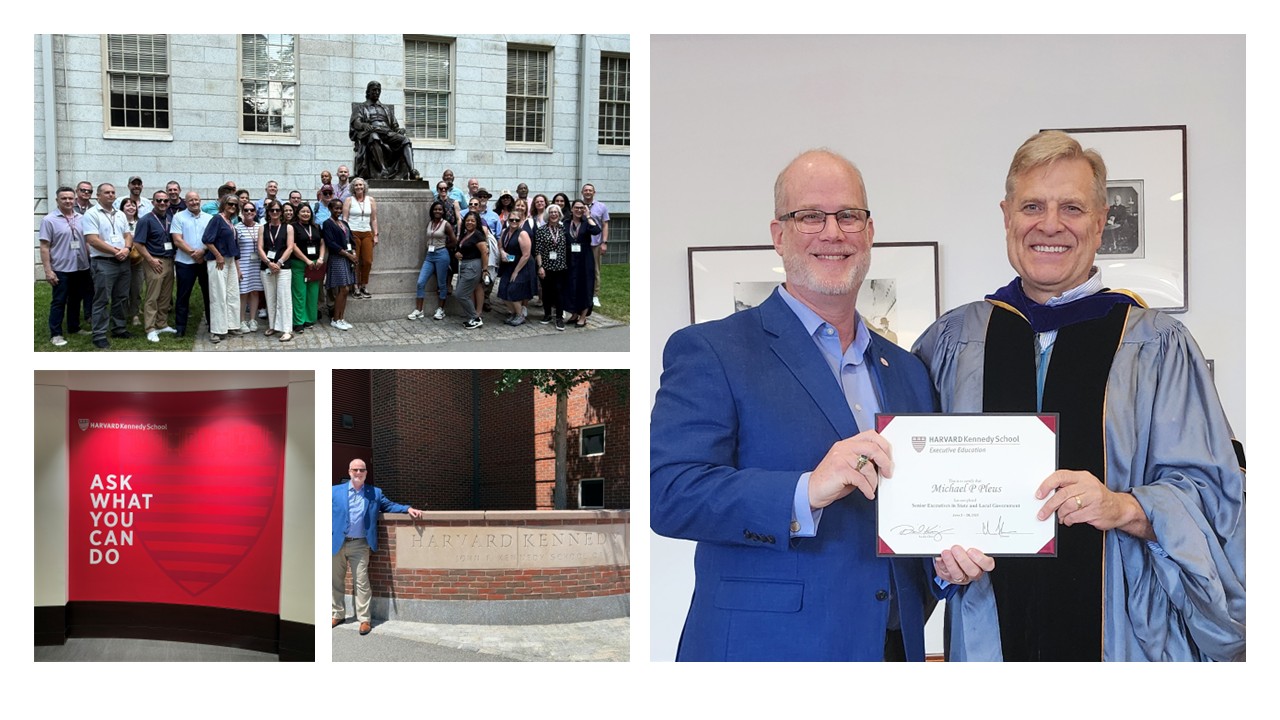
This year, I was honored to receive the Ferguson Group scholarship to attend the Harvard Kennedy School’s Senior Executives in State and Local Government program. I’m deeply grateful to the late William Ferguson Jr. for his strong belief in local government management, as well as the continued commitment of the Ferguson Group, which has helped public management professionals access this outstanding opportunity for many years. I would also like to thank ICMA and the selection committee for their time and commitment to the selection process for the scholarship.
When I first decided to apply, I had spent nearly 25 years in the public management profession, but I was searching for experiences that would enhance my contributions to the profession and my community. I learned about the program at the 2018 ICMA Annual Conference in Baltimore, and realized that I knew several graduates and discussed their experiences with them. Hearing their stories convinced me that the program could be life-changing. I first applied in 2019, and after not being selected, a friend encouraged me to try again. I applied in 2020, but the program was cancelled due to the COVID-19 pandemic. I reapplied in 2023 and 2024, and in 2025, I was selected. I still remember getting that call from Chris Gendell, the Ferguson scholarship program manager at ICMA. I was thrilled! I could not wait for my Harvard experience to begin.
Leading up to the program, we had a Zoom call with faculty chair David King and program manager Christian Flynn, who explained the program logistics in more detail and gave us instructions on using Canvas, the learning management system. Soon, the reading began, and there was a lot of it! I tackled the first week’s materials early to get a head start—a step I strongly recommend. Even with that head start, there was a lot of required reading throughout the program.
Soon after, I packed for Cambridge. I had been to Boston for the 2013 ICMA Annual Conference, but I hadn’t explored Harvard or Cambridge. They used to host program participants in the dormitories, but we were hosted at the DoubleTree Suites, just a short walk to Harvard Kennedy School. I arrived the day before the program started, and I was excited to check into my room and begin my tour of the Harvard campus. I walked on the trail that ran along the Charles River, then on to the Kennedy School building, and began to take in what would be my home for three weeks.
The Senior Executives for State and Local Government program falls under the Executive Education program at the Harvard Kennedy School. Its purpose is to help program participants navigate the greater demands placed on state and local government at a time where they face a skeptical and divided constituency. The program is an intensive, three-week experience designed to stretch and strengthen public leaders. Through faculty-led case studies, simulations, and peer dialogue with officials from across the United States and around the world, we explored topics ranging from adaptive leadership and negotiation to equity, public communication, crisis management, creating public value, and innovation. What stood out most was how to lead through uncertainty and build coalitions across divides—skills that are urgently needed in government today. The program pushed us to reflect not just on policy, but on purpose, and how to align values with public service.
My cohort included city managers, assistant city managers, mayors, finance directors, union officials, municipal police officials, state legislators, state officials, county officials, and school board officials from 19 states, Canada, Ireland, England, and Pakistan.
Faculty chair David King described the program as an ecosystem for exploring public policy issues with the toolkit that they help us create in the first two weeks. We delved into adaptive leadership, creating public value, negotiation, political structures and public engagement, using evidence and data, generative AI, finance, economic development, and emergency management. We also spent a day together on Thompson Island participating in Outward Bound, a great exercise in team building and creative problem solving.
In the classroom, participants are encouraged to, as Professor Marty Linksy would put it, “raise the heat” to explore the more challenging issues often left unexplored because they can be so divisive under normal circumstances. We used the toolkit we built in the first two weeks to solve three case studies selected by the class in week three. The case studies were presented by the cohort as public policy issues that they were trying to solve in their community. We acted as consultants tasked with developing solutions, and then presented our recommendations to the class.
On the final day, we had a graduation ceremony, received our certificates, and began the hard process of saying goodbye to our new friends. The three weeks passed rather quickly, but the friendships and connections we made will last a long time. We experienced a lot together and opened up to each other, allowing ourselves to be vulnerable. As a result, we were able to discuss challenging public policy issues we face in our own communities with individuals that may have very different views than we do. However, throughout the experience we all remained committed to respectful discourse and “sharpening the saw” toward the goal of becoming better public servants.
After returning home, we committed to implementing key takeaways from the program and chose “accountability buddies” from among our peers to check in with regularly. All in all, this was an incredible experience. If you want to take your career to the next level, I encourage you to apply for the scholarship to participate in this outstanding program.
Learn more about the scholarship here.
MICHAEL PLEUS, ICMA-CM, is city manager of DeLand, Florida, USA.
Publish with ICMA!
We’re searching for interesting and insightful stories that can help others learn a memorable takeaway to serve their communities better.
