These meditations began as simple dialogues between two placeholder voices—Protagon and Antagon—used to explore complex problems and ideas. As the project evolved, those voices matured into what they truly represented.
Protagon became Dr. Concepto: the voice of conceptual clarity and analytical structure. Antagon became Mr. Unhyde: the one who reveals hidden assumptions and probes beneath the surface. They are not adversaries. They represent the dual nature of disciplined thinking—one that constructs meaning, and one that tests it. Together, they model how we think rigorously about complex professional problems.
What follows is a brief conceptual meditation on why building a shared understanding of core concepts at the strategic level is essential to the success of our organizations.
Opening Inquiry
Mr. Unhyde: Dr. Concepto, you often speak of concepts as though they are the hidden machinery behind everything we do. But surely the major themes we explore in our organizations—strategy, analysis, leadership, even change—should rely more on tangible experience than on abstract ideas.
Dr. Concepto: You touch the surface, Mr. Unhyde, but miss the essence. Every discipline—philosophy, organizational science, strategy—rests on an invisible foundation: concepts. They are the mental building blocks that allow us to think, categorize, analyze, and act. As humans, we think in concepts.
Mr. Unhyde: Surely we can live and act without them.
Dr. Concepto: We can live and act without consciously recognizing them, but we cannot think without them. Without concepts, there is no analysis; without analysis, no strategy; without strategy, no streamlined progress. More fundamentally, without concepts, we could not interpret the world around us at all.
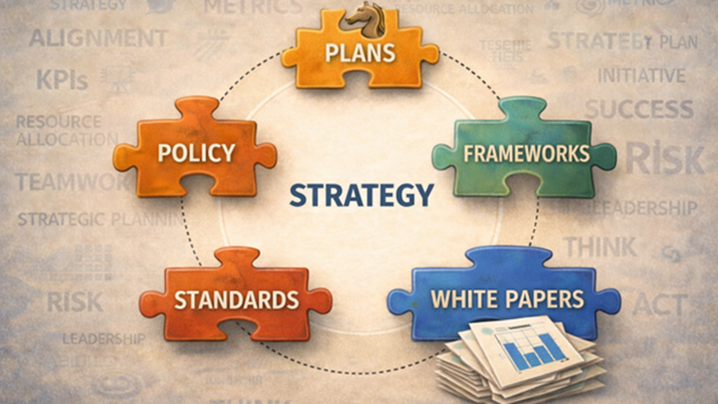
And understand this, Mr. Unhyde—strategy is not confined to one formal document. It lives in every document that guides collective action: strategic plans, standards, policies, procedures, frameworks, and white papers. Each of these is a strategic instrument. Each helps pave the way from the grand intent into the operational practice. Success or failure depends on whether the concepts employed are shared, coherent, and understood in the same way by those who must act on them.
Mr. Unhyde: Then understanding concepts is not academic trivia, but a practical skill?
Dr. Concepto: Exactly. We may live without being aware of how constantly we use concepts—or without understanding them. But when we do understand them, conceptual clarity strengthens analysis, strategic planning, and problem-solving across all domains. Before we can solve a problem, we must understand the concepts through which we interpret it.
What Is a Concept?
Mr. Unhyde: Then define it. What is a concept?
Dr. Concepto: A concept is a general idea formed in the mind—an abstraction that groups together instances, experiences, or phenomena under a shared meaning. For most professional work, a simple definition—a general idea—is sufficient.
Mr. Unhyde: Examples?
Dr. Concepto: Plan. Leadership. Risk. Strategy. Goal. Initiative.
Mr. Unhyde: These vary widely.
Dr. Concepto: They do, yet they serve the same purpose: helping us make sense of the world. Psychologists often use the term construct—emotional intelligence is a good example—while philosophers tend to prefer concept, such as the concept of leadership. In practice, both refer to mental representations that guide understanding and action.
Concepts in Practice
Mr. Unhyde: Why insist so strongly on the role of concepts and conceptual awareness?
Dr. Concepto: Because abstraction is the foundation of disciplined thought. Many professional misunderstandings are not technical—they are conceptual. We attempt analysis without clarity, planning without shared meaning, and standardization without first agreeing on which key terms matter and how they should be defined.
Mr. Unhyde: So we risk disagreement if we do not first establish a common understanding of the topic at stake?
Dr. Concepto: Precisely. When foundational concepts are unclear or misaligned, even well-designed standards and strategies struggle. What appears to be disagreement over execution is often disagreement over meaning.
Mr. Unhyde: How, then, do we actually use concepts in strategic thinking?
Dr. Concepto: We use them as terms in our strategic documents. Risk, goal, result, threat—these are all concepts. Once they appear in official guidance, they must be clearly defined. Too often, we treat them as self-evident.
Consider risk and threat. They are frequently used interchangeably, yet they are not the same. Risk refers to something that may occur—a possibility. Threat usually denotes something imminent or actively present. When such concepts become operational terms in policies, plans, or standards, ambiguity is no longer harmless. Conceptual clarity is what prevents confusion. You do not want to allocate all your resources to low-probability risks. But when facing a genuine strategic threat, you may need to mobilize everything at once.
Mr. Unhyde: Can you give another practical example?
Dr. Concepto: I was participating in a strategic planning session in which we were identifying key areas to address. Infrastructure was one of them, and everyone initially agreed—until I asked a simple question: What do we mean by infrastructure?
The context was the role of infrastructure in the timeliness of 911 response. The group included participants from administration, operations, and IT. This raised the question of whether infrastructure referred only to roads or also to IT infrastructure. While the initial intent focused on roads and their condition, the discussion revealed that IT infrastructure played an equally critical role and needed to be addressed explicitly.
The team ultimately chose to clarify the concept by adding specific descriptors—e.g., infrastructure (roads, IT infrastructure)—to ensure a shared understanding.
Mr. Unhyde: And what could be the effect of non-unified interpretations of concepts like infrastructure?
Dr. Concepto: They can lead to operational risk and strategic consequences. Consider guiding documents such as professional standards, standard operating procedures, and policies. Any key term used in these documents should be clearly defined to provide a unified understanding—this is the role of standardization. Otherwise, the result may be inconsistency in interpretation and practice.
Mr. Unhyde: A quiet but consequential problem.
Dr. Concepto: Indeed. Poorly defined terms lead to poor standards. Poor standards lead to inconsistent practice. And inconsistent practice introduces risk—often without anyone noticing the conceptual root of the problem. When standards are interpreted differently, the interoperability and unity of action among those applying them are at risk.
Closing Insight
Mr. Unhyde: So, conceptual clarity is not optional when the success of our organizations is at stake?
Dr. Concepto: It is a hidden building block of strategy. When we clarify our concepts, we clarify our intent. Conceptual thinking is the hidden discipline behind effective analysis, sound strategy, and meaningful standardization.
Mr. Unhyde: I now see how important conceptual awareness and clarity are, since we interpret the world around us through concepts.
Dr. Concepto: You have truly grasped the essence of this meditation.
Publish with ICMA!
We’re searching for interesting and insightful stories that can help others learn a memorable takeaway to serve their communities better.
