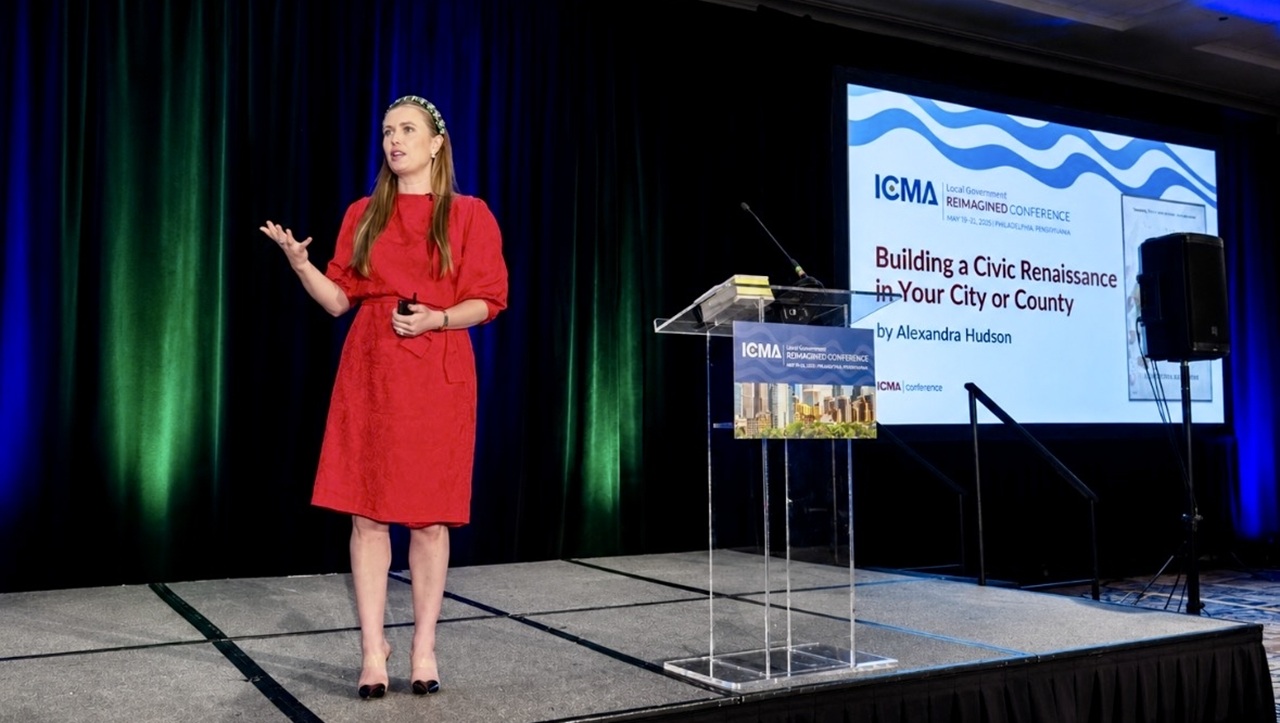
At a moment when local governments are navigating polarization, public distrust, and increasing incivility, keynote speaker Alexandra O. Hudson offered attendees at ICMA’s Local Government Reimagined Conference a different perspective. “This isn’t just a crisis of difference or division,” she said. “We are living through a crisis of dehumanization.”
Drawing from her book, The Soul of Civility, Hudson challenged attendees to reconsider what civility actually means. Too often, she argued, civility is confused with politeness. But the two are not the same.
“Civility is the art of human flourishing,” Hudson said. “It is the bare minimum of respect that we are owed and owe to others by virtue of our shared personhood.” Politeness, by contrast, is often merely performative—“the external stuff,” she explained, “technique.”
Hudson’s interest in the subject began at home. Her mother, known professionally as “Judy the Manners Lady,” taught her children the rituals of etiquette: how to shake hands, set a table, and interact graciously with others. But Hudson said she always questioned the “why” behind those rules. “I am constitutionally allergic to authority,” she joked. “I always hungered for a kind of philosophical moral underpinning to our social norms.”
That search intensified during her time working in federal government, where she encountered what she described as two destructive extremes. One group was openly hostile—people who shouted or steamrolled coworkers in meetings. The other appeared polished and gracious on the surface, but used niceness manipulatively. “They would smile at me one moment and then stab me in the back the next,” she recalled.
Though those approaches seem opposite, Hudson argued that they are fundamentally alike. “Both the hostile mode and the polite mode see others not as ends in themselves, but as means to an end,” she said. “Neither sees other human beings in the fullness of who we are.”
One story she shared involved a colleague who lavished her with compliments before asking for help with a project he had neglected. After Hudson finished the work, he took full credit and immediately discarded the relationship. “I remember feeling so degraded in that moment,” she said. “I felt so used.”
Throughout the keynote, Hudson repeatedly returned to the idea that real civility is not about avoiding disagreement. In fact, she argued, true respect sometimes requires discomfort. “Sometimes respecting someone requires being impolite,” she said. “Telling a hard truth in teaching, in robust debate, risking hurting someone else’s feelings, is actually sometimes respectful to them and respectful to ourselves.”
To illustrate the point, Hudson turned to history, highlighting lesser-known figures she believes embody genuine civility. One was William Penn, founder of Pennsylvania, whose Quaker beliefs rejected the rigid social hierarchies of 17th-century England. Penn and other Quakers refused to bow to aristocrats or use deferential language because they believed all people possessed equal dignity. “They flowed from true respect and love for their fellow human beings,” Hudson said. “They knew people could comply with outer norms and niceties but secretly not actually respect the dignity of the other.”
Her second example was Edward Coles, an abolitionist who directly challenged Thomas Jefferson over slavery. Hudson described Coles as a “lowly intern” who nevertheless found the courage to confront one of the most powerful men in America. Coles eventually freed the enslaved people he inherited and later became governor of Illinois on an anti-slavery platform. Hudson called him “an unsung hero of civility” because he demonstrated that civility can require moral courage and speaking truth to power.
The keynote resonated especially strongly during the audience Q&A, when local government leaders asked how these ideas apply in contentious public meetings. Hudson emphasized that civility does not mean tolerating abuse or disorder. “Letting yourself get steamrolled is not loving,” she said. “That’s not respectful.” She encouraged communities to establish clear expectations for respectful engagement while also doing the quieter internal work necessary to build trust within governing bodies before public conflicts escalate.
Hudson also introduced the concept of “unoffendability,” which she called the superpower of the twenty-first century. “You can’t control others,” she said. “You can only control yourself.” Rather than immediately assuming malicious intent, Hudson encouraged leaders to adopt what her grandmother called “a story of exoneration” instead of “a story of condemnation.” In practice, that means interpreting another person’s outburst or hostility as potentially rooted in pain or struggle rather than assuming they are simply a bad person.
Perhaps the keynote’s most interesting takeaway came through Hudson’s invitation to “porch.” After leaving Washington, DC, she moved to Indiana and was invited by a neighbor to spend time on her front porch. Hudson described it as “a quiet but subversive revolution” against isolation and division. “People across race, class, geography, location” gathered not to debate politics or seek agreement, she said, “but just to be people.”
For Hudson, those small acts of local connection are where civic renewal begins. “Every single one of us has way more power to be a part of the solution than we realize,” she told attendees. “I can’t control what’s happening in Washington. I can’t control what tragedy is happening across the world. But I can control myself. And I’m going to double down and make my community better and stronger right where I am.”
As local government leaders continue grappling with polarization and public distrust, Hudson’s keynote offered something both hopeful and demanding: a reminder that democracy depends not only on institutions and procedures, but on the daily practice of recognizing one another’s humanity.
Publish with ICMA!
We’re searching for interesting and insightful stories that can help others learn a memorable takeaway to serve their communities better.
