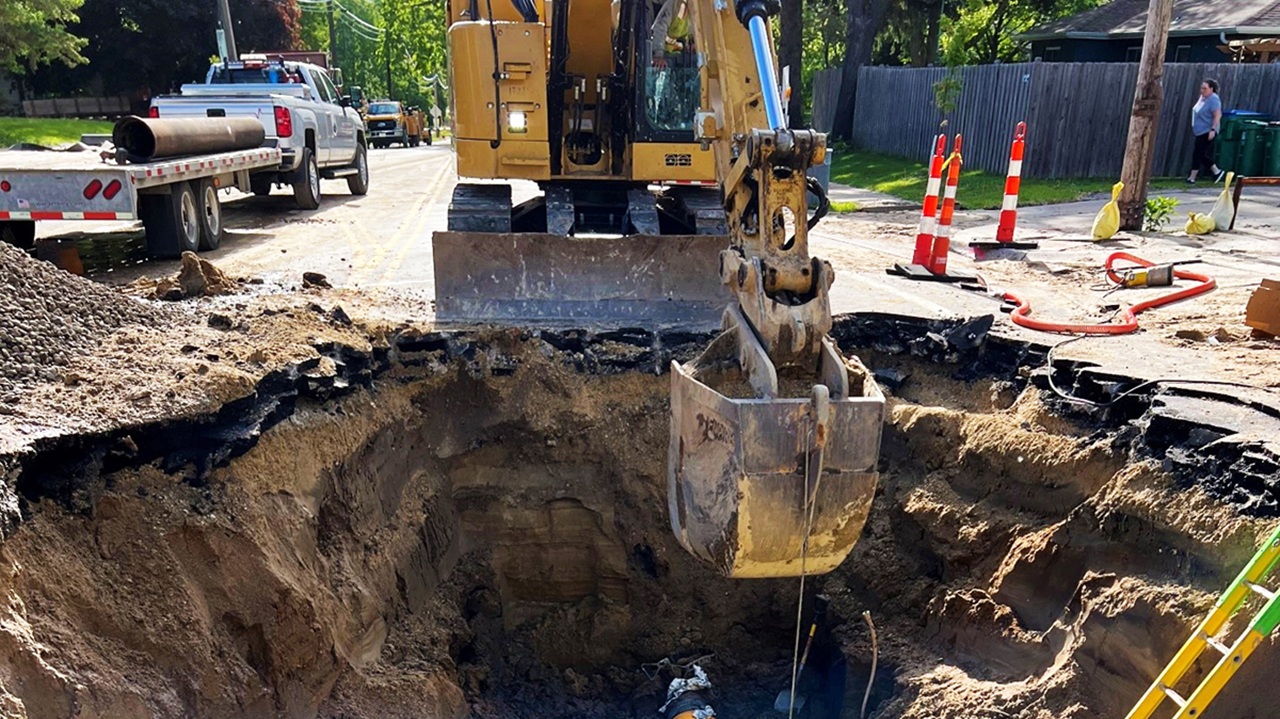
Early one morning in May 2022, public works crews in St. Louis Park, Minnesota, responded to what initially appeared to be a routine watermain break. Within hours, it became clear the situation was anything but routine.
Residents discovered contaminated water emerging through basement floor drains. Some found several feet of water in their homes. Personal belongings, appliances, flooring, and mechanical systems were damaged. In some homes, the contamination rendered the basement temporarily uninhabitable. By the end of the day, 54 homes had been impacted.
Two weeks later, as many of these residents were in the midst of or finishing repairs, the same section of watermain ruptured again, affecting a significant number of the same homes.
For St. Louis Park, the incident quickly evolved from a typical infrastructure repair into a complex emergency involving property damage, public trust, and community recovery.
The experience offers valuable lessons for municipalities worldwide about responding to infrastructure failures while maintaining public trust.
An Unusual Infrastructure Failure
Communities across the nation and in Minnesota are faced with the challenge of addressing aging infrastructure. A 2022 Minnesota Infrastructure Report Card reported that “much of Minnesota’s infrastructure is aging and reaching the end of its expected lifespan.” St. Louis Park is no different, with most of the public infrastructure constructed before 1960.
Most watermain breaks result in water flowing to the surface and are quickly spotted and fixed, with little or no damage to properties. The St. Louis Park incident was different.
Instead of rising to the surface, the escaping water from a 12” pipe entered a nearby sanitary sewer main. This allowed the escaping water to travel through sanitary sewer pipes and into homes, eventually emerging through basement drains. The situation repeated itself two weeks later when the same pipe broke again and water once again entered many of the same homes via sanitary sewer pipes.
The nature of the failures raised immediate questions from residents: Was the repair not completed to standards? Was nearby construction on private property responsible? Could additional failures occur? Answering those questions became central to restoring public confidence.
Managing the Emergency
Rapid Information Escalation: In emergency situations, early situational awareness can significantly influence response decisions. In this case, it took several hours before staff and city leadership fully realized the scope of the damage from the initial watermain break. This led to an important lesson learned: the importance of minimizing the time and steps required to escalate information from field crews to leadership.
Supporting Residents Immediately: In addition to repairing the watermain, the city provided immediate, direct assistance to affected residents. Services included:
- Garbage collection and debris removal, including delivering large bag dumpsters for disposal of damaged items.
- Contractors to inspect and restore sewer service connections.
- Help coordinating cleanup and sanitation.
These practical supports helped residents begin recovery quickly.
While staff managed the operational response, elected officials focused on being present in the community by visiting homes, listening to residents, and helping to relay information back to city leadership. This visible presence helped reinforce that the city was taking the situation seriously.
Supporting Community Recovery
Responding Beyond Liability
Due to the unusual circumstances, including community suspicion that vibrations from nearby construction on private property had caused the breaks, the city retained an independent engineering consultant to investigate the failures. To increase trust in the results, St. Louis Park invited affected community members to identify representatives to be involved in the process. The city committed to full transparency with the results.
Ultimately, the insurance investigation found the city was not legally liable, while the engineering investigation determined that the repair had been completed to industry standards and the breaks resulted from pipes weakened by corrosive soils.
Although the investigation clarified the technical cause of the failures and the city’s transparency in the review process helped restore trust, residents still faced ongoing disruption, financial hardship, and heartbreak. For the city, the question became not only what it was legally obligated to do, but also what it should do to support the community.
Some homeowners discovered their insurance policies did not fully cover the damage. Others faced cleanup delays or difficulty finding contractors willing to work in contaminated basements. Irreplaceable family mementos and heirlooms were lost.
St. Louis Park had previously purchased the highest level of municipal liability insurance available, providing up to $40,000 in coverage per affected property. However, it quickly became clear that damages in many homes would exceed that amount. City leaders concluded that helping residents recover would serve a clear public purpose: restoring safe living conditions and helping the neighborhood recover more quickly.
The city council ultimately created a reimbursement program to help cover eligible expenses beyond what residents received from their homeowner’s insurance and the city’s insurance coverage. The reimbursement program required homeowners to sign a liability waiver to receive funds and to help the program meet public purpose requirements. Thirty-two property owners accessed the program. The total cost to the city was approximately $1 million, or about $31,000 per household.
Listening First
While the financial response helped stabilize property owners and showed residents that the city would stand with them in hardship, restoring trust required more than financial compensation. It required centering the people who were affected by this very disruptive incident and ensuring they were heard and supported throughout the process.
City officials held multiple community meetings and council meetings to explain what had happened and to hear directly from residents.
At early meetings, many residents expressed frustration and fear. Some worried about the safety of their homes, while others were dealing with insurance challenges or delayed repairs. Media picked up on the story quickly and coverage of the breaks lasted for several nights.
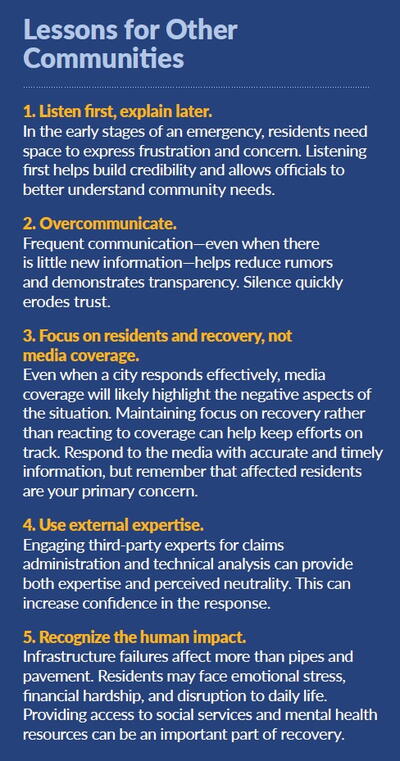
Rather than focusing immediately on technical explanations, city leaders listened. Providing space for residents to share their experiences and concerns proved essential for rebuilding trust.
Transparent Decision-making and Communications
The city adopted a strategy of frequent communication through a dedicated webpage, email distribution list, community meetings, council reports, and direct mail.
Every update—no matter how small—was shared. While the volume of communication required significant effort, the transparency helped rebuild trust and reduce misinformation.
Additionally, some residents had difficulty navigating the insurance process and needed extra support to restore their homes to be safe and to meet building codes. Others were dealing with physical or mental health issues that complicated their ability to cope with this event. The city partnered with a county social worker in these situations, providing extra support and ensuring all residents had safe and secure homes.
Moving Forward
Assessing Infrastructure Risk
As the emergency response concluded, city staff turned their attention to how existing infrastructure planning could be bolstered or rethought to help avoid a similar incident in the future. Results of that analysis included piloting new technology to measure pipe wall thickness in selected project areas and a vulnerability assessment of the city’s underground infrastructure system. The assessment evaluated both:
- The likelihood of watermain and stormwater failures.
- The potential impact of failures in different locations.
Prior to this review, the city relied on break history to inform its capital improvement planning. Now, the vulnerability study results have been folded into the city’s capital improvement planning process.
Public Education
To help all residents better understand how water and sewer systems function and how the city prioritizes infrastructure investments, the city created and mailed a special four-page edition of its community newsletter focused entirely on underground infrastructure. View the online version of the newsletter here.)
Conclusion
Infrastructure failures are inevitable in aging systems. What matters most is how communities respond when they occur.
In St. Louis Park, the 2022 watermain breaks were a difficult and disruptive event for residents. Yet the response ultimately strengthened the city’s approach to infrastructure management and resident communication.
The experience reinforced the importance of proactive infrastructure planning, transparent communication, and a response that recognizes both technical and human dimensions of infrastructure failures. Perhaps most importantly, it demonstrated that maintaining public trust during an emergency requires more than repairing what’s broken.
As evidence of this, one affected resident who had been one of the most vocal critics during the emergency sent a heartfelt thank-you a year later. In part, it said, “You all listened and took action, and YOU MADE THINGS RIGHT. You listened to angry, traumatized, and grief-stricken citizens. And you listened gracefully, tactfully, and you didn’t bark back...your willingness to pave new roads and come up with a reimbursement program unlike any other before changed our life.”
KIM KELLER is city manager of St. Louis Park, Minnesota.
JACQUE SMITH is communications and technology director for St. Louis Park, Minnesota.
Publish with ICMA!
We’re searching for interesting and insightful stories that can help others learn a memorable takeaway to serve their communities better.
