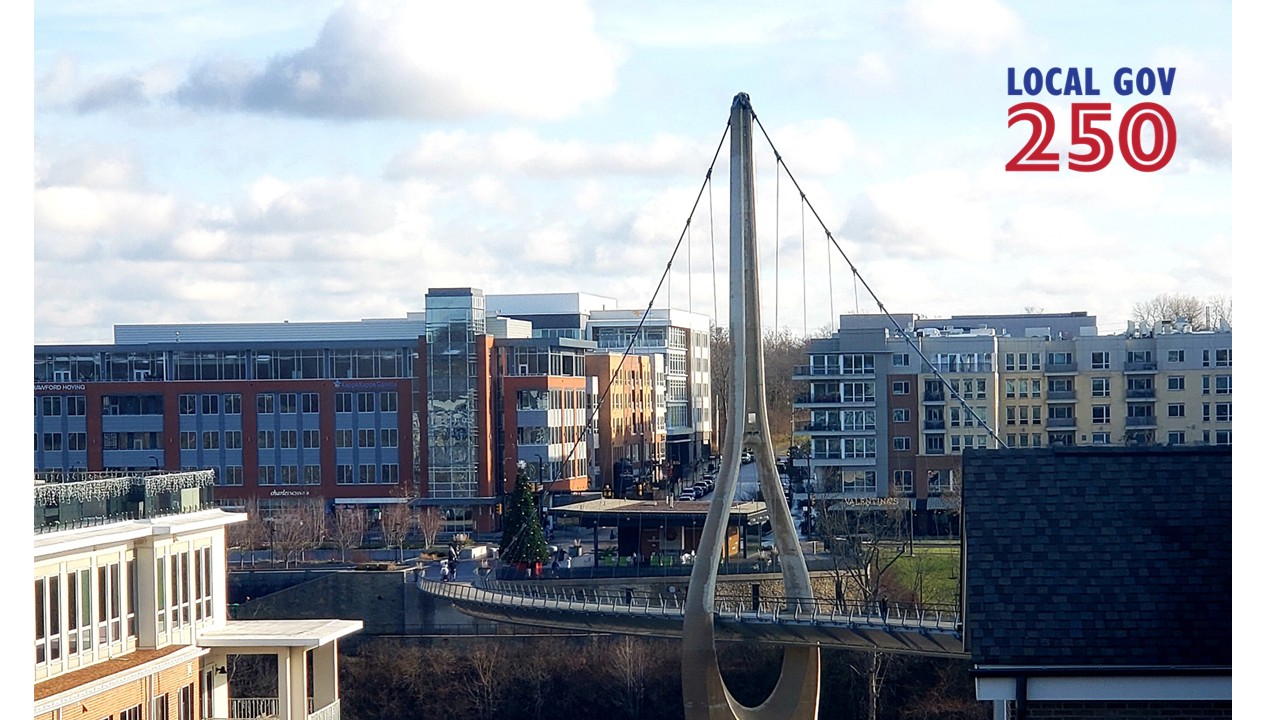
In Dublin, Ohio’s 2025 National Community Survey, 99% of residents rated the city as an excellent or good place to live, and overall quality of life came in at 97%—results that reflect years of intentional, resident-centered governance for the suburb of almost 50,000 near Columbus.
Then city leaders did something that distinguished them just as much as the scores themselves. They looked carefully at a few categories where Dublin had slipped slightly against national benchmarks: housing affordability, public transit, and cost of living. They treated those findings as a signal, not a footnote.
The instinct to absorb strong results with gratitude and difficult results with curiosity captures something essential about how Dublin has built an enviable trust record in local government. “You build trust by listening, reacting, and doing something about what you’ve heard,” said Brandon Brown, Dublin’s chief innovation and technology officer.
The Trust Crisis Is Real
As the United States marks the semiquincentennial anniversary of the signing of the Declaration of Independence, the document’s radical proposition that governments derive their just powers from the consent of the governed feels fragile.
The anniversary comes at a time when public trust in the federal government has reached historic lows: 17%—near the lowest point in nearly seven decades of polling, according to a December 2025 survey by Pew. The 2026 Edelman Trust Barometer shows trust declining and a world retreating toward insularity, with people narrowing their worlds to more familiar circles in response to technological disruption, economic stress, and geopolitical tension.
For most of American history, local government has been viewed differently than the government in Washington, DC. People might distrust Congress, but they generally trusted the city manager who answered the phone about a pothole or park needing attention. It’s a distinction with deep roots. Before national identity fully took hold, Americans built trust through their towns, counties, and colonies, where governance was close, visible, and personal.
A 2025 Governance poll by Gallup showed that 59% of Americans trusted their state government to handle state problems, and 65% trusted their local government to handle local problems. The averages have remained similar across the past decade and are broadly in line with Gallup’s measurements from the 1970s.
That trust reservoir isn’t bottomless, and it is being tested. When residents lose trust in local government, the consequences compound: lower compliance with regulations, less civic participation, resistance to new initiatives, and weaker democratic legitimacy for the decisions local managers make every day. In recent years, local governments have begun moving beyond intuition toward a more disciplined understanding of trust.
Why Trust Is Central to Strong Communities
Trust in local government underpins democratic legitimacy, effective governance, and community resilience, yet it remains difficult to define and measure in practical ways.
The need for greater context around resident trust helped drive a multi-year public-private-academic partnership between Arizona State University, government technology companies Envisio and Polco, and three diverse U.S. municipalities. The goal is straightforward but ambitious: move beyond anecdotal evidence about trust and create a validated, research-based tool that any local government could use to diagnose where it stands with residents and why. The experiences of Dublin, Ohio, and Broadview, Illinois, demonstrate how communities of very different sizes can apply the same trust-building principles in different ways.
Drawing on an extensive annotated review of the existing trust literature and original survey data from almost 3,000 residents, the study developed and empirically tested a multidimensional Trust Index. Factor analysis supported a cohesive construct of trust comprised of four interrelated dimensions:
Competency: Do residents believe the city delivers quality services and provides value for their tax dollars?
Integrity: Does local government act in the community’s best interest, keep its word, and take responsibility when things go wrong?
Openness: Is the government transparent? Does it actively inform residents and genuinely welcome their involvement?
Fairness: Are residents treated fairly, with respect, and are decisions made without favoritism or bias?
The research also surfaced a striking finding about the relationship between information and trust. Among residents who described themselves as “very informed” about their local government’s activities, roughly 80% expressed confidence in that government. Among those who were only “slightly informed,” confidence dropped sharply.
Informing residents through active communication across multiple channels—not just posting information online and waiting for them to find it—emerged as one of the most powerful levers available to local managers. Increased access to information and clearer communication about government actions and priorities appears to be associated with higher levels of confidence and perceived legitimacy.
Taken together, the results indicate that trust is influenced not only by service delivery but also by the extent to which residents feel informed and included in local government processes. Indeed, the trust indicators comprising the openness and integrity dimensions had an outsized impact on residents’ levels of trust. Building a stronger base of resident trust in their local government provides a firmer foundation on which residents can come together and address community challenges.
How Dublin and Broadview Put Trust Into Practice
In Dublin, one of the clearest examples of resident-centered communications is Tell Dublin, the city’s standardized resident engagement platform. It replaced a patchwork of survey tools and forms, with a single system that captures resident feedback across everything from community events to major planning initiatives.
That philosophy shapes policy decisions as well. When Dublin considered new regulations for residential solar installations, it gathered more than 1,000 responses through Tell Dublin before council amended the ordinance based on that feedback.
“We shouldn’t expect residents to seek us out for information,” said Bruce Edwards, Dublin’s digital and brand manager. “Our job is to understand where residents already get their information and meet them there—whether that’s Nextdoor, Facebook, or another platform. The days of posting something on the website and assuming everyone will find it are over.”
That philosophy extends to Dublin’s use of a platform that analyzes public sentiment across social media and civic channels, giving the communications team a near real-time read on how residents are experiencing city services and decisions. The goal, Brown explained, is to close the loop—not just gather input but demonstrate to residents that their feedback changed something.
Dublin also takes a conservative, long-horizon approach to fiscal management that Brown credits as an underlying trust asset.The city council established a policy dedicating 25% of income tax revenues to annual capital projects. Maintaining reserves, avoiding over-reliance on grants, and consistently reinvesting in infrastructure helps Dublin avoid service disruptions or tax surprises that erode resident confidence. Even when the 2025 survey showed slight declines in areas like housing affordability, the city’s leaders acknowledged the findings publicly, situated them in a regional context of central Ohio’s persistent housing shortage and connected them to ongoing planning initiatives. The transparency itself is the trust-building move.
When Broadview, a Chicago suburb of roughly 8,000 residents, surveyed its residents in 2022, it found high levels of trust in the community, demonstrating that these same trust principles can work in a much smaller communities with different resources and challenges. After participating in the Trust Index research, village leaders recognized that many residents simply didn’t see or experience the work of their local government. Through Ask Broadview, residents can submit questions and receive AI-assisted answers, with department leaders providing video responses when appropriate. The village also used resident feedback to shape its first comprehensive plan update in nearly two decades. “It opened our eyes to the power of listening,” said village administrator LeTisa Jones. “When we asked our residents what they wanted, they helped shape the vision for a stronger, more connected community.”
A Framework for Action
The research and the experiences of Dublin and Broadview point to a set of practices that can be applied across communities of different sizes, demographics, and political contexts.
1. Measure before you assume. The Trust Index research found significant variation across communities in which dimension of trust was most in need of attention. Resident surveys and data tools can pinpoint where the gap is, so leaders can target resources effectively rather than treating trust as a single undifferentiated problem.
2. Make information active, not passive. One of the strongest predictors of trust in the research was whether residents felt informed about what their local government was doing. That means omnichannel outreach—social media, newsletters, neighborhood platforms, direct mail where needed—not just a website update.
3. Close the loop publicly. Residents who have given input and never hear what happened with it learn quickly that participation doesn’t matter. Building in explicit feedback mechanisms—communicating how survey results influenced a decision, reporting back on a plan’s implementation milestones—turns one-way communication into a trust-building cycle.
4. Treat transparency as a strategy, not a policy. Proactively sharing financial information, planning decisions, and service data—even when results are mixed—builds more trust than carefully managed messaging. Residents are more forgiving of imperfect outcomes than they are of a lack of transparency.
5. Build equity into operations, not just statements. The fairness dimension of the Trust Index tracks whether residents believe they are treated fairly and with respect. That is a function of everyday interactions—how service requests are handled, whose concerns are heard, who has access to engagement processes—not just policy language.
6. Think institutionally, not episodically. Dublin and Broadview illustrate that trust-building is not a campaign. It is the accumulated result of consistent systems: standardized feedback tools, disciplined fiscal management, representative hiring practices, and follow-through on commitments made during community engagement processes.
The Oldest Test of Democratic Legitimacy
The founders made a radical bet 250 years ago that the government could earn and sustain the trust of the people it served. The local level has always been where that bet gets tested most concretely—in the quality of a road, the response to a service call, and the fairness of a zoning decision. The data suggest that the test is getting harder. But it is not one that local government is destined to fail. Communities like Dublin and Broadview demonstrate that when managers treat trust as a measurable asset, residents respond.
The work of democratic legitimacy is not glamorous. It is surveys, feedback loops, omnichannel outreach, and comprehensive plans that get implemented. It is telling residents what you found out and what you’re going to do about it. This is the work that naturally builds trust, and the communities that do it consistently are the ones that will carry the promise of local self-governance forward into the next 250 years.
DAVID SWINDELL is a professor at Indiana University and a leading researcher on local government performance and civic trust.
MICHELLE KOBAYASHI is an executive strategist at Polco, a civic engagement and data analytics platform serving local governments nationwide.
ELIZABETH STEWARD is vice president of marketing and research at Envisio, a strategic planning and performance management platform for local government.
A Compass for Public Service
Introducing ICMA's special edition publication celebrating the United States of America's 250th anniversary! A Compass for Public Service features several founding documents that have contributed to the formation and development of the public administration profession over the past 250 years. In this booklet you will find documents such as the Constitution of the United States and the Declaration alongside ICMA's Code of Ethics and Declaration of Ideals. ICMA Member Price: $0.00 | Non-Member Price: $9.99
Publish with ICMA!
We’re searching for interesting and insightful stories that can help others learn a memorable takeaway to serve their communities better.
