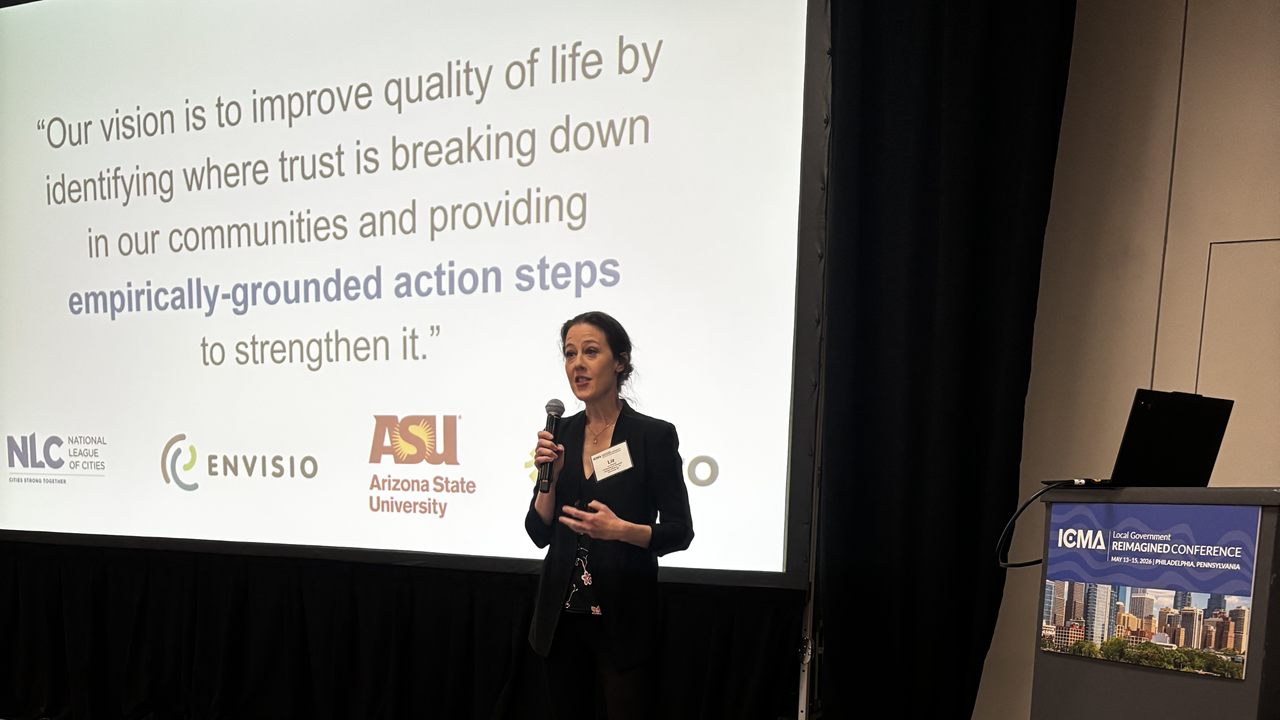
At the ICMA Local Government Reimagined Conference in Philadelphia, held May 13–15, 2026, one message came through clearly: local government’s trust problem is real, but it’s not irreversible.
In their session, “Reclaiming Civic Trust: New Models for Fiscal Transparency and Engagement,” presenters Elizabeth Steward, Chris Morrill, and David Swindell explored why trust in government has eroded and, more importantly, what local leaders can actually do about it.
Their answer: trust grows when residents feel informed, involved, and connected to decisions that affect their daily lives.
The Trust Problem Is Getting Worse
Steward opened with findings from annual surveys conducted by Envisio and research partners asking local government leaders about their greatest challenges. For the last four years, the top response has remained the same: a breakdown of trust. And that decline is happening at every level of government.
To better understand trust, researchers partnered with communities across the country, the National League of Cities, Arizona State University, and other organizations to study what actually shapes resident perceptions of local government.
The result was a framework identifying four major “Indicators of Trust”: competency, openness, integrity, and fairness. Each category included more specific measures. Competency included service quality and perceived value for taxes paid. Fairness focused on treating residents respectfully and equitably. But the strongest drivers of trust came from openness and integrity.
Residents were significantly more likely to trust local government when they believed their leaders did the following:
- Informed residents.
- Welcomed public involvement.
- Acted in the community’s best interests.
- Took responsibility.
- Followed through on commitments.
One finding stood out above all: residents who felt informed trusted local government more, even if they did not always agree with decisions. That insight reframed transparency as something much more active than simply publishing reports online.
“Transparency,” Steward emphasized, “isn’t passive.” It requires storytelling, context, and communication that meets residents where they are.
Why Trust Matters More Than Ever
The presenters explained why this work has become so urgent, identifying a series of interconnected challenges facing local government today:
- Declining legitimacy of government as an institution.
- Information overload eroding confidence in official sources.
- Fractured publics with no single “community voice.”
- Misaligned expectations about what local government can realistically deliver.
- Increasing polarization.
- What Morrill called “the politics of cynicism”—opposition without solutions.
In many communities, national political dynamics are increasingly spilling into local governance. This shift creates enormous challenges for city/county managers and local officials trying to facilitate productive dialogue around complicated issues such as housing, infrastructure, budgeting, and public safety.
The presenters argued that rebuilding trust requires rethinking not only communication strategies, but the design of civic engagement itself.
Transparency Only Works If Residents See Results
One community highlighted during the session was Dublin, Ohio (a city of close to 50,000), which has consistently scored well above national benchmarks in resident trust surveys. According to Steward, Dublin’s success comes from sustained, multi-channel engagement and a commitment to acting on resident feedback.
The city uses mobile apps, text services, chatbots, and digital engagement tools alongside more traditional outreach methods. They also actively monitor community sentiment to identify concerns before they escalate.
But technology alone is not what builds trust. The real difference, Steward said, is that Dublin closes the feedback loop. Residents can see how their input influences outcomes. One example involved designated outdoor refreshment areas. After residents expressed support for more flexible public gathering spaces, the city implemented them and explicitly communicated that the decision came directly from community feedback.
That follow-through matters. Residents disengage when participation feels symbolic. They re-engage when they believe their time and input actually shape decisions.
Public Engagement Should Be Intentional and Strategic
Morrill—executive director/CEO of the Government Finance Officers Association (GFOA)—expanded the conversation by focusing on fiscal transparency and the design of public engagement processes.
Drawing from work by GFOA, Morrill argued that local governments often unintentionally undermine trust by overwhelming residents with complexity. Financial reports may technically satisfy transparency requirements, but if residents and even elected officials cannot understand them, transparency loses its value.
The solution, he suggested, is not less information but clearer communication and more meaningful participation. The presenters outlined four major ways local governments should rethink public engagement:
- Re-establish legitimacy by treating residents as co-producers of public outcomes, not passive observers.
- Align public expectations with governmental realities before frustration builds.
- Gather feedback from a fractured public, especially voices that traditional meetings often miss.
- Counter cynicism by channeling energy into collaborative problem-solving.
Morrill stressed that engagement must move beyond the traditional public hearing model, which he described as one of the least effective forms of participation. Instead, governments should design engagement intentionally and strategically.
10 Principles for Better Engagement
The session included a detailed framework for rethinking public engagement, built around 10 design principles:
- Quality over quantity.
- Build institutional capacity.
- Use engagement as sense-making.
- Help residents engage with complexity.
- Encourage co-creation.
- Revitalize rights and responsibilities.
- Develop strategies for bad actors.
- Understand the expert’s role.
- Balance expert knowledge with public input.
- Make engagement work for elected officials.
The presenters repeatedly emphasized that poorly designed engagement can actually damage trust. One slide even warned, “Low-quality engagement may lower trust more than none.”
Morrill advised local governments to “pick their spots” carefully and focus on deeper, more productive engagement rather than attempting broad but shallow outreach. The presenters outlined situations where engagement works best:
- When decisions have not already been finalized.
- When tradeoffs are real.
- When multiple stakeholders must work together.
- When middle ground exists.
- When organizations have the capacity to support meaningful participation.
They also cautioned against engagement efforts when decisions are already made, issues are overly technical, or organizations lack the staffing and systems needed to facilitate quality dialogue. “If the decision is already made,” Morrill said, “don’t create false hope.”
Moving from Opinion to Wisdom
Throughout the session, the presenters returned to the idea that engagement should not simply collect opinions—it should help communities make sense of difficult issues together. Morrill described this process as moving from “opinion to wisdom,” which requires creating environments where residents can better understand tradeoffs, complexity, and competing priorities.
Examples included deliberative forums, appreciative inquiry, participatory budgeting, collaborative strategic planning, and the “Kiva process,” a facilitated dialogue model based on Native American traditions that prioritizes structured listening and constructive conversation.
Bringing Democracy Closer to Residents
Swindell continued the conversation by introducing the concept of municipal federalism, a governance model that brings certain neighborhood-level decisions closer to residents themselves.
The premise was simple: many people disengage because participation does not feel meaningful. Neighborhood meetings often lack authority, influence, or visible outcomes. Residents end up believing that their time is better spent elsewhere. To change participation, Swindell argued, governments must change incentives.
Under municipal federalism, neighborhood councils or associations would gain limited “provision authority” over localized issues such as:
- Zoning variances and land-use recommendations.
- Code enforcement assistance.
- Neighborhood park planning.
- Traffic flow decisions.
- Curb and sidewalk maintenance priorities.
- Participatory budgeting.
- Community development initiatives.
Of course, the local government would still control finances and legal authority. Neighborhoods would not receive unrestricted spending power, but they would gain a more meaningful role in shaping localized decisions.
Swindell framed the concept as a way to restore civic habits that communities once developed more naturally. “We’ve lost a sense of who our neighbors are,” he said. By creating smaller, more immediate opportunities for participation, local governments can help residents reconnect not only with institutions, but with one another.
Trust Is Built Through Relationships
The session closed with a series of practical steps for local governments seeking to rebuild trust:
- Embed long-term vision into budgeting and planning.
- Design deliberate, high-quality engagement before decisions are made.
- Engage residents in real tradeoffs.
- Use collaborative sense-making approaches.
- Build systems grounded in fairness, accountability, and transparency.
Across all three presenters, the central message remained the same: trust grows when residents feel informed, respected, included, and connected to decision-making processes that shape their communities.
And while national polarization may dominate headlines, the presenters argued that local governments still have a unique opportunity to model something different. Not by promising perfection, but by creating systems where residents can genuinely participate, understand difficult choices, and see evidence that their voices matter.
Publish with ICMA!
We’re searching for interesting and insightful stories that can help others learn a memorable takeaway to serve their communities better.
