
This is the third of a four-part series covering how local government leaders are putting AI to practical use in New Zealand. Read part one and part two, and part four.
When Wellington City Council set out to build Mātai Manapori – TrackDem, it began with a simple but stubborn problem: transparency existed, but accessibility did not. Council decisions were buried in dense PDFs that were difficult to search for staff members and nearly impossible for residents to navigate without insider knowledge. TrackDem—whose Māori name means “observe democracy”—was designed to make civic decisions visible, searchable, and understandable for everyone.
The “aha” moment came during a 2021 local government event designed to develop creative solutions to community problems that led the project team to realize that meetings were only a delivery mechanism. The public was interested in the decisions themselves and not necessarily the meetings. Instead of refining static documents, they reimagined the system around live, structured decision data. With leadership buy-in, the prototype evolved into Mātai Manapori – TrackDem, a digital register of more than 7,000 council decisions complete with voting records and implementation updates.
This shift didn’t just improve usability, it reframed transparency as participation. By operationalizing the council’s democratic values, TrackDem directly responded to resident feedback that cited “lack of transparency” as a barrier to civic engagement.
Key Factor for Adoption: Community Engagement
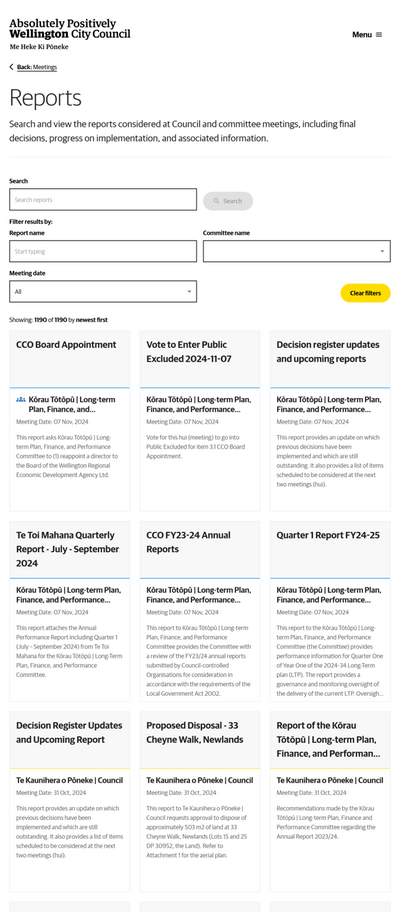
From the outset, the team engaged a diverse set of user groups, including passionate residents, journalists, advocacy organizations, councilors, and internal staff to guide design and iteration. These personas shaped every aspect of the tool, from plain-language summaries to mobile-friendly layouts. Each testing round refined how decisions were displayed and searched, ensuring the tool met real user needs, not assumptions.
Accessibility and inclusion were non-negotiable. Mātai Manapori adheres to web content accessibility guidelines (WCAG), supports screen readers, and performs seamlessly on mobile devices. Language was simplified in response to citizen feedback, and every feature was tested for usability.
One of the other main goals in developing the online system was “lowering the civic participation cost.” While this may sound abstract, TrackDem delivers tangible results. Citizens can now find and share decisions within seconds, and staff have seen a 75% increase in average time-on-page, which suggests deeper engagement with council decisions and more informed residents. For analysts, the entire dataset is downloadable, enabling data-driven research and media reporting that were once impossible.
Councilors received training and one-on-one support, allowing them to link directly to decisions and voting records in social media posts, newsletters, and public communications. For the first time, elected members can connect constituents straight to the authoritative source. This ability strengthens accountability and public conversation and allows elected officials to be more visible to community members.
A Look Behind the Scenes
From a technical standpoint, the system balances openness with responsibility. Each decision’s lifecycle is tracked with role-based access, ensuring that only authorized staff can publish or amend content. Every change is logged and version-controlled, and the Council’s Democracy Services (council support) team must approve public updates. This audit trail prevents errors from cascading into misinformation and allows annotated corrections if needed.
Security was independently validated through penetration testing, and accessibility experts reviewed the interface for users of diverse abilities. Regular usability testing keeps both internal and public users confident in how the system works.
Staff workloads have also eased. Manual spreadsheets and email chains were replaced with automated workflows that notify only those who need to act. Information requests are faster, duplication is reduced, and no one has asked to return to the old way of working.
Recognition and Replication
Mātai Manapori – TrackDem has already transformed how democracy is accessed in Wellington, which has inspired other councils to explore similar systems. Users across sectors have praised it as intuitive, fast, and genuinely empowering.
To encourage adoption elsewhere, Wellington has published its design materials, data model, and architecture online. Other councils can reuse these components and adapt them to their own content-management environments.
Wellington City Council is receiving positive feedback from folks across sectors.
One councilor notes, “This absolutely builds a good template for future features and is a big step forward,” while another says “This is SO cool. Oh my gosh, I'm having such fun searching through all the decisions. It’s really user-friendly.
Journalists have also noted the positive nature of the new tool, saying, “Big fan of the new webpage! Much easier to see when the agendas have been uploaded and the layout looks really nice.” With Mātai Manapori – TrackDem, Wellington City Council hasn’t just digitized its decisions—it has redefined what transparent governance can look like in the 21st century.
Local Government Reimagined Conference - The AI Edge: Orlando, FL | April 8-10, 2026
What's working with AI in cities and counties like yours? Hear from practitioners navigating the pitfalls, finding the wins, and separating hype from reality.
Session Spotlights:
- Navigating the Ethics and Politics of Municipal AI: A Practitioner Roundtable
- Bridging Silos: How We Can Use AI to Unlock Smarter, Safer, and Healthier Communities
- Mobile Workshop: The Institute for Simulation and Training at the University of Central Florida. Learn More
VIEW ORLANDO SCHEDULE | REGISTER FOR ORLANDO
Publish with ICMA!
We’re searching for interesting and insightful stories that can help others learn a memorable takeaway to serve their communities better.
