
Powered by Tyler Technologies
From the wind-down of federal stimulus funding to declining revenue and escalating costs, we are in a tough budget cycle. As ICMA noted in December 2025, local and state governments face the challenge of maintaining fiscal stability amid federal appropriations, uncertainty, and policy shifts.
It’s no surprise that, as a frequent speaker on priority-based budgeting, I am seeing growing interest in reimagining budgeting.
The reasons for this interest are clear. Government is facing the twin challenges of balancing tighter budgets while aligning scarce resources with key initiatives. To meet these challenges, governments are adopting priority-based budgeting methodologies to fund ambitious goals while still saving money.
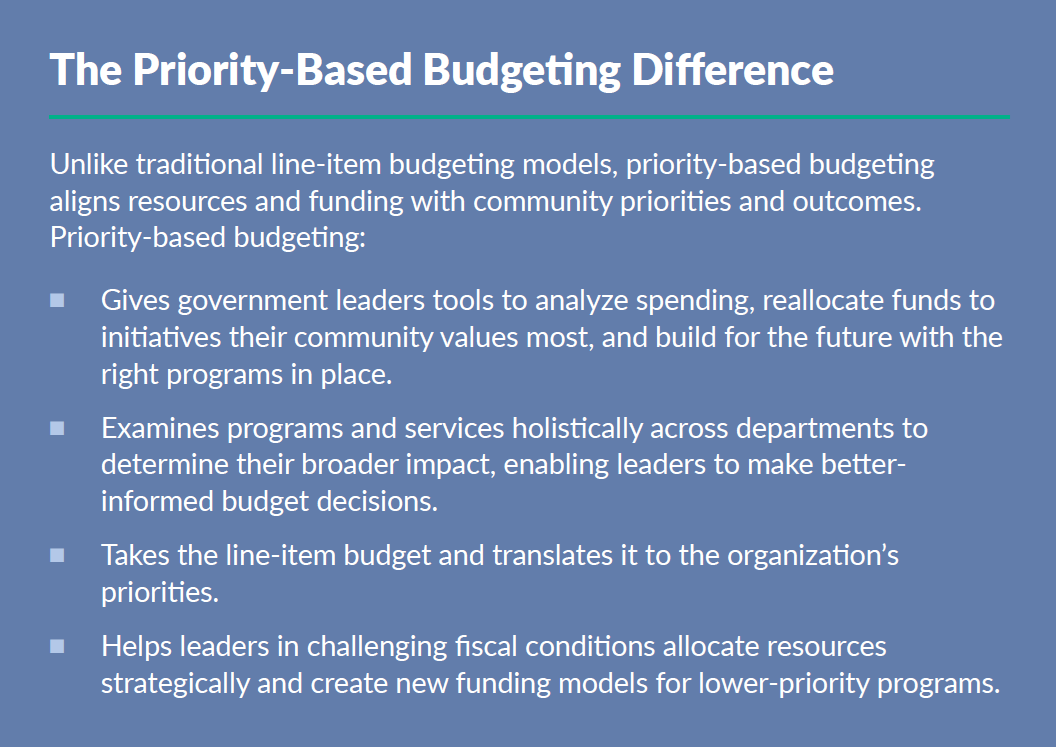
Priority-based budgeting is breaking the cut-or-tax binary by aligning line-item budgets with the most important government priorities. It’s a move away from describing your department’s business in line items and moving toward talking about the programs, services, and priorities your organization aims to achieve. It’s a paradigm shift.
To illustrate the impact of taking a new look at budgeting, I am sharing how a Florida county’s adoption of priority-based budgeting has met ambitious goals of saving money and supporting priorities.
After more than a decade of rising costs and annual property tax hikes, Collier County, Florida, faced a decisive moment. Residents wanted change, and county leaders found themselves grappling with a complex web of challenges. With more than 600 separate county services, recurring budget growth, and deeply ingrained practices, it became clear that only a fundamental transformation would restore long-term fiscal discipline and deliver genuine value to the community.
The Challenge:
Seeking a Remedy for Property Tax Hikes and Inefficiencies
Collier County property taxes had been increasing for 13 consecutive years, fueling resident dissatisfaction and eroding public trust. Services had multiplied across departments, resulting in significant overlap, including duplicated work and mounting inefficiency. Budgeting had become a cycle driven by incremental annual increases, with spending rising to keep pace with inflation or expanded service demands. But budgeting was not explicitly tied to actual community priorities or measured outcomes.
In response, elected officials responded with a mandate for lower taxes and more efficient government. “We had to do something radical to begin the process,” says Chris Hall, county commissioner.
Hall and fellow commissioners tackled the issue, working late into the night during a budget workshop to approve a plan to hold taxes steady while making tough spending cuts. They then began searching for a solution they could partner with in the process, a commitment that would reshape Collier County’s future financial operations.
The Solution:
Priority-Based Budgeting Drives Data-Informed Transformation
The county turned to priority-based budgeting. Using Tyler Technologies’ Priority Based Budgeting software, Collier County established a framework to assess every service offered, scoring more than 600 county programs for cost, impact, and legal mandate. Through AI-powered analysis and ROI optimization reports, Collier County identified $40 million in immediate savings, consolidated departments, and redirected resources to programs aligned with both government and public priorities.
Hall explains, “By using artificial intelligence, setting up a dialogue, and making decisions with data, we were able to move forward fairly rapidly.”
As Collier County learned, AI is well-suited to the priority-based budgeting process. Governments have ample fiscal data in the ledgers and line-item budgets stored in their ERP and finance systems. But it can be hard to see the big picture across multiple departments. At the line-item level, it’s easy to get lost in the weeds.
That’s where the priority-based budgeting methodology using AI comes in. Priority-based budgeting is an evolution of (not a replacement for) line-item budgeting. It links line-item expenditures to programs, layering in data on the populations those programs serve, how they are funded, whether they are mandated, and how they support agency priorities.
By looking at programs and services holistically to determine their broader impact, priority-based budgeting pinpoints expenditures aligned with overall community goals and reveals opportunities for resource reallocation and alternative revenue generation.
This enabled Collier County leaders to make better decisions. The process translated data into a story and a common language that county leaders and residents could understand, trust, and act on. By surfacing opportunities to optimize resources, it also ensured the budgeting process looked beyond taxes and cuts in a way that was more transparent to constituents, building public confidence that tax dollars were being used responsibly.
“The innovation from the data allowed us to make decisions that were not emotional, not wondering if we should or if we shouldn’t,” says Hall. “It allowed us to make decisions based on the pure data. If we had to close a service, we had the data to prove it and to show why. If we needed to increase a service somewhere, we could do so with a fee, with a grant, with general fund tax money, with tourist development funds, etc. It was those kinds of ideas coming to us from the data that empowered us to make such decent decisions so quickly.”
A Different Way of Thinking About Budgeting
Priority-based budgeting is an innovative and powerful alternative to traditional government budgeting. But it requires an optimistic, open-minded approach from public officials.
We’ve trained ourselves to speak to resource scarcity and think about cuts. We have to shift our perspective to think about optimizing resources and aligning programs with priorities. The priority-based budgeting process required a significant shift in mindset and practice, particularly for team members who had spent decades working within the old systems.
To make a successful transition, Collier County invested in targeted workshops and engagement, empowering employees to take ownership of new data and models.
Hall notes that getting staff buy-in is a key to success.
“The first thing that I would recommend is to have a serious discussion with your leadership,” he says. “You have to get buy-in from them. You have to communicate the vision, communicate the passion, communicate the need to your staff and to your leadership, so that they join you in this. This is the new standard. It is the new way of life. And every one of our department heads and directors understands that.”
As an example of doing business differently, the county used the methodology to identify opportunities for public-private partnerships for projects and smart-fee structures, creating new revenue streams while better aligning county assets with community needs. In its first year, Collier County partnered with outside organizations to invest more than $16 million in asset development, including sports and recreation facilities.
Through steady engagement and commitment to transparency, the budget managers and county leaders moved away from the status quo, setting clearer guardrails for resource allocation and program strategies. The county’s budgeting workshops soon became venues for collaboration, with stakeholders and residents beginning to see the impacts firsthand.
The Results:
Savings, Tax Relief, and Sustainable Investments in Community Priorities
Collier County’s results were immediate and sustained. Property taxes remained unchanged for two straight years, halting 13 years of increases. The initial priority-based budgeting effort unlocked $40 million in savings, all without eliminating essential services. A total of $150 million in redirected resources allowed for strategic investment in high-impact programs and the consolidation of overlapping departments.
Staff reported that decisions were faster and more precise, and both commissioners and managers gained the confidence and practical tools needed to keep Collier County fiscally responsible and responsive to evolving public needs.
Through priority-based budgeting, the county was able to visualize spending.
“The three main rules of real estate are location, location, location, and the three main rules of budgeting are identify, identify, identify,” says Hall.
Thanks to its work, the county was able to put its programs into four different categories in a quadrant.
- High cost, high impact.
- High impact, low cost.
- Low impact, high cost.
- Low impact, low cost.
This view enabled the county to prioritize its return on investment. In addition, the software provided insights into program redundancies, further optimizing savings.
“We saw that we were doing things just because we’ve always done them,” says Hall. “We saw in some areas that we need to step up here, and we can implement this and increase our service here and not do it at an additional cost to the taxpayer.”

CHRIS FABIAN is senior director of product strategy for Priority Based Budgeting at Tyler Technologies. He has helped more than 300 government entities and schools implement priority-based budgeting. Chris is the co-founder of what is now Tyler’s Priority Based Budgeting. This budgeting methodology leverages machine learning and AI to predict and identify priority-based budgeting opportunities and savings. He has served as an internal business consultant for local government. (chris.fabian@tylertech.com)
Publish with ICMA!
We’re searching for interesting and insightful stories that can help others learn a memorable takeaway to serve their communities better.
