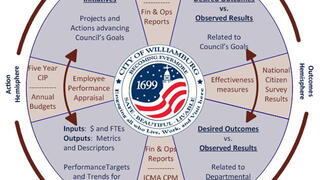
In Williamsburg, every other year the council redefines their strategic priorities for the following two years, known as their Biennial Goals, Initiatives and Outcomes (GIO’s). Currently, the GIOs contain 10 general goal statements, about 80 concrete initiatives, and 60 outcome measures and ratings. Initiatives are specific and measurable projects and activities over that advance the goal. Initiatives are not a comprehensive list of services and activities, but rather new actions or changes in direction.
Local government leaders have truly been agonizing over how to balance their budgets, many times dramatically cutting services as times have gotten tough, and wishing they had more – or perhaps better – data about the efficiency, quality, and effectiveness of the services they provide. Many finance officers, city council members, county board members, and citizens wonder how the service performance of their communities actually compares to that of other local governments.
The Alliance has collected the following lessons learned as it relates to sharing services and conducting partnerships. These lessons are offered as considerations when thinking through the collaboration process.
The essence of collaboration is working together to get something done that cannot be done working alone. Collaboration in local government involves working across institutional boundaries to engage outside individuals and entities in a way that reshapes the processes of decision making or service delivery.
This collaboration of four public partners resulted from long standing goodwill through existing joint use of community and school facilities. As the parties initiated their partnership, they developed a charter outlining values and a shared goal to guide their way through construction of the $62 million multi-use facility.