- Transcripts
Transcripts are generated using a combination of speech recognition software and human transcribers and may contain errors. Please check the corresponding audio before quoting in print.
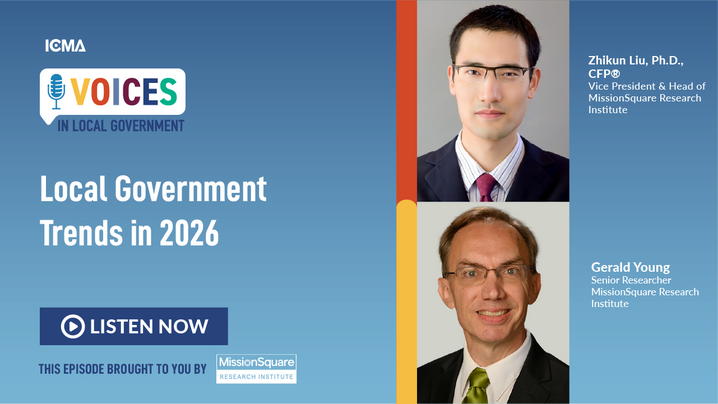
Welcome to Voices in Local Government, an ICMA podcast. My name is Joe Superville, and I am excited to welcome back to the show Dr. Drew Quinn Liu, Vice President and Head of Mission Square Research Institute, and Gerald Young, Senior Researcher. Thanks for joining us, guys. Thank you. Thank you very much, Joe. All right. Local government workplace trends in 2026. Listeners can find the research and more resources at research.missionsq.org for Mission Square.
Today, we are going to cover five topics. First, financial wellness, generic benefit or strategy. Two, guaranteed income options and how that shapes employees' saving, investing, and retirement income choices. Three, artificial intelligence. This one specifically, we're going to get into how it impacts staff. So I think it's relevant for the listeners out there, kind of how to navigate the ever-changing AI topic.
Then we're going to wrap up with retirement decisions, human advice slash technology. And finally, employers recognizing and tracking mental and emotional labor, which is an interesting distinguishment there. So first off, financial wellness moving from a benefit to a strategy. Drew Quinn, can you elaborate this for the audience and specifically want to get into how this is measured? I think that's the key point on this topic. Yes, we see a mindset change from our research.
What I mean by mindset change is in our research, we find that more than half of the employees, 52% to be exact, say that personal finance are a major source of this stress. Among those with low financial well-being, the number jumps up to 79%. That compares to 4% among those with high financial well-being. So this is something kind of alert us. We typically see the financial wellness program in the past will are like a few webinars a year in in terms of hr or uh employers kind of efforts other deadlines too for the employees yeah or it doesn't stop yeah yeah yeah so so now maybe we can see more personalized and targeted financial well-being or financial wellness programs so uh for example
We can bring two things. We can bring targeted support instead of generic programming. And also we can bring personalized delivery. So not a one size fits for all workshops. All right. So can you give us a couple of specific examples on what or how this is driving? What are the kind of fundamental impacts that's causing these results? Yes, we see employers focus on specific drivers now like for example high debt burdens it could be student loan debt could be mortgage could be other things which changes employees morale and their work stress as well as of course the overall financial well-being and we also see some kind of shared cost have kind of increased the burden for the employees another thing we noticed that in our research but a lot of employees haven't are employers haven't seen as a key driving factor is there's a gap between what employees think they know about finance and what they actually know with these examples i think we can encourage or advocate hr managers and employers to target the personalized or customized financial well-being programs to different groups of employees that could help a lot and also instead of just one or two webinars a year we can maybe build a program to follow them along throughout their uh career okay what about the measurement side that was part of it how can the employers not just try and implement these strategies but then measure see what the results are yes uh communication is key i think um
Instead of just pushing out broad financial wellbeing programs, maybe we can ask more questions. We can maybe using different ways of communication technologies to enhance the two way street of financial wellbeing enhancement programs. For example, we can listen to what the employees are.
thinking and worried about in terms of personal finances as well as maybe even design a questionnaire for them to answer a survey so we can be better prepared and target their personal maybe even family financial problems. Right. Because if you're going to customize the program, you need the data points from the individuals to then be able to match. So there's responsibility on both sides, not just the employer, but the employees actively participate if they want the better outcomes as well. Yeah. A good tip is Mission Square Research Institute already have so many surveys about this. So maybe we can even help a little bit. Okay.
So the next topic, guaranteed income, which is a great phrase. I was joking with Gerald earlier that a marketer must have come up with that decades ago. But guaranteed income options, shape-saving, investing, and retirement income choices.So how does that connect to personal finance choices? And how do the employers fit in with this category? That's a good question. We see a lot of research in recent years about guaranteed income in the private sector.
And we actually thought about maybe we can take a look at the public sector too. Traditionally, they have their DB plans as their guaranteed income options. And we haven't seen a lot of research on how these DB plans plus Social Security, if they have, change their financial behaviors. In particular, if they have a guaranteed income or if they think they have a stable income in retirement then it's more likely to influence their decisions on how much to save how much investment risk they are comfortable with and how confident they feel about their long-term financial security and that translates to work retention and tenure and even work morale and stress too. So we think that's kind of an interesting topic to explore. Yeah, it ties back into that first category on how the employees are feeling. The numbers are the numbers and the reality is the reality, but how they feel about it is also an impact.So why is it important to study the behavior impact on this guaranteed income? Is there a correlation or causation with that improving and then productivity and morale going up?
Definitely.I can give you an example, Joe. So if you think you have a good resource of guaranteed income, how does that change your defined contribution plan participation as well as the investment lineups? So let's say if you think I have about 60 or 70 percent of my retirement needs covered by my guaranteed income options you are more likely to be more aggressive or taking more investment risk in your defined contribution plans. You can think
You can think of it as an add-on or a benefit. So you can invest in more maybe high-risk, high-performance investment options. Or maybe you think the opposite way. You think, I want to make sure I cover the 30% I'm lacking, and I want to just invest in something conservative so I can just cover that I'm good with.So that's just one example why this is important another one is um in terms of saving so if you uh if we think our retirement in retirement income sources are pretty much covered by guaranteed income then we might be able to rethink how much we want to save on the uh maybe a savings account or ira or 457 plan so this is a another example for
uh of why do you think uh why we think that behavior will be changed by these uh income options all right and how can plan sponsors communicate these dynamics more effectively because again people are busy they're stressed out about deadlines and finances in general and it kind of sounds good to learn more about this but then it's tough to follow up so how can the employer and the sponsor side make it easier that's a good question um that's why we want to put special focus or emphasis on public sector before we treat them separately employers reach out to the participants who are eligible for for example 457 plan or defined contribution plan and ask them why don't you save enough or why do you think you are uh you don't have enough uh extra income to save for these plans now we can actually coupled with the communication uh or was there maybe retirement allocation to db plans we can say hey we find out that you are you have a portion of guaranteed income for your retirement maybe it's time for you to think about the dc plan so you can take more high return and a little bit play a little bit your investment options so you can be better prepared for your retirement
All right, Drew Quinn, so how can plan sponsors communicate this design and what should they be thinking about in general on the design aspect of the program? So I think what you mentioned is plan design. So when we talk about the different types of retirement plans, there's a distinction between DB and DC.
dc is defined contribution db is defined benefit so the plan design special uh how to say features can be utilized to incorporate guaranteed income features effectively effectively with the defined contribution features so defined benefit is more like pension right or social or um how to say uh annuity plan so basically you work for several years and the employer will pay you a fixed amount of how to say pension after your retirement and that you have a formula so for defined contribution what you do is you contribute to a pool of money and your employer maybe match a few percentage of your contribution and then one when you retire you have a lump sum pool of money so that's why we say defined contribution um so you have to figure out how much you spend um after you get this lump sum of money when you retire right so you have to make your own retirement spending strategy in the defined benefit part you don't have to they just come kind of like a paycheck but it's a percentage of your previous income when you're working so you just receive a paycheck every month so that Those two are complementing each other. That's why we think it's interesting to rethink the connections between the two when we do the plan design and also use guaranteed income as a supplement or the other way, use defined contribution as a supplement for DB or guaranteed income so we can be better prepared or help the participants to be better prepared for their retirement.
And of course, communication is a key, as you mentioned. Yeah, again, and it's complicated. I think for the people doing it every day, you all obviously understand it and we appreciate explaining for us. Yeah, I think just one sentence will summarize that. How do we help participants connect today's decision to their future retirement paycheck? Right. So if the employers or client sponsors grab this concept, and then put their communication strategy centered around this, then we can have better results for our planned participants or for our employees. Right. And it's not necessarily advising or pushing anyone in one direction or the other. It's making sure you understand the choices. And as you said earlier, customizing it so everyone, every individual can have the facts to then make a good decision for themselves.
Artificial intelligence. Gerald, can you tell us how staffing impacts show to be more important than use cases?Sure, glad to. I don't think we are in any way saying the use cases are not important. Certainly, there are great gains either currently being made or projected to be made in terms of efficiency, productivity, or even new services that would be enabled by AI that perhaps we've not even conceived of prior to this. But on the human side of things, just because you can be more efficient doesn't mean that's not going to have an impact on your current employees. In particular, in the survey that we conducted this past year, 20% of employees said that they were either very or extremely concerned that AI would lead to either significant retraining requirements for them or the entire replacement of their job function, which really has an impact potentially on morale, employee retention, and whether they are as productive as they could be if they're constantly worried about these looming impacts for them. That's not to say that it's necessarily a bad thing.
Actually, we've seen those who are very prepared for using AI in their work, their morale is actually good. So it's not that one is necessarily causing an impact on the other. But I think the most extreme situations that we've seen have been that 62% of the respondents said they had not received any training on AI from their employer. And likewise, 28% said that the AI generated content that their organization is putting out is rarely or never overseen or reviewed by any staff. And when you have all the potential for bias or hallucination in AI, that really is a warning flag that perhaps there's something here that the organization should be doing more to address. And while it might be that they've put policy in place. 15% of the employees said that they were not sure if their employer had policies prohibiting or limiting the use of that AI. So really, an awful lot of this goes back to communication. Just adopting a policy doesn't mean that everybody understands it. Just because you said it once doesn't mean you don't have to keep reinforcing that.
And You know, it's something that's a real back and forth with employees to make sure that, you know, as they are starting to use AI, maybe after they've had some training on that, that you talk with them about, okay, is this doing what we thought it was going to do? Do you need more in the way of support to help you do what you need to do?
So does the data show that organizations should slow down their AI implementation? Because I think the obvious knee-jerk reaction is like, This train has left the station. There's no stopping it. So I don't think you're implying that they should stop or slow down. And we're not. And, you know, the types of implementations that are being pursued are all in areas that make sense. Again, they are productivity tools. They are predictive tools, whether that's for preventive maintenance or policing or, you know, really understanding things, even, you know,
agency responding to regional issues. You know, that's terrific. And we want to pursue those types of improvements in what AI can do. But it's the communication, it's the expectations, it's listening to employees, and it's acknowledging that, yes, some of these impacts could be out there. So let's, you know, make clear up front that we are trying to
respond to those concerns that employees might have. And at the same time, if we prepare the employees well, if they have that understanding of the policies, they have the training that they're looking for, then they will, again, feel prepared, the morale will be supported, and there may also be spillover positive effects, like we found that those who are
feeling very prepared for using AI in their work are also feeling more comfortable in using AI for things like retirement planning. They have that facility in using the tools and it's not simply, hey, I saw this tool on my personal device and I'm going to run with that without necessarily following those internal policies.Right. Drew Quinn, do you have anything to add on the AI topic? Because again, it can kind of go all over the place. Some of it's hypothetical, some of it's projection, but what are your thoughts on the staff aspect of AI?
Yeah, I think the real takeaway is whatever pace you choose, again, communication and training must keep up. That means setting clear policies, provide training, clarify when human review is required, and listening to employee outcomes and employee concerns.
So that's, to sum up, organizations should keep these steps to find that workforce disruption, not the technology, is the bigger challenge. And on AI, join your peers, ICMA and Mission Square for the Local Government Reimagined Conference, April 8 to 10 in Orlando.All right, next topic. Advice technology and personalization are becoming central to retirement decision-making. Drew Quinn, can you kind of tell us how those blend together and maybe even how the hybrid model is really the way to go?
Yes. Our research finds some interesting results. Before, we're thinking those employees who are forward-thinking or AI-centered, however you want to describe them.
they are good with technology so they don't think they need human interaction but our research and our survey find the opposite we find that employees with the highest ai adoption rates are also the ones more likely to work with human financial professionals 72 versus 15 to be exact so people who think they they are more technology focused or they use ai more
72% of them would like to work with a financial professional versus those people who are not. Only 15% say, oh, I would like to work with a financial professional. Yeah, maybe it's because they know it can't do it just yet and they're not confident it can just take over. Yeah, yeah. There is a reason on that part. So that tells us that the technology or AI, if you will, and the human advice is not is not substituting each other, it's complementing each other. So in terms of organizations, I think by increasing engagement, we not only maybe send them more emails or have more conversations with them, but also we can leverage those technologies. We can use that as a tool to reach out more people, to reach out more diversified demographics.
So that's kind of why we think this is a trend. We want to integrate the personal device with technology and also, of course, customization and personalized drive for retirement decisions.Does the research indicate about AI being an quote-unquote acceptable substitute or replacement for the human financial advice? It sounds like no, it still should be a blend.
Right, right. there are two caveats technology makes people more aware of the complexity of their decisions so when they ask for example when they ask how much should i say for retirement to ai or they ask how much should i spend when i retire they think that's a very easy question but even ai will tell them this is a complex question here are the steps we should follow and here are the data points i need to collect from you before i make a recommendation so that can be helpful for them to start thinking about financial wellness retirement security and now it's a perfect time for humans to provide reassurance and context that algorithms can't so when when they start to realize this is a problem i have to face and i have to take strategic steps to secure my retirement future then maybe they will seek out more for the uh human professionals or advisors to help them so now the hr or our employers can design specific benefits or even communication strategies to help them with that so i think these two are complements they don't necessarily substitute one uh one another so that's what our researchers look uh is showing us. And I think that's a good way to look at in 2026. How can we kind of follow this trend and leverage AI or advanced technology to complement our retirement advice? Yeah, and that gets back into the hype machine of AI can get out of control.
But if everyone's looking at more a tool for specific it can help here here and here in these ways but the human oversight at least at this point is not replaceable yeah yeah remember everybody every ai will declare first uh i can make a mistake so just don't listen to me 100 yeah exactly and then as you said earlier it's Finance is, I think, at least me, people can think of it in math terms, and it's just strictly logic or math, but there are emotional aspects. And even tying it back to that first topic, how does the employee feel about their financial security can be as important to what the exact number might show on any given line or spreadsheet. Yeah, yeah. I think reassurance and the personal level communications slash relationships is what
human advisors can provide on top of what ai technologies can show the uh the participants or employees yeah these are the kind of the leverage points for uh human device i would say and even with the risk assessment the ai might look at all the numbers and then spit out well mathematically this is where you should put that but but the person the person can have the conversation about what is it going to take for you to feel good about this and not
stress about it at least not as much tomorrow and yeah from now and again i don't think the robots can get there just yet that's good yeah especially during the market volatility or economic downturn i don't think um ai can kind of say hey calm down just listen to me it will go fine uh it i don't know how many investors will actually be calm because ai said so.
Gerald, what takeaways were learned about employers recognizing and tracking mental and emotional labor? And if you could, I don't know if there's an exact definition, but could you define those for the audience and distinguish it a little bit for the kind of just accepted term of labor? I'm working. This is the work I do. What is exactly meant by mental or emotional labor?
Well, every job has certain characteristics that define it, and we tend to think of those in, I'd say, somewhat antiquated terms. Maybe a hundred and some years ago, as people looked at time and motion studies, it was, well, okay, you need to lift this and connect it to this. And later on, we got to the point of saying, well, as a shorthand for certain jobs. Maybe we want to look at the educational background that somebody needs to do this job well. In the last couple of years, there's been a lot of focus on rethinking that, looking beyond simply that shorthand of a degree and saying, what are the skills-based reasons for hiring for a particular position? So perhaps if somebody is coming from an alternate pathway, You know, maybe their experience in project management came from a prior career in the military or the private sector or whatever that might have been. They don't necessarily need that degree, but they have the skills, the experiences that will be translatable to what we're asking them to do. The mental and emotional aspects of it really go into, you know, just what those words. connote is that there are things that are part and parcel of a particular job that are beyond the physical beyond the um you know strictly on paper requirements for this task and what's really different about the mental and emotional is that those are things that may last beyond the work day so if you think of mental commitments to doing a job, yes, you can finish doing that job, but you may be extremely stressed after you finish that and you're carrying that stress with you. You can imagine, for instance, an air traffic controller having a lot of stress and not necessarily being able to turn that off the minute their job ends for the day.
Yeah, city county manager, sorry to interrupt, and it's not as safety oriented as an air traffic controller, but the city county manager is the 24-7 is a cliche maybe, but it's true. Their phone will ring anytime, anywhere, and they're expected to be on it. And not only be on that line, but to be able to balance the, in their case, the political and the operational aspects of their work. From, let's say, an emotional standpoint, it may be that people working in public health and social services, in public safety, are dealing with extremely emotional
and very human interactions with people who are in high stress or traumatic situations. And they do the best they can to respond to those, you know, in the moment situations, but they also have impacts that continue for them beyond that situation itself. So the Research Institute conducted a survey and that report for that is not out yet we're going to be releasing that later on this spring looking at how some of these impacts have been felt by employees and where they have not necessarily been dealt with appropriately either because those employees have been hesitant to talk about those issues or they have not sought out assistance even if their employer is providing assistance Or perhaps they are feeling that those impacts are maybe too individual. So if you are responding solo to, let's say, a social services situation, your coworkers may not be aware of what you dealt with mentally, psychologically in that moment.
uh and maybe it's not something that you feel comfortable sharing with them or perhaps it's something that you know if you are experiencing that with others you know again there is maybe a a tendency to push those things down to suppress them and to move on so just like employers are trying to look at the education and skills and the task focus of
an individual occupation, they're also looking at and need to look at the mental and emotional aspects as well.Yeah. And as you said, the data will be out later this spring, but can you give us a little teaser even what should employers be doing to ensure they are safeguarding and supporting employees' mental health or at least putting, that's not like a binary thing. You don't just reach this point and say, yep, we did it, but it's an ongoing. objective that maybe doesn't have a finish line, but what can the employers actually do practically in the short term, at least, or immediate? What can they do right now to try and help?
Yeah. Well, as we've looked at the types of programs that employers have put in place, it's almost universal these days that they have an EAP or an employee assistance program. And that's a great, I'd say, first step. you know again i think the data that we have seen
still shows that a lot of these employees are not necessarily acknowledging or discussing the issues that they are facing. So that's where it's important not only for the employer to put out a memo or a policy to say, hey, this is available for you, but for the various levels of the organization to reinforce that it's acceptable to talk about these issues.
So whether that's a supervisor talking about it, or in some cases, peer support networks, you know, making it clear that, you know, if there is something that you feel that you need to talk about, or, you know, if it is a critical incident in a public safety perspective, that you automatically talk about those things after the fact. So that that support becomes really the expectation that yes, you can talk about it. Yes, we will be talking about it. And no, it will not simply be to check a box and say that we've done it. And the one thing that I would add is that just because there are mental and emotional aspects of work does not mean that those are always negative. And in many cases, research bears out that there can be a significant psychological boost to the mental and emotional feelings that employees have because they are feeling like they are doing important work. So they are helping the public. They are helping the individual patients or cases that they are working on. And they feel likewise a camaraderie or a morale boost from the coworkers with whom they form a team in accomplishing these four.
these goals for the public. So, you know, supporting that type of an atmosphere is just as important as supporting the individual and the impacts that they may be feeling on a negative side.Yeah, 100%. I think in local government, it's kind of a two-sided coin where the public service is a motivator and a often booster of morale or effort, but that also can cycle back into that.
obligation or maybe even guilt, as we were talking about, whether you're the city manager, department head, or just staff, the expectations, even if they're self-imposed, might creep up a little too high because of that same importance on the job. So I think, as you said, employer to employee or peer to peer co-workers together, even what ICMA tries to do with our members, with the support groups and the regional calls, is just to have people, just to feel connected with others who kind of share their their burden um even across jurisdictions is important i'm looking forward to that report and it will be on the mission squared website and icma will also help get that out later this spring it will and the only other aspect that i want to be sure to mention is that there are also uh questions that we asked in that survey that are really interesting to consider from let's say the social media standpoint because there are lots of ways that You might not necessarily think of employees having a mental and emotional burden from their job, but it may be that they are very much in a public fishbowl because people see the work that they do. And for whatever reason, politically or socially, it becomes a flashpoint for online discussion or doxing or whatever the case may be that all of a sudden they need, you know both more acknowledgement and support for what they are going through for something that may have nothing to do with them personally.Right, right. Well, Drew Quinn Liu and Gerald Young, thanks for taking us through the trends of 2026 and all the dynamic aspects of the workplace and financial aspects beyond just the paycheck. To close out, is there an overall theme or conclusion from this round of research that you two kind of just want to circle back to one more time or emphasize?
I think across all five trends, one theme stands out. Successful organizations will pair innovative technologies or innovation with intentional investment in and engagement with people. Whether the issue is AI governance, financial wellness outcomes, retirement income choices, or the emotional demands of work, 2026 will reward employers who move beyond adoption and offer their employees practical supports that are clearly communicated, well-designed, and measurable. That's what we're looking ahead, and hopefully our research will follow up with those trends too.All right. Well, again, the data and the research, both already published and upcoming, can be found at research.missionsq.org. Thanks for joining.
Thank you very much.
Yes, thank you.
Guest Information
Zhikun Liu, Ph.D., CFP®, vice president, head of MissionSquare Research Institute
Gerald Young, senior researcher, MissionSquare Research Institute
Topics
Financial wellness: Generic benefit, or strategy?
Guaranteed income options altering
Artificial intelligence impact on staffing.
Retirement decisions: Human advice vs Technology.
Employers recognizing and tracking mental and emotional labor.
Resources
MissionSquare Research Institute
Local Government Reimagined Conference - The AI Edge: Orlando, FL | April 8-10, 2026
