By Tafveez M. Mir, chief executive officer, Municipal Administration, J&K Housing and Urban Development, India
When Waste Becomes a Governance Signal
Urban waste management is seldom treated as a strategic governance concern, despite being one of the most visible and politically sensitive municipal services. More often, it is framed as a technical service function to be improved through better equipment, optimized routes, or new treatment technologies. In many cities, waste systems operate quietly in the background of everyday administration and attract sustained attention only when breakdowns become visible.
In cold climate cities, however, waste management behaves differently. Harsh winters, prolonged snowfall, freeze-thaw cycles, and pronounced seasonal population fluctuations place continuous strain on systems that are designed around average operating conditions. Collection routes become unreliable. Disposal sites face access constraints. Mechanical failures increase, and service backlogs accumulate. What initially appears to be an operational lapse often signals a deeper institutional challenge.
This article argues that waste management in cold cities functions as a governance stress test. It exposes the limits of local government capacity under climate stress and seasonal variability. It also reveals institutional weaknesses that technology alone cannot resolve. In these contexts, waste systems fail not because cities lack tools or awareness, but because governance arrangements are not designed to operate continuously under environmental and operational pressure.
Viewing waste management through this governance lens is essential for improving sanitation outcomes. It is equally important for strengthening local government capacity in an increasingly climate altered environment. This is particularly relevant for cold climate tourist, alpine, and high latitude cities where seasonal demand peaks coincide with the most challenging operating conditions.
Cold Cities and the Limits of Average Based Planning
Most urban service systems are planned around assumptions of stability. Infrastructure standards, staffing models, procurement rules, and budget allocations are typically calibrated to average demand and predictable operating conditions. In temperate cities, this approach can often be sufficient.
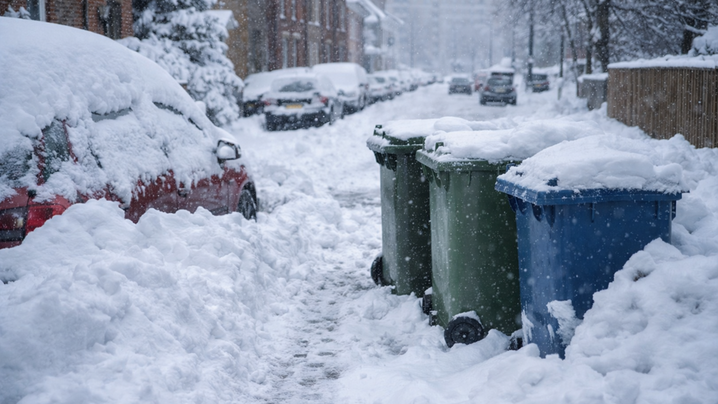
Cold cities disrupt this logic. Winter conditions fundamentally alter how waste systems function. Snow accumulation restricts access to collection points. Narrow or snowbound roads slow operations, while reduced visibility increases safety risks. Mechanical failures rise under freezing temperatures, and landfills or transfer stations face seasonal access constraints. As services become intermittent, informal disposal practices often increase.
At the same time, many cold cities experience sharp seasonal population shifts. Tourism peaks, seasonal labor inflows, and temporary migration significantly increase waste generation. This increase occurs precisely when service capacity is most constrained. Demand surges, therefore, coincide with environmental stress, compressing already narrow margins for error.
The challenge is not the absence of technical solutions. Cold weather equipment exists, and alternative routing strategies are well understood. What fails instead is the administrative ability to scale, adapt, and respond. Planning frameworks that treat winter conditions as exceptions rather than baseline realities leave cities structurally under prepared.
Waste management thus becomes an early indicator of a broader governance problem. Institutions designed for average conditions are increasingly being asked to govern extremes.
Waste Management as a Peak Load Governance Challenge
In cold cities, waste systems operate under recurrent peak load conditions. These are not isolated emergencies. They are predictable seasonal stresses that return each year. Yet governance arrangements often continue to treat them as temporary disruptions rather than as permanent features of the operating environment that require structural accommodation.
Municipal organizations are rarely designed for elasticity. Staffing levels remain fixed. Procurement processes limit rapid adjustment. Annual budgeting cycles leave little room for seasonal reallocation. Coordination across departments such as sanitation, transport, public works, and emergency services often remains fragmented.
As a result, winter waste management evolves into a form of permanent emergency governance. In practice, this involves shortened collection routes, deferred vehicle maintenance, ad hoc staff reallocations, and informal decision making that substitutes for missing institutional protocols. Officials make daily trade offs under constraint. They prioritize some areas over others and gradually normalize service degradation. Over time, these practices erode organizational resilience and weaken public trust.
These failures are frequently misdiagnosed. Public debate tends to focus on contractor performance or operational inefficiencies. The underlying issue, namely the inability of governing systems to operate reliably under sustained peak stress, remains largely unaddressed.
Climate Stress as a Force Multiplier
Climate change intensifies the challenges already faced by waste systems in cold cities. In these contexts, climate impacts rarely appear as gradual or predictable trends. Instead, they manifest through greater variability and uncertainty. Winters may be shorter, but they are often more intense. Snowfall patterns become erratic, freeze-thaw cycles occur more frequently, and infrastructure deterioration accelerates. Extreme weather events disrupt access and logistics with little warning.
Waste systems that already operate close to capacity are particularly vulnerable under these conditions. Collection schedules lose reliability. Equipment failure rates rise. Disposal infrastructure degrades faster than maintenance budgets can absorb. Emergency responses that were once occasional become routine.
Climate stress does not create new governance problems. It amplifies existing ones. Where institutional capacity is limited, climate variability narrows tolerance for error and accelerates system failure. Waste management breakdowns under these conditions are not simply sanitation issues; they are symptoms of governance systems approaching their operational limits.
Visibility, Equity, and the Politics of Waste
Waste management failures are highly visible. In tourist-oriented or globally connected cold cities, service disruptions circulate rapidly through social media and reputational channels. Images of uncollected waste or overflowing bins quickly undermine destination branding and political credibility.
This visibility places pressure on municipal leadership to prioritize rapid and highly visible responses that signal action. Such responses often do little to strengthen underlying systems. Short-term clean ups and symbolic interventions take precedence over institutional reform. Attention shifts away from service reliability toward perception management.
Service degradation rarely affects all residents equally. Peripheral neighborhoods, informal settlements, and less visible areas tend to experience longer and more frequent disruptions. When residents perceive that waste services are prioritized for visitors or central districts, trust in local government deteriorates and perceptions of inequity harden.
Waste management thus becomes a point where environmental stress, administrative capacity, and political legitimacy intersect. These interactions shape broader public evaluations of governance competence and fairness.
Why Technology Alone Falls Short
In response to mounting pressure, cities increasingly turn to technological solutions. Smart bins, route optimization software, mechanized equipment, and public private partnerships are widely promoted as fixes. While such tools can improve efficiency, they rarely address the core governance challenge.
Technology assumes institutional capacity. It requires trained staff, reliable data, adequate maintenance budgets, and effective coordination. In organizations that are already stretched thin, new systems often add complexity without strengthening underlying capability.
Many technological interventions are also project based. They attract funding and visibility, but do little to build the long-term institutional resilience required to manage seasonal and climatic stress year after year.
In cold cities, waste management success depends less on innovation and more on institutional fundamentals. These include staffing depth, adaptive procurement systems, interdepartmental coordination, and fiscal flexibility. Without these foundations, technology becomes an overlay rather than a solution.
What Cold City Waste Systems Reveal About Governance Capacity
Waste management in cold cities reveals three broader lessons for local governance.
First, environmental specificity matters. Governance systems must be designed around actual operating conditions rather than regional averages or ideal scenarios. Treating winter stress as exceptional rather than structural almost guarantees underperformance.
Second, capacity is dynamic and relational. It is defined not only by budgets or infrastructure inventories, but by the ability to adapt, coordinate, and respond under pressure. Elasticity, rather than efficiency alone, determines institutional resilience.
Third, essential services function as diagnostic tools. How a city manages waste under climate stress offers insight into how it is likely to perform across other domains, including water supply, transport, emergency response, and public health.
Toward Capacity-Centered Waste Governance
Improving waste management in cold cities requires a shift in perspective. The objective should not be to optimize systems for normal conditions. It should be to design institutions capable of governing during the most demanding months of the year.
This implies several practical changes. Planning frameworks should treat winter conditions and seasonal variability as baseline realities. Staffing models should provide predictable surge capacity through seasonal staffing provisions, cross-trained crews, or pre-agreed redeployment protocols. Procurement and budgeting systems should allow for pre-authorized seasonal expenditures and winter-specific operational costs without procedural delay. Coordination mechanisms should be strengthened so that waste management is integrated with transport planning, emergency preparedness, and climate adaptation.
Above all, waste governance should be recognized as institutional infrastructure. Like physical assets, governance systems require sustained investment, maintenance, and adaptation. Without this foundation, even advanced technologies will underperform.
Waste as a Window into Climate Ready Governance
Waste management in cold cities is often discussed as a technical challenge. In practice, it is a governance stress test. It reveals how local institutions perform when climate variability, seasonality, and demand pressure converge.
Cities that succeed are not those with the most sophisticated technology. They are those with governance systems designed for pressure. These systems plan for extremes, build institutional elasticity, and treat essential services as indicators of systemic health.
As climate variability intensifies, more cities will face conditions once considered exceptional. Cold city waste systems offer both an early warning and a practical opportunity. By learning from these contexts, local governments can move beyond reactive fixes and toward institutions capable of governing reliably in an increasingly unstable environment.
Key Takeaway
Waste management failures in cold cities are rarely technical. They reflect governance systems that are not designed for sustained climate stress, seasonal demand, and institutional pressure.
Call to Action
Local government leaders should treat waste management as a governance diagnostic. Rather than asking whether technologies are sufficient, cities should ask whether their institutions are built to operate under climate-altered conditions. They should invest deliberately in institutional capacity with the same seriousness accorded to physical infrastructure.
Publish with ICMA!
We’re searching for interesting and insightful stories that can help others learn a memorable takeaway to serve their communities better.
