
As the chief executive, your days are packed with staff meetings, reports, agenda preparations, countless emails, and solving a myriad of problems. But one of the most important ways for you to spend your time is tending to your relationship with each of your governing body members.
They rely on you for information, advice, constituent problem solving, and just being an ear for their frustrations. Your city council or board has only a few direct reports, and you are the one in charge of the organization. It is essential that you pay close attention to what they need, how they are looking at issues, and how you can help them be effective in their policy role. That takes time, and investing the time in these relationships is extremely beneficial.
No doubt you have a variety of ways of keeping your governing body informed so they hear about important issues from you first before they read about it in the paper. Typical methods are “the city managers weekly report” on Friday, phone calls about big emergency responses going on in the community by police and fire departments, staff reports on major projects, and emails and texts on individual constituent matters. These are all vital, yet they are not enough to build your relationship with your elected officials. For that, there is no substitute for in-person, face-to-face communication through the one-on-one meeting.
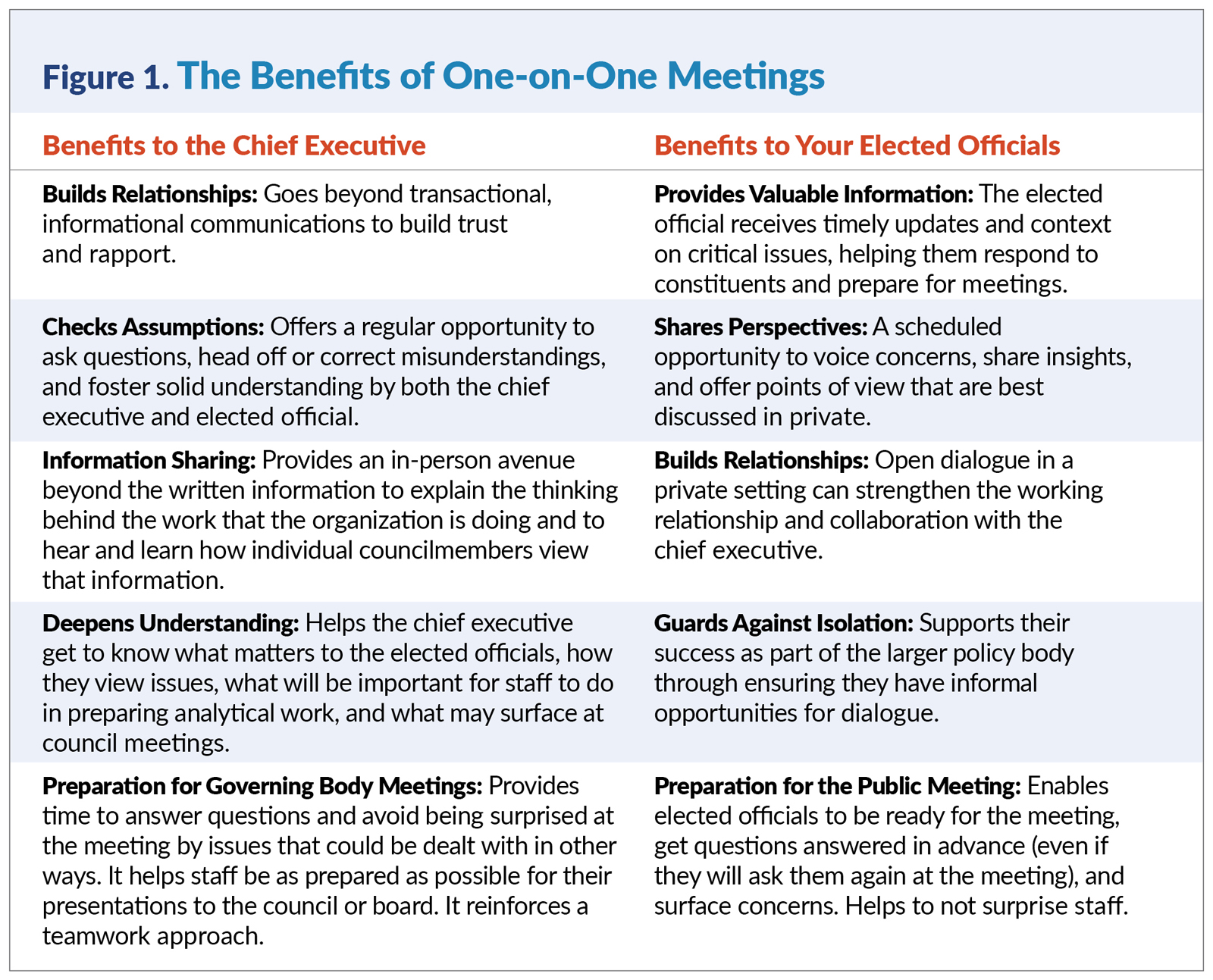
By having a regular, scheduled meeting with each of your elected officials, you can listen, share, observe body language, clarify assumptions, and truly connect. These opportunities are critical to your success as the executive leader and the success of your governing body. It reinforces the teamwork approach that is so essential to good government and effective governance.
“With 17 different individuals cycling through my seven-member council over five challenging years as Gilbert’s city manager, regular one-on-ones were absolutely critical to my success. I was able to quickly build trust and establish working relationships with new councilmembers as we navigated major decisions like a $650 million water treatment plant project, launching our first ambulance service, managing explosive growth in a community of 300,000 residents, and raising the sales tax rate for the first time in 24 years to fund $700 million in critical infrastructure.” —Patrick Banger, city manager, Glendale, Arizona
Establishing Expectations from the First Day
The expectation that individual meetings between the chief executive and all members of the governing body should be a standard norm. The chief executive should have this as a regular part of his or her orientation of new elected officials. Right after an election, these one-on-one meetings should be set up.
Best Practices for Effective One-on-Ones
Get Them on the Calendar (and Keep Them There)
Consistent scheduling is key. These can vary between weekly to two weeks to monthly, but a regular schedule is the key. Standard practice is every two weeks, with a weekly meeting with the mayor or chair to review agendas and prepare for various meetings or ceremonial duties.
Come Prepared
Develop a list or agenda for each meeting. Some items will be common to all (e.g., upcoming agenda items, major projects), while others may be unique to their specific interests or district needs. Ensure all members receive the same core information, but tailor the discussion to their individual priorities. Do ensure that you are not giving information to some and not all. The principle of treating all of them equally is essential.
Make it Convenient for Them
Your councilmembers are volunteers or part-time elected officials with busy lives. If a member is hesitant or refuses to meet, be flexible. Offer to meet for breakfast or lunch, or go to their office or a convenient location. The goal is to remove any barriers to participation.
“I have found my weekly council one-on-ones to be of paramount importance for my success as a manager. It is a weekly five-hour commitment, but that time is very important to build and strengthen my relationships with each councilmember both professionally and on a human level. I strategically utilize these meetings to communicate how I am approaching my leadership and management of the organization and discuss major policy issues that will have community impact. Listening is key. These meetings provide me insight of where my individual councilmembers are on their priorities and what matters most to them that I can then share with my team.” —Alex Khojikian, city manager, San Mateo, California
The Perils of Neglecting One-on-Ones
The absence of regular one-on-one meetings creates significant risks:
Information Gaps
Governing body members miss out on crucial updates and context, leaving them ill-equipped to respond to constituent inquiries, making wrong assumptions, or not participating effectively in public discussions. This can cause the elected officials (as well as staff) to be frustrated, and when that happens, they may well blame the city/county manager for lack of information or “skewing” the information.
Erosion of Trust
Without dedicated face-to-face time, the vital relationship between the city/county manager and the governing body can wither, replaced by transactional exchanges that lack depth and trust. Over time, this can lead to mistrust of the chief executive, which bodes ill for the organization as well as for the executive’s future.
Isolation
Governing body members can feel isolated, leading to a sense of detachment. This can create a “us versus them” problem between the elected body and the organization.
Unwritten Messages
Some sensitive topics or nuanced discussions cannot and should not be put in writing. They require direct conversations. These vital interactions are lost without in-person meetings.
If you are struggling with your governing body members and are not having one-on-ones with them, by introducing these individual meetings you may find your relationships turning around for the better.
“Over the course of my career, the council/manager one-on-one meetings have been fundamental. The councilmembers appreciate them; my staff appreciate them because they know I will relay information or harvest questions from them to be better prepared; and I appreciate them for the value of establishing and maintaining those vital relationships.” —Sherilyn Lombos, city manager, Tualatin, Oregon
Beyond the One-on-One
In addition to the one-on-one meetings, the chief executive should constantly be looking for ways to connect with governing body members. Great ways are the standard methods previously noted, such as weekly reports, informational emails, or texts about emergency responses.
But other ways are also important, such as picking up the phone and sharing some information or asking a question—anything to connect, build the relationship, and learn what is important to your elected officials. Don’t always rely on simply replying to an email. Sometimes a direct phone call is far more effective for clarifying an issue, understanding the “why” behind a question, or addressing a concern with nuance that the written word can’t convey.
Conclusion
The world of local government is a dynamic one. Conditions change regularly. The elected body is expected by their constituents to know what is going on. They need to be kept informed and the chief executive is the one to do that. Effective communication is the bedrock of success.
While information can be shared through reports and emails, the personal, dedicated one-on-one meetings with your elected officials are essential in building relationships, checking assumptions, learning, and avoiding or correcting misunderstandings.
Make these one-on-one meetings with your elected officials a priority, make them regular, and make them count! You will be a more effective leader for doing that.
JAN PERKINS, ICMA-CM, is a former city manager in two California cities and currently vice president of Raftelis, serving cities, counties, and special districts.
TAMARA LETOURNEAU, ICMA-CM, is an experienced city manager, currently serving as city manager for Laguna Niguel, California.
Publish with ICMA!
We’re searching for interesting and insightful stories that can help others learn a memorable takeaway to serve their communities better.
