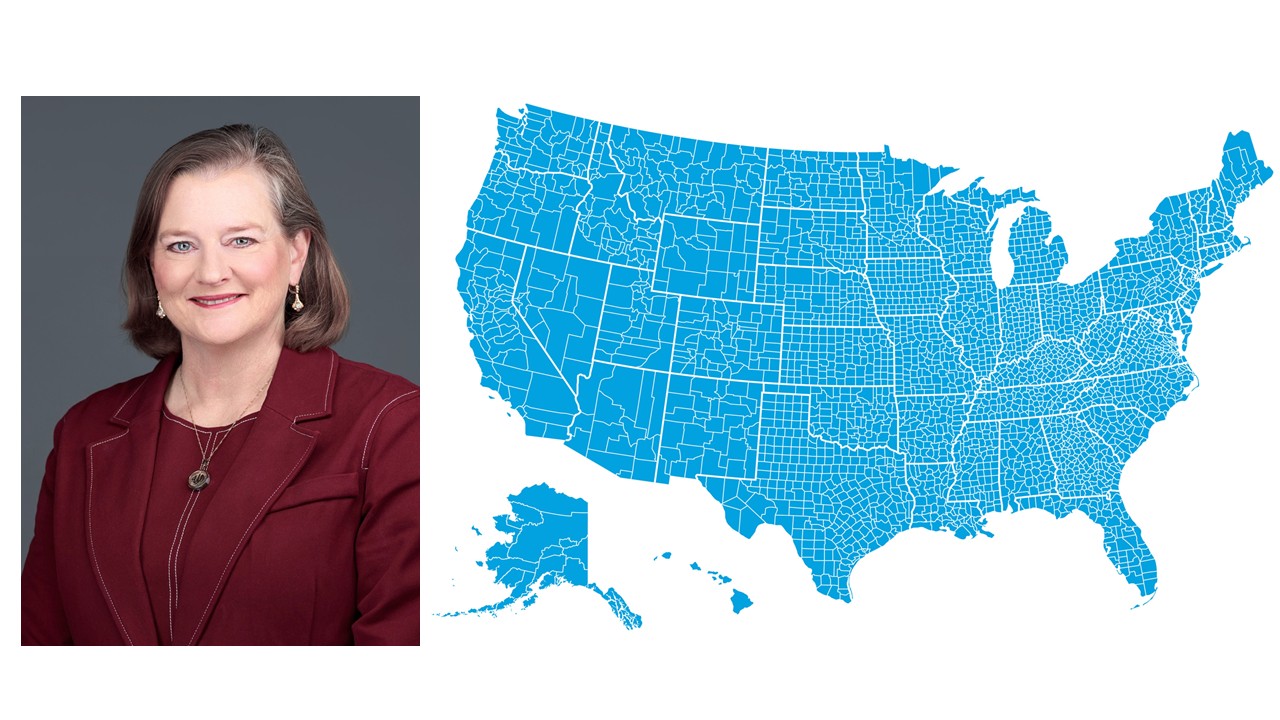
Local government in the United States is remarkably diverse. From cities and towns to townships, villages, boroughs, and special districts, communities organize themselves in ways that reflect their history, geography, and needs.
Counties sit at the center of this ecosystem,* bridging state policy and local service delivery. They are both familiar and complex—serving rural, suburban, and urban communities alike—and they play an essential role in the strength and success of our profession.
County governments are the primary service provider for roughly half of the U.S. population, yet no two counties look exactly the same. Some serve millions of residents across vast metropolitan regions; others cover wide geographic areas with small populations and limited tax bases. This variation is not a weakness—it is a defining feature of county government. Counties must continuously adapt to differences in scale, governance structure, and community expectation, all while delivering core services that residents rely on every day.
That need to adapt is where innovation becomes central to county government. Counties often operate where challenges are most visible and most complex—public health, human services, justice systems, infrastructure, and emergency response. Whether responding to workforce shortages, implementing new technology, or redesigning service delivery models, counties are frequently at the forefront of practical innovation. They innovate not for recognition, but out of necessity—finding new ways to serve residents efficiently, equitably, and sustainably.
At the same time, counties demonstrate extraordinary resilience. Economic cycles, natural disasters, public health emergencies, and demographic change test local governments regularly. Counties must respond quickly, coordinate across jurisdictions, and maintain continuity of service even when resources are strained. Their ability to absorb shock, recover, and improve reflects the professionalism and commitment of county managers and staff. Resilience is more than bouncing back—it’s about learning, adjusting, and emerging stronger.
Counties also differ from cities and other local governments in important ways. Their service portfolios are broad, their governance structures varied, and their stakeholder environments are complex. Counties work with elected officials who may represent wide and diverse constituencies. They collaborate with municipalities, special districts, and state agencies—often simultaneously.
Despite these differences, our members who serve in counties share a common foundation with all professionally managed local governments: a commitment to ethical leadership, effective management, and service to the public.
This was formally acknowledged by the ICMA membership in 1991 when we voted to change our name to be inclusive of counties, becoming the International City/County Management Association.
That shared foundation is why counties are so integral to our professional organization. The recognition of counties within our profession affirmed what county managers already knew—that innovation, professionalism, and excellence thrive at the county level.
ICMA members “affiliate” with one another in smaller communities that allow people with unique shared experiences and aspirations to connect. For our county members, that space is the National Association of County Administrators (NACA). We appreciate the opportunity this creates for county leaders to share experiences and to recognize their colleagues.
Earlier this year, NACA established the County Administrator of the Year award in honor of former county administrator David J. Krings. Michele Lieberman, ICMA-CM, county manager of Alachua County, Florida, is the first recipient of this inaugural award. We congratulate Michele and appreciate NACA’s commitment to lifting up members who contribute to our profession.
As you read this month’s articles, remember that best practices are scalable and adaptable. The idea itself may not be directly transferable, but it is important to ask yourself what could be adapted to the context of your own jurisdiction. Every community is different, regardless of the underlying legal basis for the local jurisdiction. The challenge of professional management is to identify how to take the idea and adapt it to your community.
As we continue to elevate innovation and resilience as core themes of our work, counties offer compelling examples of both. Their experiences strengthen our collective knowledge, their challenges sharpen our professional skills, and their successes demonstrate the value of professional management.
Recognizing counties is not simply about structure or scale; it is about honoring the leadership that makes local government work.
* With notable appreciation for the exceptions that prove the rule: Louisiana is divided into parishes rather than counties. Alaska is divided into boroughs and census areas, not counties. In Connecticut, counties exist on paper for statistical purposes, but do not function as local governments. In Rhode Island, they exist in name only but have no governing authority. In Virginia, you live in a city or a county, but not both.

JULIA D. NOVAK, ICMA-CM, is executive director of ICMA.
Publish with ICMA!
We’re searching for interesting and insightful stories that can help others learn a memorable takeaway to serve their communities better.
