
On a rainy Tuesday night in GeneriCity (our fictional municipality for this article), the council chamber was packed. A routine agenda item—utility rates—had drawn an unexpectedly large crowd. Residents insisted the city should “tighten its belt” and questioned why previous increases had not solved the problem. When the finance director walked through the numbers, even seasoned councilmembers admitted they were unsure how the current rates had been set. Staff left the meeting with a clear lesson: without a transparent methodology, rate-setting becomes a political minefield.
This scene is familiar across the country. Local governments of all sizes are navigating long-term inflation, supply-chain instability, aging infrastructure, and an ever-widening set of federal and state regulatory expectations. These forces converge to create a looming fiscal cliff for many utilities: costs rising faster than revenue structures that were never designed to withstand sustained economic pressure. Yet rate-setting remains politically sensitive in almost every jurisdiction.
The result? Many communities rely on ad-hoc adjustments, postpone rate increases, or defer capital maintenance. Over time, these decisions create rate deficiencies: underpricing, thin reserves, and operational vulnerabilities that erode service reliability and public trust.
These challenges affect all utilities, whether serving 2,000 residents or 200,000. Leaders must balance affordability with financial sustainability, equity with operational reality, and political considerations with stewardship. As costs rise and regulatory expectations increase, CAOs need a rate-setting model that is adaptable and defensible.
This article introduces cost-plus pricing as a practical framework that addresses these needs. The method aligns with ICMA’s core values, particularly honesty, stewardship of public resources, and informed decision-making, while providing a clear, replicable process accessible to staff at all levels. The sections that follow outline why traditional approaches fall short, explain the cost-plus model in practical terms, and provide implementation steps and communication strategies for CAOs, assistant managers, and analysts. And, as GeneriCity learned, the difference between stability and conflict often hinges on whether rate-setting is guided by transparent methodology or political momentum.
When Incremental Rates Fall Short
Local governments frequently rely on familiar rate-setting methods that appear manageable but fail to be fiscally sustainable. Understanding these limitations helps leaders recognize why a structured approach is needed.
Incremental Adjustments Mask Underpricing
Many communities increase utility rates incrementally—4% here, 7% there—without reassessing the underlying cost structure. This approach feels intuitive because it avoids spikes, but it rarely reflects real conditions. Over time, the gap between revenue and cost widens. Utilities become vulnerable to operational disruptions, emergency repairs, and depleted reserves. The central problem is simple: incremental adjustments respond to comfort, not reality.
Benchmarking Alone Is Insufficient
Benchmarking, comparing rates to nearby or similar cities, is a common tool to provide utility pricing context. However, it is not a rate-setting method. Benchmarking cannot account for local cost drivers; its focus is external.
A community operating a 40-year-old wastewater treatment plant cannot sustainably price service by mimicking a neighbor with new facilities and lower operating costs. Therefore, benchmarking is most effective when paired with a cost-based method, such as cost-plus pricing, that ensures internal needs are met before comparing external prices.
Misalignment of Fixed vs. Volumetric Charges
Many systems unintentionally misalign cost recovery. Fixed costs, like personnel, plant operations, electricity, debt service, often represent a majority of utility expenses. Yet some municipalities unintentionally recover these costs through volumetric rates.
This pricing creates financial volatility. A wet year or conservation mandate can reduce utility consumption, cutting revenue despite fixed costs remaining unchanged. Conversely, in a dry year, volumetric rates may burden residents during times of necessity. While an intentional conservation strategy can be to shift some fixed costs into the volumetric rate, accidental misallocation exposes the system and people to risk.
Political and Communication Barriers
Rate-setting discussions often begin only when expenditures exceed revenues or after contentious public meetings. If staff cannot explain how rates are calculated, skepticism grows. Residents may default to assumptions that the city is overspending or that rates fluctuate arbitrarily.
Without a defensible methodology, staff are left reacting to public frustration rather than leading informed discussions. City/county managers and analysts need tools that simplify complex financial realities and build a foundation for transparent, proactive engagement.
What Is Cost-Plus Pricing?
Cost-plus pricing is a structured pricing method that begins with the actual cost of providing a service. It is widely used in industries where input costs fluctuate or where major infrastructure requires periodic renewal. For local governments, the method creates transparent, predictable rates that support operational and capital stability. Cost-plus pricing aids in designing a rate that reflects present operating costs and can account for future needs.
Cost-plus pricing divides total utility costs into fixed and variable components. It then applies the following formulas:
Fixed Cost Charge: (Fixed Costs × Margin) ÷ Number of Consumers
Volumetric Cost Charge: (Total Variable Costs × Margin) ÷ (Consumers × Average Consumption)
Costs must match the billing period. For monthly billing, annual costs should be divided by 12; for bi-monthly billing, by 24. This ensures that revenue aligns with the time scale of expenses.
The margin represents reserve needs, inflationary pressures, and capital cycles. It is not profit; it is strategic reinvestment that protects the system from shocks and supports long-term renewal. As Utpal Dholakia with Harvard Business Review notes, the method works best when organizations require stable revenue for reinvestment and when transparency can strengthen trust, conditions common to municipal utilities.
Core Components
The model has four main steps:
1. Identify all fixed and variable costs.
Include utility operations, personnel, insurance, electricity, chemicals, plant maintenance, and administrative overhead.
2. Allocate administrative and overhead expenses.
Utilities often rely heavily on citywide services such as finance, HR, payroll, legal review, and IT. These costs should be allocated appropriately.
3. Determine the margin.
The margin should reflect long-term capital needs, inflationary risks, and reserve requirements. It creates predictable, responsible funding for system renewal.
4. Translate costs into fixed and volumetric charges.
This ensures that fixed costs are recovered through fixed fees and variable costs through volumetric rates, providing stability and effective cost allocation.
Why the Method Is Defensible
Cost-plus pricing is defensible as a method as pricing is transparent and based on the system’s needs. It is able to link utility rates to costs, supporting planning and minimizing the need for emergency increases. Moreover, it is grounded in honesty and transparency, core tenets of the ICMA Code of Ethics, providing a consistent pricing framework. By aligning revenue with the cost of service, cost-plus pricing prevents the march toward fiscal cliffs caused by deferred maintenance and chronic underpricing.
Pricing Utilities for the Long-Term
This section provides a six-step outline for the process of applying the cost-plus pricing model. Unique about the framework is its adaptability to local governments and simplicity to update through spreadsheet tools.
Step 1: Gather Data
Begin by collecting the utility-related expenditures, including operating costs, debt service and capital item costs, and administrative overhead. In addition, collect the number of utility consumers and the average level of consumption per billing period.
Step 2: Determine Fixed vs. Volumetric Components
Classify each cost as fixed or variable. Fixed costs are necessary for system operation regardless of consumption; variable or volumetric costs change with output. Assistant city/county managers, budget analysts, or general analysts can create a simple matrix sorting charges into categories. This is often the first step in illuminating unrecognized cost pressures.
Step 3: Select the Margin (“The Plus”)
Margin selection is strategic. You should consider capital renewal cycles, regulatory mandates, reserves and financial risk, equity and affordability, and inflationary pressures. Managers should engage councils early to explain what the margin represents and why it matters. Analysts can run sensitivity tests showing how different margins affect revenue and customer bills.
Step 4: Set the Tiers
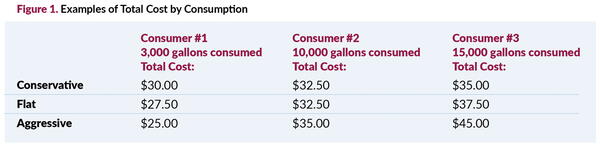
Communities commonly use uniform rates or tiered structures. Tier design influences consumption behavior and equity outcomes. Leaders should compare percentage increases in each tier to regional peers and internal goals. Comparing percentage differences between your government and comparable governments’ tier percentage increase or decrease can help provide suggestions for making a rate more or less aggressive).
Step 5: Model Rate Scenarios
Using the cost-plus formulas, consider developing multiple rate scenarios. Options may include:
- A steady phase-in approach.
- An immediate adjustment.
- A more aggressive rate structure that anticipates inflation.
- A less aggressive structure emphasizing affordability.
Analysts should provide scenario tables showing revenue stability, impact on different customer classes, and effects on reserves.
Step 6: Phase-In Strategy
Most communities benefit from multi-year rate transitions. Phase-in strategies reduce public resistance, ease cashflow shocks, and support long-range planning.
Leadership and Communication Strategies for CAOs
A strong rate model requires strong leadership. CAOs and their teams must guide councils and residents through a complex but essential process.
Transparency Tools: Effective tools include one-page rate explanation sheets, scenario comparison sheets, public-facing dashboards, and annual methodology updates. Basic spreadsheet software can generate tables showing cost allocations, average consumption, and the resulting rate calculations. Analysts play a key role in preparing clear, visually accessible materials. These tools reinforce ICMA principles of honesty, openness, and informed decision-making.
Council Engagement: Rate-setting should be framed as stewardship, not politics. Managers should engage councils early, consistently, and annually, emphasizing how cost-plus pricing aligns with fairness, reliability, and fiscal responsibility. Managers can facilitate workshops where councilmembers walk through simplified versions of the model, improving understanding and buy-in.
Public Communication: Transparent communication reduces resistance. Staff should explain the difference between fixed and variable costs, why the margin is necessary, and how gradual increases avoid crisis-driven spikes. Connecting rates to reliability and regulatory compliance helps residents understand value beyond cost.
GeneriCity Example: A Fictional Scenario
GeneriCity, a mid-sized municipality with 10,000 accounts, provides a clear illustration. After years of incremental adjustments, staff discovered revenue shortfalls and deferred capital needs.
Cost Classification
- Fixed costs: $4 million annually.
- Variable costs: $2.5 million annually.
- Administrative overhead: $1.2 million.
- Combined fixed costs: $5.2 million.
- Total consumers: 10,000.
- Average monthly water consumption: 7,000 gallons.
Applying the Cost-Plus Model
GeneriCity selects a 5% margin to support capital replacement. The calculations are:
Fixed Cost Charge: ($5.2M × 1.05) = $5,460,000 ÷ 10,000 = $546 per year = $45.50 per month.
Volumetric Rate: ($2.5M × 1.05) = 2,625,000 ÷ (10,000 × 7,000 gallons × 12 months) = $0.003125 per gallon, or $3.125 per thousand gallons.
The city then develops three scenarios:
- Immediate implementation, raising average bills by 22%.
- Three-year phase-in, increasing bills by about 7.5% annually.
- Five-year gradual transition, emphasizing affordability.
GeneriCity implements the three-year phase-in. Staff prepare clear summaries and host public workshops. The model’s transparency turns a contentious issue into an informed and manageable dialogue. And on the next rainy Tuesday, GeneriCity found something unusual: a quiet council meeting.
Conclusion
Accurate and transparent rate-setting is essential for protecting community assets and ensuring reliable utility service. As inflation persists, infrastructure ages, and regulatory requirements expand, cities need a defensible and adaptable framework. Cost-plus pricing provides that structure. By classifying costs, selecting margins, and aligning rates to costs, the model helps avoid crisis-driven increases and supports long-term planning.
City leadership plays a crucial rate-setting role. Implementing cost-plus pricing enables them to present clear, data-driven recommendations and avoid crisis-driven rate spikes. Municipalities that adopt structured methodologies and commit to routine updates can strengthen public trust and improve long-term outcomes.

MAX FISHER is assistant to the city manager of Levelland, Texas.
Publish with ICMA!
We’re searching for interesting and insightful stories that can help others learn a memorable takeaway to serve their communities better.
