
Strategic planning is widely recognized as a critical management practice within local government, intended to provide organizational direction, align resources with community priorities, and enhance institutional performance. Despite its widespread adoption, local government officials alike have noted a recurring challenge: many strategic plans fail to progress beyond formulation, resulting in limited operational impact.
The development of a strategic plan requires substantial investments of time, financial resources, and staff capacity. However, the successful execution of these plans often proves more difficult than their creation. Local government executives must navigate competing interests from elected officials, employees, and residents while simultaneously translating high-level goals into actionable initiatives. This frequently produces a disconnect between strategic intent (“what”) and administrative practice (“how”), undermining implementation fidelity and long-term outcomes.
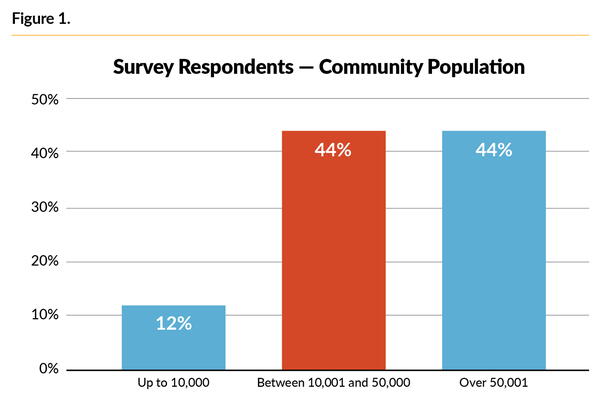
During their participation in Leadership ICMA, the authors undertook a research project to examine this implementation gap through a local government–informed lens, drawing on empirical data collected from municipalities and counties across the United States. A structured survey yielded 59 responses representing a diverse range of community sizes, governance models, and organizational capacities. Respondents included jurisdictions with populations under 10,000 (12%), between 10,001 and 50,000 (44%), and over 50,001 (44%), providing broad representation across small, mid-sized, and large municipalities and counties.
This diversity reinforces the universality of the implementation challenge across institutional frameworks.
Survey findings further indicate that while reported implementation success increases with organizational scale—71% among small municipalities, 81% among mid-sized municipalities, and 88% among large municipalities—no category demonstrates complete consistency in translating strategic plans into sustained operational practice. These results suggest that access to resources alone does not fully account for implementation effectiveness, pointing instead to structural, cultural, and managerial factors.
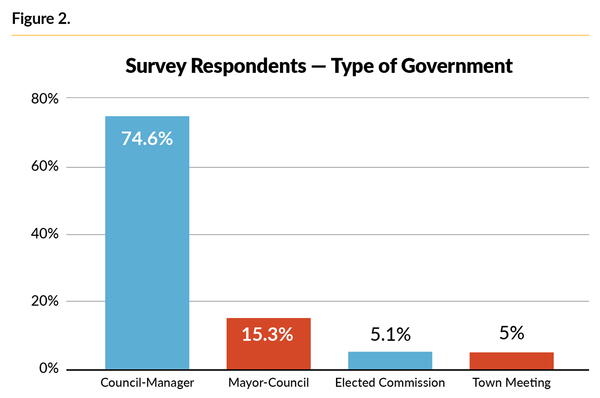
Data collection focused on local government experiences with strategic planning processes, including methods of stakeholder engagement, internal alignment, and performance monitoring. The survey instrument captured both quantitative measures and qualitative insights, enabling a multidimensional analysis of barriers and enabling conditions associated with implementation.
Collectively, these findings highlight that strategic planning challenges are not isolated to specific community sizes or governance forms but represent a systemic issue within local government administration. Accordingly, this project positions strategic planning not merely as a technical exercise but as an organizational change process requiring sustained leadership commitment, cross-departmental coordination, and clear accountability mechanisms.
By synthesizing local government perspectives and empirical data, this study aims to contribute to the applied literature on public sector management while offering evidence-informed strategies for local government managers seeking to strengthen the connection between strategic vision and operational execution.
Community Engagement
Community engagement emerged as the most frequently cited determinant of successful implementation. When asked what respondents would repeat in their next strategic planning process, community engagement was the single, strongest theme (49%), as it is “robust, phenomenal, and essential” to legitimacy and buy-in.
Community “buy-in” creates plans that consist of actionable tasks with results that are locally relevant. Engagement not only builds community trust, but fosters a sense of shared ownership for outcomes and ensures community accountability. The strategic plan is the community statement for the needs of the future. A vast majority (82%) of respondents regularly or occasionally hired a consultant. This overwhelming response indicates that consultants are a trusted resource to enhance process creditability and facilitation quality.
Nearly half of respondents (48%) indicated that they would increase or improve community engagement in their next planning process, indicating that broader inclusion and moving beyond more formal processes worked best. Expanding engagement beyond traditional form meetings through online surveys (56%) and public meetings (53%) ranked highest. As one respondent noted, “I’ve seen consultants set up where people already congregate, such as the fairgrounds, farmers markets, or parks. Rather than people attending a stuffy meeting, they can participate in normal daily life.”
Over one-third of respondents (36%) emphasized that facilitated workshops or charettes worked well, suggesting that deeper engagement is especially valued when time and capacity allow. “Our most effective strategies have been when we’ve engaged in multi-meeting charrettes with feedback loops where the public begins the first meeting with a blank slate of what can be done in the future, and works with staff and consultants over [a number of] meetings to design solutions. [This is] followed by feedback on those plans at the next meeting and a refined vision for the future over a series of meetings over three to six months.”
The findings indicate that community engagement strengthens long-term implementation. Feedback loops continue the conversation and ensure that the plan’s vision and direction remain vibrant over time. These findings suggest that community engagement is not merely a procedural component of plan development, but a structural determinant of implementation success.
Measurable Goals and Objectives
Another consistent theme across the survey data was that without accountability, strategic plans are unlikely to be successful. Respondents repeatedly emphasized that measurable goals, defined ownership, and ongoing reporting are what distinguish plans that are implemented from those that sit on the shelf.
One of the strongest indicators of success was the alignment of departmental goals with the strategic plan. Approximately 90% of respondents reported that departmental goals are tied to their strategic plan. When goals align with the day-to-day realities of departments, they translate from abstract priorities into actionable work.
The importance of measurable objectives was reinforced through repeated references to reporting and dashboards. Respondents highlighted the value of establishing key performance indicators, publicly sharing progress, and maintaining transparency, the goal of which is to reinforce accountability and build trust with elected officials, staff, and the community. One respondent explained that if they could change their process, they “would establish more formal implementation milestones and performance dashboards at the outset to track progress consistently across departments.”
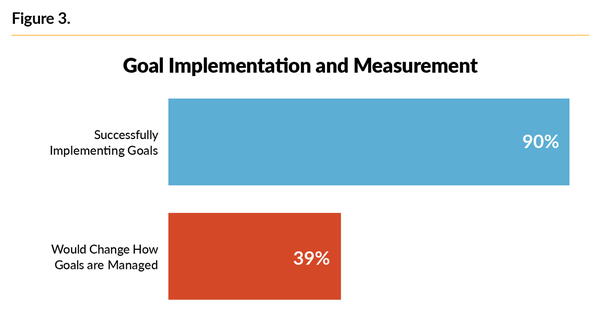
Clarity and simplicity also emerged as essential components of measurable planning. Over one-quarter (27%) of respondents highlighted the importance of keeping plans concise and focused, cautioning that overly complex plans “crumble under their own weight.” Measurable goals are most effective when they are limited in number, clearly defined, and easily understood across the organization. Although, 39% of respondents would change the way they managed goals and accountability in their next strategic plan creation, showing that although 90% of organizations implement goals, there is much work to be done to improve their measurement and reporting.
Tying budgets and employee performance reviews to the strategic plan also showed positive correlations with plan success. However, these factors did not appear to be primary drivers. Instead, they likely reflect organizational capacity and maturity. Organizations that integrate budgets and performance systems into their strategic plans are often those already implementing multiple best practices.
Measurable goals and objectives are essential to effective strategic planning. Clear ownership and realistic reporting transform plans from aspirational documents into actionable work plans. The evidence suggests that when accountability systems are embedded throughout the process, strategic plans are far more likely to be implemented successfully.
Integration of Strategic Plan into Organizational Culture
Survey respondents consistently emphasized that embedding the strategic plan into organizational culture was essential for sustained implementation. While the first two focus areas touch on engaging the community and establishing shared understanding of how the plan will be measured, survey respondents noted prominently the equal importance of embedding the adopted plan into the government organization’s culture. Without internal buy-in from a government’s elected officials and staff, a plan is unlikely to be implemented.
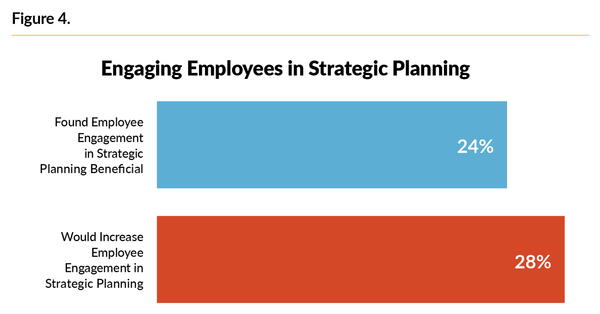
Nearly a quarter (24%) of respondents said that they found adequate internal employee engagement in the strategic planning process beneficial. This group highlighted the positive impact of staff ownership in successful implementation. One respondent stated that employees who “feel they create[d] the plan...have the most buy-in.”
Additionally, a similar number (28%) said they would increase their staff involvement if conducting another strategic plan. Several survey respondents noted that a weak point in prior strategic planning was improper weighting between community or consultant input over the thoughts of their staff. Specifically, a survey respondent found that employees who could not “casually under[stand]” their role in the strategic plan were less likely to successfully implement it.
As a subset of staff engagement, a vast majority of respondents (73%) reported their successfully implemented strategic plans were tied to their community’s budgeting process. To this end, 20% of overall respondents listed budget alignment as the single most important factor in strategic plan implementation. Inclusion of the plan in budgeting provided both tangible reporting processes and timelines. Conversely, 37% of respondents said that a lack of formalized reporting processes had or would have negatively impacted their ability to implement a strategic plan.
Finally, elected official buy-in was likewise identified as beneficial to strategic plan buy-in. While seemingly intuitive, respondents widely noted that including elected officials in the process from cradle to grave provided trust, transparency, and accountability to the process. Conversely, several respondents commented that administrators should avoid scoping the strategy on staff needs alone, instead leaving room for the priorities of the elected officials.
Additional Structural Influences
In addition to the three main focus areas for strategic plan implementation identified by the survey, two additional overarching findings came to light. While it may seem intuitive, the survey highlighted that well-resourced communities have more success implementing their strategic plans than those with less available staff and funds. While it is likely that access to consultants and dedicated staff are beneficial factors, they are not required for successful implementation. Findings suggest that smaller jurisdictions may benefit from prioritizing community engagement, defined measurement criteria, and organizational integration.
Second, respondents made clear that election cycles play a major, unavoidable factor. While some newly elected officials simply require an orientation to the existing plan to support continued implementation, others may have run against existing efforts. Electoral shifts may disrupt continuity, particularly within strong-mayor systems.
Conclusion
Strategic plan implementation ultimately hinges on three fundamentals: engagement, measurable accountability, and cultural integration. While simple, each must be treated with care and kept in sight throughout the creation of a strategic plan and, hopefully, its successful implementation.
DEMETRIUS BYNES is director of human resources for Statesboro, Georgia.
CHRISTINA CORNWELL is director of emergency management for Laurel, Maryland.
DOUG FERRALL is assistant county administrator of community services for Calhoun County, Michigan.
STONE JAMES is city manager of Twentynine Palms, California.
MYLES TUCKER is support services manager for Needham, Massachusetts.
LISA WILSON is county administrator of Sauk County, Wisconsin.
The authors were participants in the 2025–2026 Leadership ICMA Cohort.
Publish with ICMA!
We’re searching for interesting and insightful stories that can help others learn a memorable takeaway to serve their communities better.
