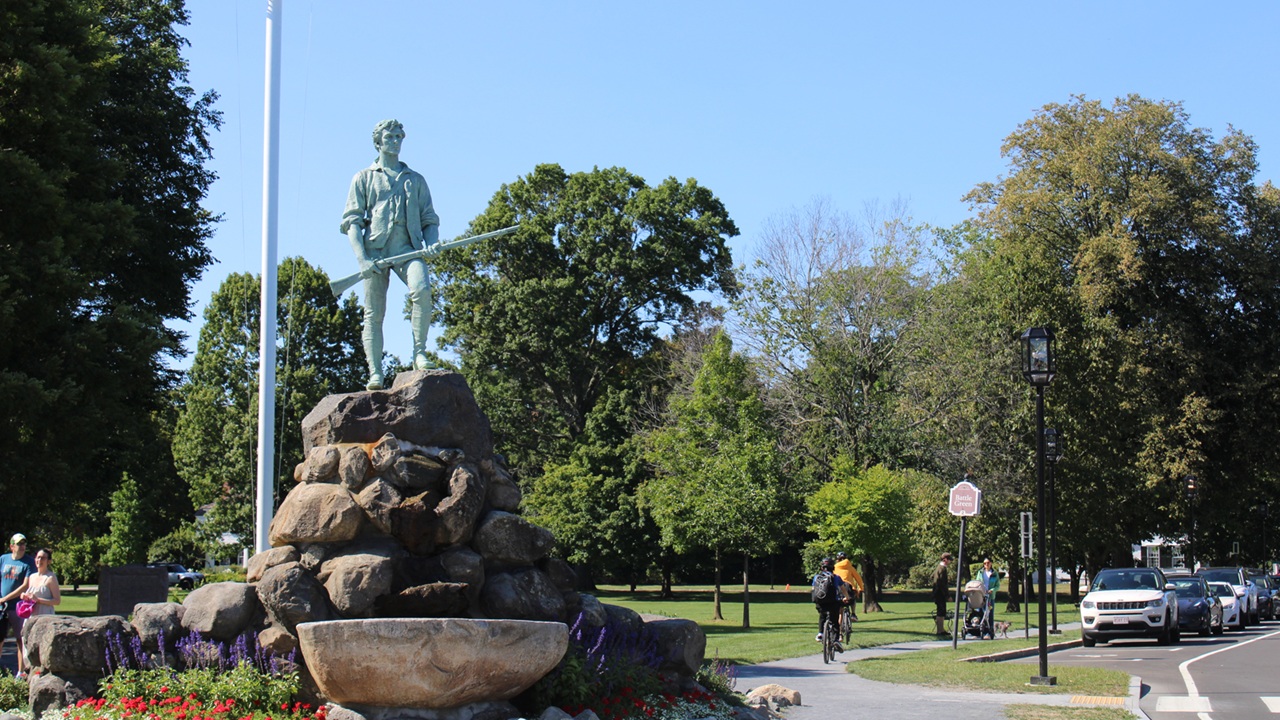
On April 19, 1775, a small band of colonial militiamen (the Minutemen) stood on Lexington Green at dawn, outnumbered and outgunned, facing the most powerful military force on Earth. (And if you’ve never attended the annual reenactment, you’re missing out!) Nobody knows who fired first—historians have been arguing about it for 250 years. What we do know is that something remarkable happened there: ordinary people, chosen by their neighbors, stood up for the idea that government must be accountable to the governed.
As America prepares to mark its 250th birthday, it feels right to pause and ask what those Minutemen were really fighting for. Not in the abstract, but in the context of daily life: the kind of democracy you find at a town meeting (our New England colleagues know what that means; for the rest, read on), a budget review, or a planning board hearing—the kind of meetings we government nerds have spent a century quietly attending.
ICMA Ethics Director Jessica Cowles pitched the idea for this article to me in December. She and I come to this work, appropriately, from the same starting point: an undergraduate classroom at Michigan State University’s James Madison College (JMC) of Public Affairs. (Go Green!) We both studied political theory and constitutional democracy within a few years of each other, and only crossed paths years later through ICMA. A coincidence that says something either about the value of a good political theory education or about the remarkably small world of public administration. Possibly both.
What Tocqueville Saw
Alexis de Tocqueville (a rock star in the JMC political theory program) arrived in America in 1831, just 56 years after Lexington, and spent nine months trying to understand what made this democratic experiment tick. (If only Bill and Ted could transport him to 2026…) He had a gift for identifying things Americans themselves took for granted. Among his most enduring observations:
“It is not the administrative but the political effects of decentralization that I most admire in America. In the United States, the interests of the country are everywhere kept in view; they are an object of solicitude to the people of the whole Union, and every citizen is as warmly attached to the general interest of his country as he is to his own. He takes pride in the glory of his nation; he boasts of its success, to which he conceives himself to have contributed; and he rejoices in the general prosperity by which he profits. He has some understanding of these things, and he loves his country for all these reasons.” —Alexis de Tocqueville, Democracy in America, Volume I (1835)
Tocqueville’s insight was not that America had a great federal government; it was that Americans had learned to govern themselves locally, and that this habit—this daily practice of democracy—was what made the larger project possible. He saw something that a lot of people in a lot of eras have seemingly forgotten: democracy is not a spectator sport. It requires practitioners.
How the Code of Ethics Shapes Fundamental Values in the Profession
This is where the ICMA Code of Ethics enters the picture—not as a compliance document, but as a statement of democratic purpose. The Code’s very first tenet (my favorite) opens with a declaration: “We believe professional management is essential to effective, efficient, equitable, and democratic local government.”
Read that again: effective, efficient, equitable, and democratic. Not effective and efficient instead of democratic. Not democratic or equitable at the expense of effectiveness. All—together—as a unified professional obligation. The framers of the Code seemed to understand—and our profession has reaffirmed ever since—that a technically brilliant local government that doesn’t serve democratic values has missed the point entirely.
What does that commitment look like in practice? It looks like making budget documents genuinely readable. It looks like holding community meetings at times when working families can attend (or offering them virtually). It looks like serving the best interests of all community members (tenet four) equitably and without discrimination. It looks like presenting council, or select board, or county commission, etc., with honest analysis even when the honest answer is politically inconvenient.
The Code also calls on members to respect and uphold democratic principles. At a time when those principles are being discussed, debated, and defined from every direction, local government managers are in a unique (and increasingly uncomfortable) position: we are neither partisans nor bystanders. We are stewards of the process itself — obligated not to any outcome but to the integrity of the system by which communities reach their own outcomes.
Lessons from Lexington
Here are a few additional facts about Lexington that don’t always make it into history books. The town meeting form of government that existed in Lexington in 1775 still exists today. The citizen town meeting members of Lexington (189 to be exact, with 21 elected to staggered three-year terms from each of nine precincts) still gather, debate, argue, debate some more, and then vote on local matters in a tradition of direct democracy that is nearly as old as the country itself.
The select board—a title so wonderfully archaic it practically demands a tricorn hat—continues to oversee town affairs alongside a professional town manager backed by an incredible senior management team. Captain John Parker, who commanded the militia on the Green that April morning, had been selected to lead by his neighbors. He was not appointed by a distant authority; he was chosen by the people who would stand beside him.
The Custodian’s Work
Local government is where democratic habits are formed and sustained. It is where residents learn that their voice has weight, that showing up matters, that the decisions made in modest municipal buildings affect the texture of daily life. Tocqueville understood this. The authors of the ICMA Code understood it. And every manager who has sat through a contentious public hearing at 11 o’clock on a weeknight, committed to letting every voice be heard before the vote, understands it in a very immediate (and probably caffeinated) way.
Democracies decay when their small but vital daily practices erode—when people stop believing their participation matters, when the work of governance feels remote and opaque, when the distance between resident and decision grows imperceptibly wider, and when civil discourse becomes neither civil nor much of a discourse.
We are democracy’s quiet custodians. Not its authors, not its defenders in any dramatic sense, but its day-to-day keepers. We make sure the meeting notice goes out on time, the public comment period is real rather than performative, the staff report tells the truth even when the truth is complicated. These small things stack up, cumulatively, to form the foundation upon which the entire enterprise sits. Take care of the little things, Emily Dickinson told us, and the big things take care of themselves.
Standing on the Green
Those assembled on Lexington Green in 1775 were not ideologues. They were farmers, tradesmen, and neighbors—people with a practical, personal stake in the question of who governs. They understood something that has not changed in 250 years: that self-governance is not a condition you achieve and then maintain passively. It is a practice, and it requires people who take it seriously.
The ICMA Code of Ethics exists because this profession made a collective decision, more than a century ago, to take it seriously. To commit, formally and publicly, to something larger than organizational efficiency or career advancement: to the idea that professional local government management is, at its core, a democratic act. Two hundred fifty years after the shot heard ‘round the world, the work continues—at town meetings, city councils, and county commissions; in budget meetings and planning offices; in every community where a professional manager and an elected body are trying, together, to get it right. While the Green has gotten a good deal quieter, the stakes are no less real.

STEVE BARTHA, ICMA-CM, is town manager of Lexington, Massachusetts.
Publish with ICMA!
We’re searching for interesting and insightful stories that can help others learn a memorable takeaway to serve their communities better.
