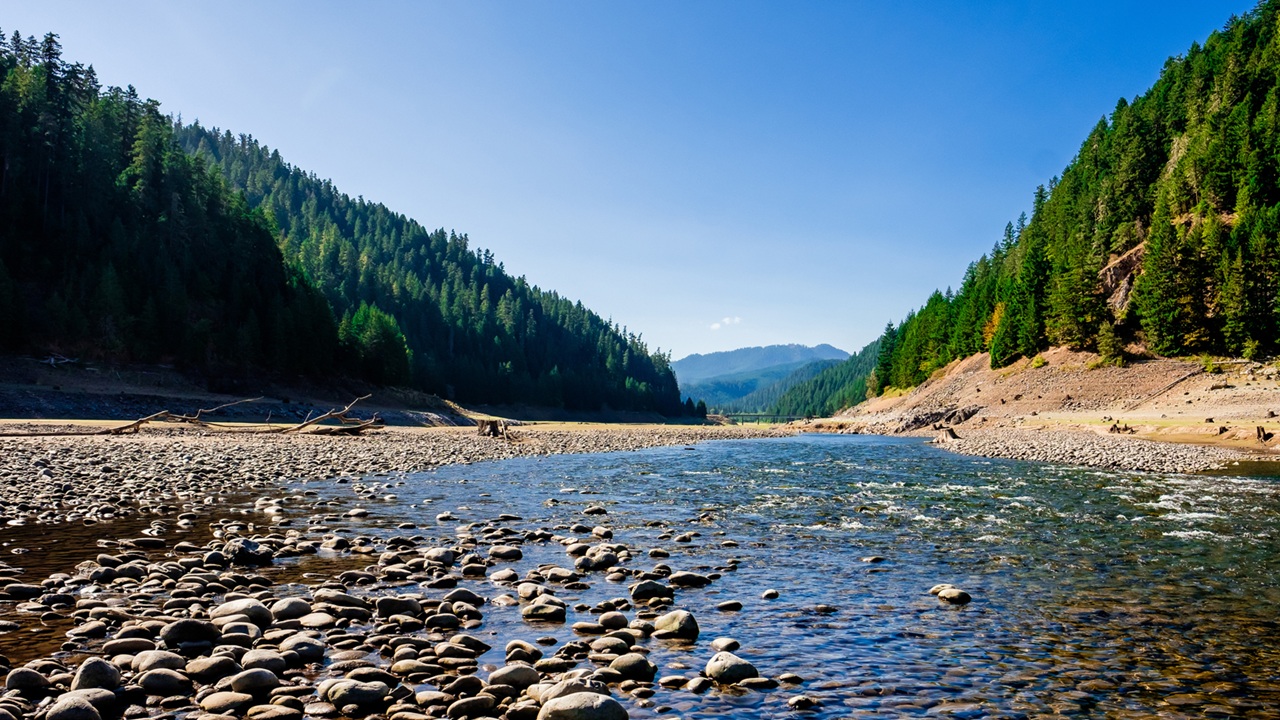
When Oregon lawmakers passed the Oregon Plan for Salmon and Watersheds in 1997, backed by a $30 million funding package, no one could guarantee how well it would work. Decades of overfishing, logging, and industrial activity had left the state’s rivers and streams polluted, water temperatures rising, and riparian areas (the banks of the rivers and streams) damaged. By the 1990s, the situation was so dire that the National Marine Fisheries Service listed Oregon Coho salmon as a threatened species.
Instead of imposing new top-down regulations, legislators tried something different: they empowered citizen groups, nonprofit organizations, private firms, and government agencies to work together to restore the state’s watersheds.
Legislation for Collaboration
Nearly three decades later, that bet appears to have paid off. In our new study in Public Administration Review, my colleagues, Yixin Liu and Tina Nabatchi, and I found that Oregon’s collaborative approach improved water quality by about 5% after the 1997 law took effect. Analyzing 42 years of Oregon water quality index data, we found that the law’s impact wasn’t just symbolic—it produced measurable improvements within six months.
Average water quality scores jumped from “poor” to “fair,” and those gains have largely remained stable until now. The lesson is clear: collaboration isn’t just a feel-good buzzword. When it’s embedded in law and backed by institutional design, it becomes a form of civic infrastructure, capable of delivering real environmental results across jurisdictions and over decades.
Before the law, Oregon’s restoration efforts were rather fragmented. Local conservation groups, landowners, nonprofits, and agencies often worked in isolation, with little coordination or support for collaboration from the state. The 1997 legislation changed that dynamic by creating watershed councils and authorizing a state grant agency—the Oregon Watershed Enhancement Board—to coordinate and fund collaborative projects.
To date, these institutions have supported more than 20,000 collaborative projects. Together, they give communities the structure, legitimacy, resources, and technical help needed to manage watersheds, which don’t fit into jurisdictional boundaries. Thus, we call this a watershed moment for collaboration. Even accounting for factors like land use and seasonal variations, the legislative framework itself stood out as the key turning point.
Lead Organization and Goal Management
But the legislation alone wasn’t enough. The study goes deeper, analyzing 8,853 collaborative projects completed between 1997 and 2020. We found that who leads a collaborative effort matters as much as the legal framework that enables it. Projects run by local governments and watershed councils were the most effective at improving water quality. In contrast, projects led by citizen groups or state agencies showed insignificant effects. Why? Local governments occupy a “sweet spot.” They have enough authority and technical capacity to coordinate across boundaries, yet remain close enough to residents to build trust and tailor solutions to local conditions. Watershed councils also performed well because they are designated 501(c)(3) nonprofit organizations and operate as long-term collaborative governance regimes, not temporary partnerships. This means watershed councils are designed to build, nurture, enact—and most importantly—sustain collaboration to improve watershed health.
Another lesson from Oregon’s experience is about goal overload. Environmental projects are rarely simple. A single initiative might aim to restore fish habitats, reduce erosion, improve water quality, and enhance education—all at once. But more isn’t always better. We found that citizen-led projects that juggle too many goals performed worse on average. Local governments managed goal diversity relatively better, but state agencies excelled at turning multiple goals into stronger water quality outcomes. While state governments may lack the local knowledge or close relationships with the community residents to address place-based goals, they may have stronger coordination capacity than other lead organizations.
Key Takeaways for Local Government Officials
Oregon’s story offers two pieces of practical guidance for turning collaboration into real progress.
Design matters.
Laws that merely provide funding or encourage partnerships are rarely sufficient. Oregon’s approach worked because it formalized collaboration through creating councils, assigning responsibilities, and funding the work. The improvements in water quality show that well-designed collaboration doesn’t have to be sluggish. With structure and accountability, even large-scale networks can produce results quickly and maintain those results over decades.
Leadership matters.
While grassroots efforts are valuable, government-led collaborations often have a better-developed capacity to deliver. Local governments often strike the best balance between technical expertise and community trust. They can bridge the gap between state directives and on-the-ground needs, something neither high-level bureaucracies nor citizen groups can do alone. State governments, meanwhile, are uniquely equipped to coordinate complex, multi-goal projects and transform them into impact.
Designing Effective Collaboration
The broader message extends beyond rivers and salmon. Whether the challenge is affordable housing, wildfire prevention, or infrastructure modernization, many public problems today demand the same kind of institutionalized cross-sector collaboration that Oregon built into law nearly three decades ago. When embedded in law, managed with intention, and informed by data, collaborative governance can offer a powerful alternative to the siloed and adversarial approaches that too often stall problem-solving. But collaboration is not a silver bullet, and not all collaboratives are created equal. The sweet spot lies between rigid top-down mandates and loose partnerships. Collaboration succeeds when it is designed with clear rules, adequate resources, and reliable brokers who can keep diverse actors aligned toward shared goals. Otherwise, it risks becoming a performative exercise that drains communities of resources—human, financial, and motivational.
Oregon’s watersheds still face challenges, but their recovery is proof that when institutions invite everyone to the table and give them the tools to act, progress is both possible and measurable. The Oregon plan stands as a model of governance design in an era when nearly every public problem crosses boundaries, whether geographic, organizational, sectoral, or political. Government can legislate collaboration—not by forcing it, but by building and sustaining the systems that make it work.
JIHO KIM is an assistant professor in the School of Public Affairs, Watts College of Public Service and Community Solutions, at Arizona State University. (jkim635@asu.edu)
Publish with ICMA!
We’re searching for interesting and insightful stories that can help others learn a memorable takeaway to serve their communities better.
