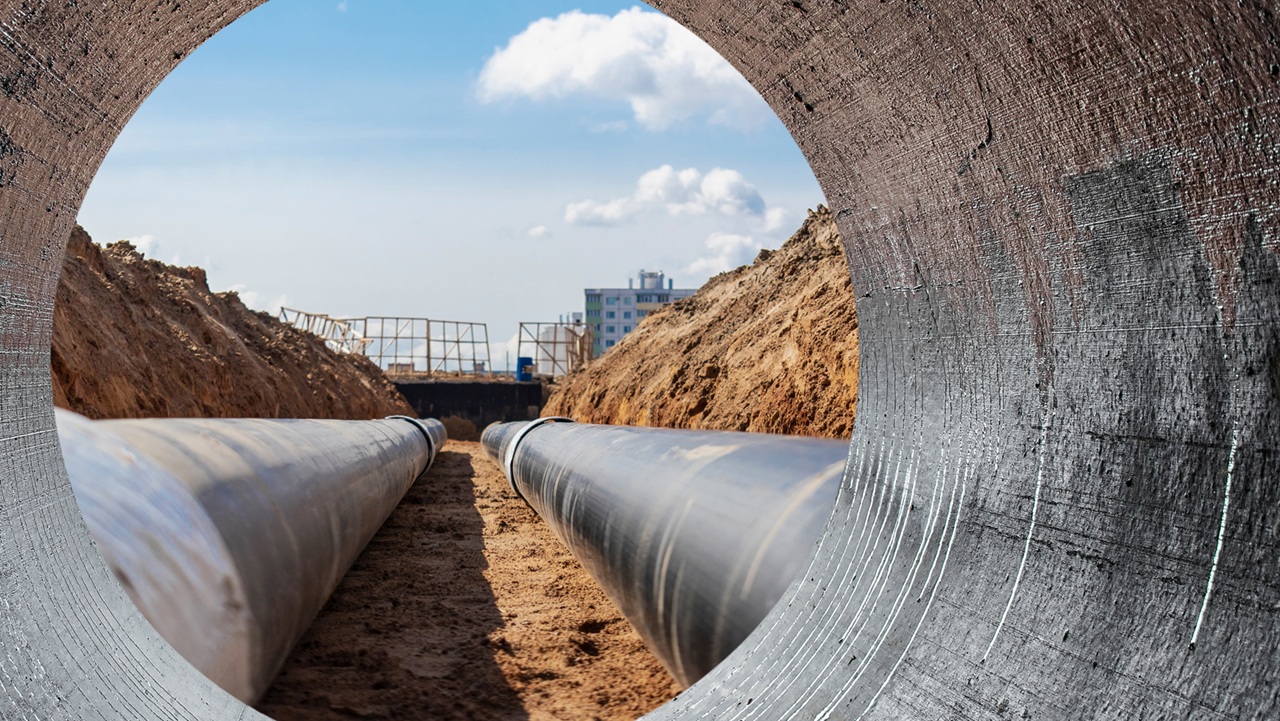
What do we mean by resilient ? Merriam‑Webster defines resilient as “(a) capable of withstanding shock without permanent deformation or rupture, and (b) tending to recover from or adjust easily to misfortune or change.”
In infrastructure policy, the American Society of Civil Engineers (ASCE) defines resilience as the ability to plan, prepare for, mitigate, and adapt to changing hazardous conditions to enable rapid recovery and return to functionality—accounting for interdependencies across sectors.
While resilience conversations often center on designing for extreme weather, our experiences as a former city manager and consulting engineers to public utilities in smaller communities in the southeastern United States suggest that the ability to maintain and modernize aging infrastructure is an equally urgent challenge that should be included in the resiliency discussion.
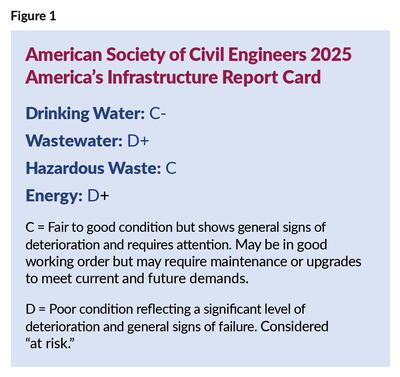
America’s infrastructure is improving—but only modestly—and key utility sectors commonly owned and operated by local governments continue to receive grades in the C and D range. In ASCE’s 2025 Report Card for America’s Infrastructure, drinking water remains at C-, wastewater at D+, energy at D+, and hazardous waste improved to C.
Across all 18 categories, ASCE estimates $9.1 trillion is needed between 2024 and 2033 to reach a state of good repair, with an anticipated funding gap of roughly $3.7 trillion even if current federal investment levels continue. In 2024, the National League of Cities City Fiscal Conditions Report noted that finance directors’ confidence in their city’s ability to meet budgetary needs has historically fluctuated with the availability of one-time federal support. As extraordinary levels of ARPA and other pandemic-era federal support are ending, 61% of respondents reported some level of concern in their city’s ability to meet budgetary needs: slightly (28%), somewhat (16%), moderately (10%), and extremely (7%).
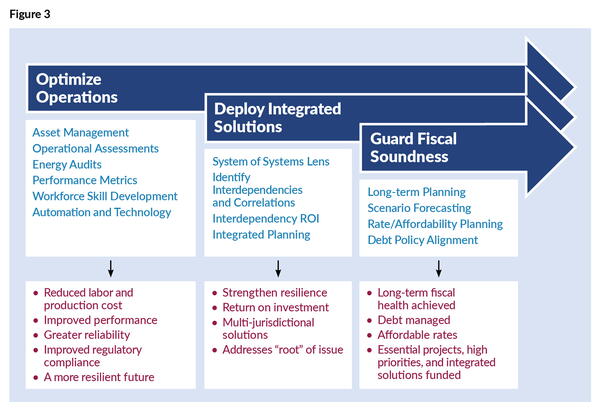
Against this backdrop, we propose a three-prong strategy that can be implemented at the local level to strengthen resilience in critical infrastructure: optimize operations, deploy integrated solutions, and guard fiscal soundness.
Optimize Operations
Optimizing operations means continuously improving efficiency, reliability, productivity, and cost effectiveness without compromising quality or safety. Practically, this involves an asset management program, clear operating standards, key performance indicators (KPIs), and routine review of workflows, staffing, procurement timelines, and operating expenses to identify where risk can be reduced, value increased, and resiliency enhanced.
Benchmarking operations against a mandated or desired set of standards and/or KPIs is the starting point. For drinking water and wastewater utilities, minimum benchmarks include permit compliance, renewal requirements, and adherence to state and federal rules. In Georgia, for example, the Water Stewardship Act framework requires many public water systems to complete annual water loss audits, implement a water loss control program, set individual water-supply efficiency goals, and demonstrate progress.
Utilities can also pursue higher levels of recognition and best practice alignment through professional programs. The Georgia Association of Water Professionals sponsors annual awards programs, including “water plant of the year” and “water reclamation facility of the year” that use published criteria to recognize operational excellence.
Internal benchmarks such as response time to work orders, emergency repair frequency, overtime hours, and energy usage can also be utilized to optimize operations while also aligning with broader community performance and sustainability goals. For example, according to the EPA, drinking water and wastewater treatment plants are frequently the largest energy consumers for municipal governments, often accounting for 30–40% of the total municipal energy demand.
EPA goes on to suggest that as much as 40% of the total operating costs of a drinking water system can be energy. Therefore, optimizing the treatment process can support broader community goals of reducing energy consumption and greenhouse emissions (created by energy production) while also optimizing operations in water and wastewater treatment plants.
Optimizing operations also provides opportunities for automation and implementing “smart” systems that yield multiple compounding benefits, such as incorporating AI to provide real-time data that can be utilized to constantly tune systems, inform preventive maintenance, and improve labor productivity. Other benefits of optimization include extending asset life, deferring capital replacement, stronger compliance performance, improved protection of public health and the environment, and increased system reliability and resilience.
Deploy Integrated Solutions
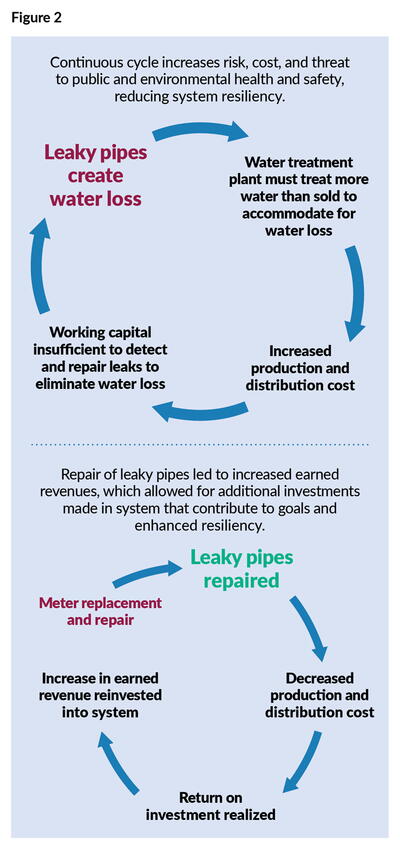
ASCE describes infrastructure as an interconnected “system of systems.” When one part underperforms, cascading impacts can appear elsewhere. However, these impacts may go unnoticed if parts of the system are managed or funded separately.
A clear example is non-revenue water (NRW). Bluefield Research reported in 2025 that nearly one in five gallons (19.5%) of treated drinking water in the United States is lost before reaching customers or is improperly billed, resulting in more than $6.4 billion in uncaptured revenue annually. Bluefield also estimates that about 87% of total water loss is driven by real losses such as leaks and pipe bursts.
When a community bills wastewater service based on metered water sales, NRW can “punish” a system twice: (1) production and treatment costs rise for water that never produces revenue, and (2) wastewater revenues decline when billed water volumes are understated.
Integrated solutions explicitly quantify these cross-system effects so projects can be evaluated based on lifecycle costs and avoided risks—not only on the narrow cost of a single repair.
No longer should we ask if we can afford to fix the leaky pipes or replace old, uncalibrated or non-working water meters. Rather, we should recognize the impact of leaky pipes or old water meters on increased costs and failures across the system (production, treatment, emergency repairs) and deploy an integrated solution that addresses the root of the issue.
Integrated solution planning can also accelerate supply solutions. In parts of Georgia facing rapid growth and emerging water scarcity, one client community is pursuing a “One Water” approach that coordinates water, wastewater, and reuse strategies across jurisdictions to optimize the entire water cycle operations, from making the drinking water and delivering it to their customers to collecting it and reclaiming it as drinking water for future generations.
Guard Fiscal Soundness
Resilience ultimately requires financial capacity. The Government Finance Officers Association recommends that governments prepare and maintain a long-term financial plan that projects revenues, expenses, financial position, and external factors at least five years into the future—and longer where debt financing and/or utility rate setting is involved. The plan should be reviewed annually and updated as assumptions change.
We recommend starting with a financial report card for each enterprise system (e.g., water and wastewater). At a minimum, this should track revenues, expenditures, net position (reserves), and core ratios such as the operating ratio, debt service coverage ratio, and capital condition indicators. From that baseline, scenario planning can test the impacts of required capital projects, integrated solutions (including expected returns on investment), debt capacity constraints, and rate/affordability targets.
The traditional playbook of repeated rate increases and incremental debt issuance is increasingly constrained by affordability concerns, political tolerance, and debt limits. The American Water Works Association’s 2025 State of the Water Industry survey underscores these pressures: financing for capital improvements is the sector’s top challenge and only 41% of utilities report feeling very or fully able to cover costs through rates and fees.
We see clients reach or exceed allowable debt limits before completing essential or mandated projects. For some, this has meant forgoing essential projects; for others, it has presented questions of how to achieve or maintain regulatory compliance. And for others still, loan dollars have stopped flowing mid-project, putting the client in jeopardy of contract violations and liabilities with no tolerable financial solutions in sight.
Guarding fiscal soundness through transparent metrics and scenario planning helps communities prioritize investments that reduce long-term operating costs, improve reliability, and maintain compliance while creating predictable implications for customers and governing bodies.
Practical Roles and Next Steps
Subject matter experts and technical staff can:
- Move from reactive projects to system-wide integrated solutions.
- Assess operations for optimization opportunities.
- Quantify return on investment and prioritize projects that improve service and reduce operations and maintenance cost.
- Implement best practices, technology, training, and succession planning.
- Connect the dots—tell the story of risks avoided and outcomes achieved.
Finance staff can:
- Prepare fiscal health indicators.
- Develop budget and debt scenarios that include both planned projects and cost uncertainty.
- Evaluate feasibility, affordability, and long-term impacts.
- Validate return on investment assumptions.
- Monitor trends and recommend revenue/expenditure alternatives.
Conclusion
Building resilient infrastructure for the next century requires shifting from reactive repairs to intentional operations optimization, integrated system-of-systems planning and solutions development, and long-term financial planning. With disciplined benchmarking and transparent scenario planning, local governments can strengthen resilience, protect public health and the environment, and improve fiscal sustainability of infrastructure even in challenging funding environments.
MANDI CODY, JD, AICP, ICMA-CM, is a former city manager and principal and senior consultant of Momentum Results, LLC.
MARTIN BOYD, PE, is president of Carter & Sloope, Inc. Consulting Engineers.
Publish with ICMA!
We’re searching for interesting and insightful stories that can help others learn a memorable takeaway to serve their communities better.
