When two communities face the same flood, the same heat emergency, the same aging infrastructure failure, what determines which one comes through intact?
It is rarely the quality of their climate plans. Across the country, local governments have invested in vulnerability assessments, hazard mitigation plans, and adaptation strategies. Many of those documents are technically sound. Most are also sitting in shared drives, unactioned, while the hazards they describe continue to compound.
What separates communities that implement resilience from those that plan it indefinitely is not the sophistication of the analysis. It is whether climate resilience has been woven into how the community actually governs, budgets, and serves residents. A plan on a shelf protects no one. Processes, capital decisions, and infrastructure standards that account for a changing climate do.
For managers leading small and mid-sized communities, where staff capacity is limited and the cost of deferred action is highest, understanding what resilient communities actually do differently is one of the most practical investments available. The good news is that community size is not the barrier. The path to the resilience advantage is open to any jurisdiction willing to take the first step.
The Gap Between Data and Action
Ask a city manager or county administrator what the real climate challenge is. The answer is rarely a lack of information. Risk data has never been more accessible. Federal mapping tools, state vulnerability assessments, and hazard mitigation plans have put more information in front of local leaders than ever before.
What has not kept pace is the capacity to act on it. Translating risk data into a specific, fundable project that can survive the next budget cycle is a different skill from assembling a comprehensive risk inventory, and most communities have not been given the support to develop it.
A Midwestern city has FEMA flood mapping, knows its stormwater culverts cannot handle the new rain patterns, and has a grant officer who has flagged three potential funding sources. But no one on staff has the time to connect those three threads into a competitive application. The data and the money are both within reach. The bridge between them is not.
A coastal county completes a thorough vulnerability assessment. Six months later, the report is in a shared drive that three people know how to find. Staff turns over. Institutional memory fades. The findings never become a project.
This is not a failure of local government. The resilience field has contributed to the problem by consistently delivering plans and frameworks rather than operational tools that managers can act on Monday morning.
The Alignment Challenge
Even when a manager knows what needs to be done, getting it done requires alignment across departments, elected officials, and the community. That alignment does not emerge from a well-written plan.
What works are locally grounded risk narratives that connect a specific hazard to a specific neighborhood, a specific cost, and a specific consequence. When a councilmember can see what is at stake in their district in concrete terms, the political conversation changes. Stalled decisions move. Budgets shift. The same technical information that sat unused in a report becomes the basis for action.
Three Questions That Unlock Action
Budget size and staff capacity matter less than commonly assumed. What matters most is whether a community can answer three questions with enough precision to act on the answers:
1. What is the single highest-priority risk in this community, defined at the neighborhood level rather than the jurisdiction level?
2. What specific action addresses that risk and produces the best combination of safety benefit, funding eligibility, and return on available capacity?
3. Who needs to be aligned for that action to move forward, and what does each stakeholder need to understand to get on board?
When a community can answer those questions with specificity, things move. Projects get scoped. Grant applications get written. Council votes happen. Communities that invest in broad planning without developing the capacity to translate findings into specific projects often find themselves at the same starting point two or three years later. Depth of analysis is valuable. Planning without prioritization is a starting point, not a strategy.
Five Principles That Define Resilient Communities
Climate resilience field practice has identified a consistent set of principles that separate communities advancing toward implementation from those that remain in perpetual planning. They are most consequential for small and mid-sized governments, where the cost of planning without acting is most immediate.
1. Clarity beats comprehensiveness.
A community does not need an exhaustive inventory of every vulnerable asset to start acting. What it needs is a clear picture of its highest-priority risks paired with locally grounded narratives that align people inside and outside of government around a shared course of action. The goal is not completeness. It is momentum.
2. Funding readiness is a resilience strategy.
Communities that maintain a pipeline of grant-eligible, well-documented projects consistently capture more federal and state funding than those that scramble to apply when a window opens. The disciplines required to build that pipeline, specific risk framing, project scoping, and community documentation are the same disciplines required for sound resilience planning. The Hazard Mitigation Grant Program, Community Development Block Grant Disaster Recovery Program (CDBG-DR), and state hazard mitigation programs reward communities that prepare before the announcement, not after.
3. Resilience must outlast elections.
Communities that have made durable progress are those that embedded resilience into capital planning cycles, procurement criteria, budget processes, and zoning standards. A standalone initiative has roughly a four-year lifespan. Institutional integration does not. Treating resilience as a standing function of governance, rather than a time-limited project, is what creates compounding progress across administrations.
4. Equity is a practical requirement.
The communities most exposed to climate impacts are almost always those with the fewest resources to respond. Strategies that do not account for who bears risk and who has access to recovery resources tend to widen those gaps over time. Strategies that center vulnerable populations consistently generate stronger, more durable community support for the investments that implementation requires.
5. Small communities need tools built for their scale.
A city of 8,000 faces genuine climate risks: flooding, heat seasons, agricultural supply chain disruptions. It cannot absorb a $300,000 consulting engagement to assess them. The standard toolkit of large-scale adaptation planning rarely fits the capacity of a small-town public works director or a part-time emergency manager. The communities that advance furthest access approaches sized to their actual situation. Emerging low-cost, software-based approaches are beginning to close this gap, delivering hazard data and prioritized actions without requiring dedicated GIS staff or six-figure contracts.
What Integration Looks Like
Resilience is not a cost center. It is a performance strategy. Communities that have embedded climate adaptation into everyday governance are outperforming those that have not in ways that show up in grant award rates, budget efficiency, and recovery timelines. Their projects are documented before funding windows open. They spend less on post-disaster costs. The institutional trust they build makes each subsequent decision easier.
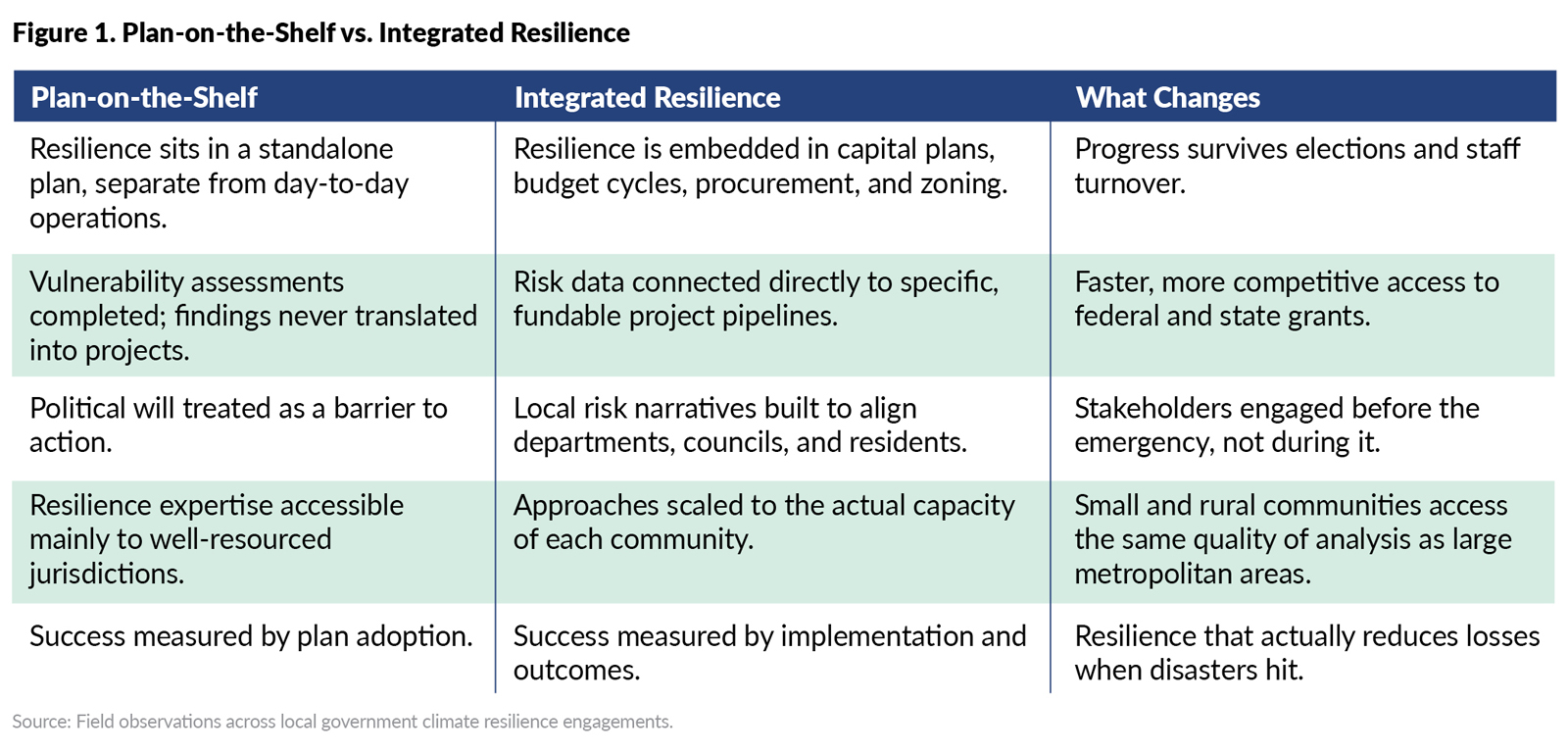
Figure 1 illustrates where the difference between reactive plan-on-the-shelf and integrated resilience is most pronounced across local government functions. Communities in the right column are not outliers. They are not consistently larger or better funded. What they share is a decision to treat resilience as something that belongs inside how government operates, not alongside it. That decision is available to any community, including small towns and rural areas that have been largely left out of the national resilience conversation.
The Small-Town Structural Advantage
The resilience advantage does not require a dedicated sustainability office or a large capital budget. Smaller communities hold structural advantages that large metros do not. They are less organizationally complex to align. Fewer departments, closer working relationships, and shorter distances between a manager’s decision and front-line implementation mean that a committed manager can move faster than a counterpart in a large city navigating layers of bureaucracy.
What small and rural communities need is not a scaled-down version of what large metropolitan areas do. They need approaches designed for their actual situation—ones that produce specific, fundable project scopes without requiring a prolonged process to generate them. Communities that start that work now, even on a single focused project, will be better positioned for every subsequent step.
Four Steps to Start
Every community sits somewhere on the spectrum between reactive plan-on-a-shelf and integrated. The goal is not to jump immediately to full institutionalization. It is to take the next step deliberately.
1. Name the single highest-priority risk.
Breadth can follow. What is needed first is one well-defined risk at the intersection of high exposure, community concern, and funding eligibility. That specificity is what turns a risk assessment into a project scope and a project scope into a competitive grant application.
2. Map the funding landscape before a window opens.
The Hazard Mitigation Grant Program, CDBG-DR, and state hazard mitigation programs operate on application cycles. Communities with scoped, documented projects ready to submit when a window opens are competitive regardless of size. Funding readiness is not separate from resilience planning. It is core to it.
3. Connect the capital plan to risk data.
Ask in the next capital planning discussion whether current and projected climate risk is a named criterion in how projects are prioritized. If not, that is the integration gap to close first. Two documents that already exist in every jurisdiction—a capital improvement plan and a hazard mitigation plan—simply need to be connected in practice.
4. Build the shared narrative before it is needed.
The communities that implement fastest share a common understanding of local climate risk across departments, officials, and residents. That understanding comes from conversations organized around specific, local, credible risk information, held before the emergency rather than during it.
Climate losses have risen from roughly $12 billion annually in 1980 to nearly $120 billion today, and the communities bearing the greatest losses are consistently those with the least capacity to absorb them. The window to build ahead of the next emergency is open. For local government managers, the question is not whether climate disruption will affect their community. It will. The question is whether the community is building its capacity now or after the fact.
JOYCE COFFEE, LEED AP, is the founder and president of Climate Resilience Consulting.
ROBERT MACNEE, PhD, is founder of the Resilience Intelligence Advantage.
Resources
- Fifth National Climate Assessment, Built Environment Chapter. U.S. Global Change Research Program, 2023. https://nca2023.globalchange.gov
- Climate and Land Use Planning: A Policy Guide for U.S. States and Territories. U.S. Climate Alliance and Smart Growth America, 2025. https://usclimatealliance.org/wp-content/uploads/2025/02/USCA_ClimateandLandUsePlanningPolicyGuide_20250211-LowRes.pdf
- Ready-to-Fund Resilience Toolkit. American Society of Adaptation Professionals. Available through http://asap-resilience.org
- Hazard Mitigation Grant Program. Federal Emergency Management Agency. http://fema.gov/grants/mitigation/hazard-mitigation
- Community Development Block Grant Disaster Recovery (CDBG-DR). U.S. Department of Housing and Urban Development. http://hud.gov/program_offices/disaster_recovery.
Publish with ICMA!
We’re searching for interesting and insightful stories that can help others learn a memorable takeaway to serve their communities better.
