There is a particular kind of pressure that comes with being an organization’s second-in-command. As the assistant chief administrative officer (ACAO), you are expected to know everything the CAO knows plus whatever the CAO forgot they knew, be ready to step in at a moment’s notice, and still somehow stay on top of projects, mentor staff, and “keep the trains running” with your assigned departments.
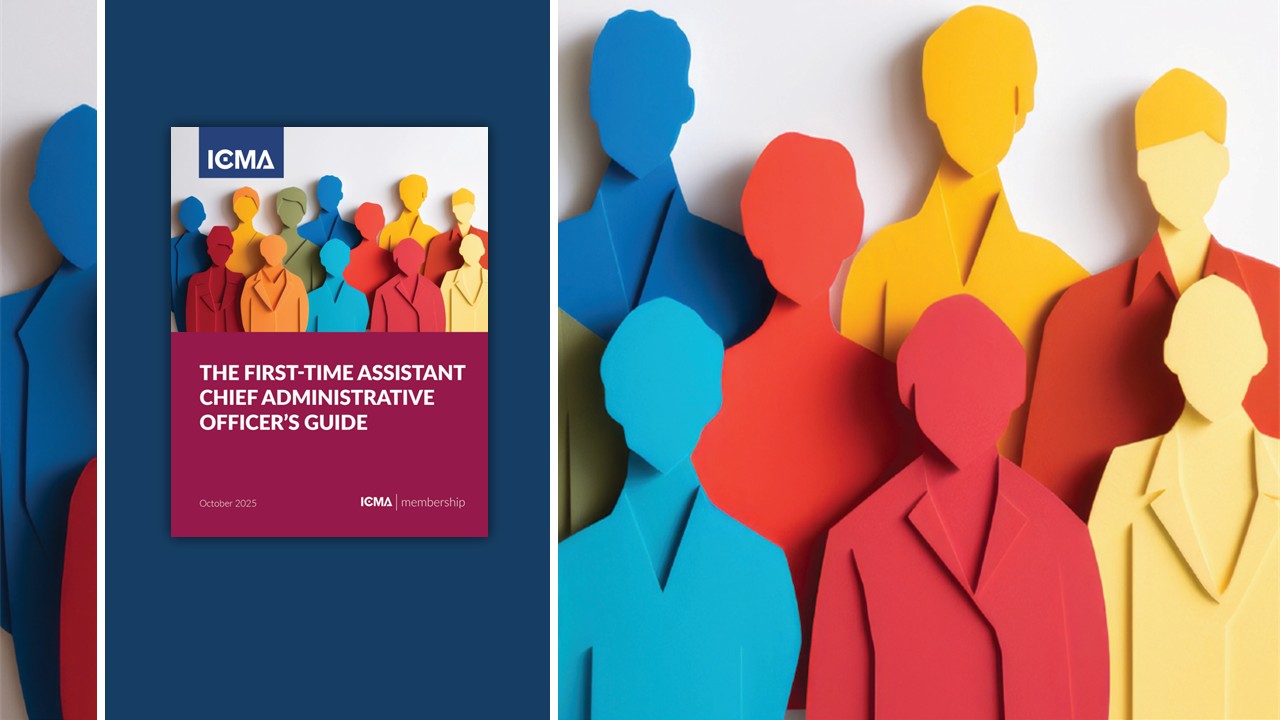
To help with this juggling act, ICMA’s ACAO Committee assembled a task force that produced the new First-Time Assistant Chief Administrative Officer’s Guide. It’s a manual designed for anyone stepping into—or even thinking about stepping into—their first ACAO role. It also serves as a refresher for those who have been in the seat a while.
Think of the guide as part tradecraft manual and part pep talk: it does not claim to make you all-knowing, but it does show you how to be reliable. The ACAO role occupies an unusual institutional crossroads of leadership, experience, and expectation where you’re expected to have some answers even as everyone else is still sorting out the issue. The authors tackle that reality by organizing its advice around practical information rather than lofty leadership slogans.
The guide is aimed squarely at recent MPA graduates, department heads, assistant-to roles, and managers coming in from other arenas such as nonprofits, the private sector, or the military. It doesn’t dance around the obvious: the transition into public administration is both technical and relational. You’re learning unfamiliar systems, regulations, and procedural guardrails at the same time you’re navigating new personalities, political dynamics, and the unwritten rules that keep an organization functioning.
What’s In the Guide (And Why It Matters)
ICMA invests in training, peer-to-peer exchange, knowledge-sharing, and lifelong learning for local government professionals. Whether you are a young manager just starting or a seasoned veteran, ICMA aims to offer tools, resources, and learning opportunities to help you stay effective.
At its core, the guide lays out three mission-critical areas for first-time ACAOs:
1. Relationship management with the CAO and elected officials.
The ACAO must be both a force multiplier for the CAO and a credible point of contact for councilmembers, department heads, and external partners. The guide breaks down how to establish scope, where to push and where to pull back, and how to present options, not problems, to the CAO.
2. Shifting from doer to director.
Many new ACAOs are promoted for technical competence and/or leadership skills. Delegation, coaching, and project oversight become important. We must become the traffic engineer who keeps the cars moving instead of seeing them in a traffic jam.
3. Operational fluency.
This is the nuts-and-bolts territory of managing a local government: budget calendars, capital planning touchpoints, labor relations fundamentals, interdepartmental coordination, and emergency operations roles. The guide does not aim to replace specialized training, but it maps where those specialties live inside the organization so a new ACAO can ask the right questions and avoid missteps.
Practical Takeaways You Can Use Immediately
The guide presents numerous takeaways for quick implementation. Here are things you can do tomorrow that move the needle:
• Create a 90-day transition plan and share it. Put your priorities in writing and run them by the CAO, key directors, and even your mentors. It creates alignment and reduces questions; it’s all about effective communication.
• Establish a delegation dashboard; track who is doing what. The dashboard will prevent chaos, ensure continuity, and helps you keep your hands out of the wrong cookie jars.
• Build a briefing template. Staff appreciate clear options and well-defined recommendations. A standard template for meetings keeps presentations tight and reduces follow-up work.
• Schedule regular one-on-ones with direct reports and the CAO. These are the conversations where friction is resolved before it becomes theater. This is also the time for two-way feedback.
• Know the ethics and rules that bind your organization. ICMA’s Code of Ethics is more than aspirational; it’s a governance tool. The guide encourages ACAOs to be proactive about ethics and transparency.
Who Will Find the Guide Most Useful
While it’s targeted at first-time ACAOs, the guide’s value extends further. Aspiring ACAOs considering the move will get a realistic preview of the job. Department heads being asked to act in an interim ACAO role will find quick orientation aid. CAOs will discover a checklist for onboarding and mentoring their new ACAO. In short, whether you are stepping in, stepping up, or supporting someone who is, the guide should shorten the learning curve and reduce avoidable mistakes.
No single handbook will cover every local government’s quirks, contracts, or political culture. This guide is deliberate because the goal was to give you a framework. It should point you toward subject matter experts and critical thinking.
A Closing Word
The bottom line: Being an ACAO can be the best job in local government and the most exhausting. You get to shape policy, mentor staff, and keep the organization flexible. However, you also inherit the organized chaos, the late-night texts and emails, and the expectations that you will always have the answer. ICMA’s First-Time ACAO Guide does not remove the stress; it reduces some of the guesswork to being a leader in local government. Always remember that you will still make mistakes, as any good leader will do, but the challenge is to make fewer of them and recover faster.
In 2026, the ACAO Committee will host a follow-up webinar that takes a deeper dive into the guidebook, breaking down key concepts, offering real-world applications, and addressing the questions that inevitably surface once the dust settles. Keep an eye out for more information—you don’t want to miss the next round of insight.
MARTY HUGHES is assistant city manager of Kennesaw, Georgia, USA.
Publish with ICMA!
We’re searching for interesting and insightful stories that can help others learn a memorable takeaway to serve their communities better.
