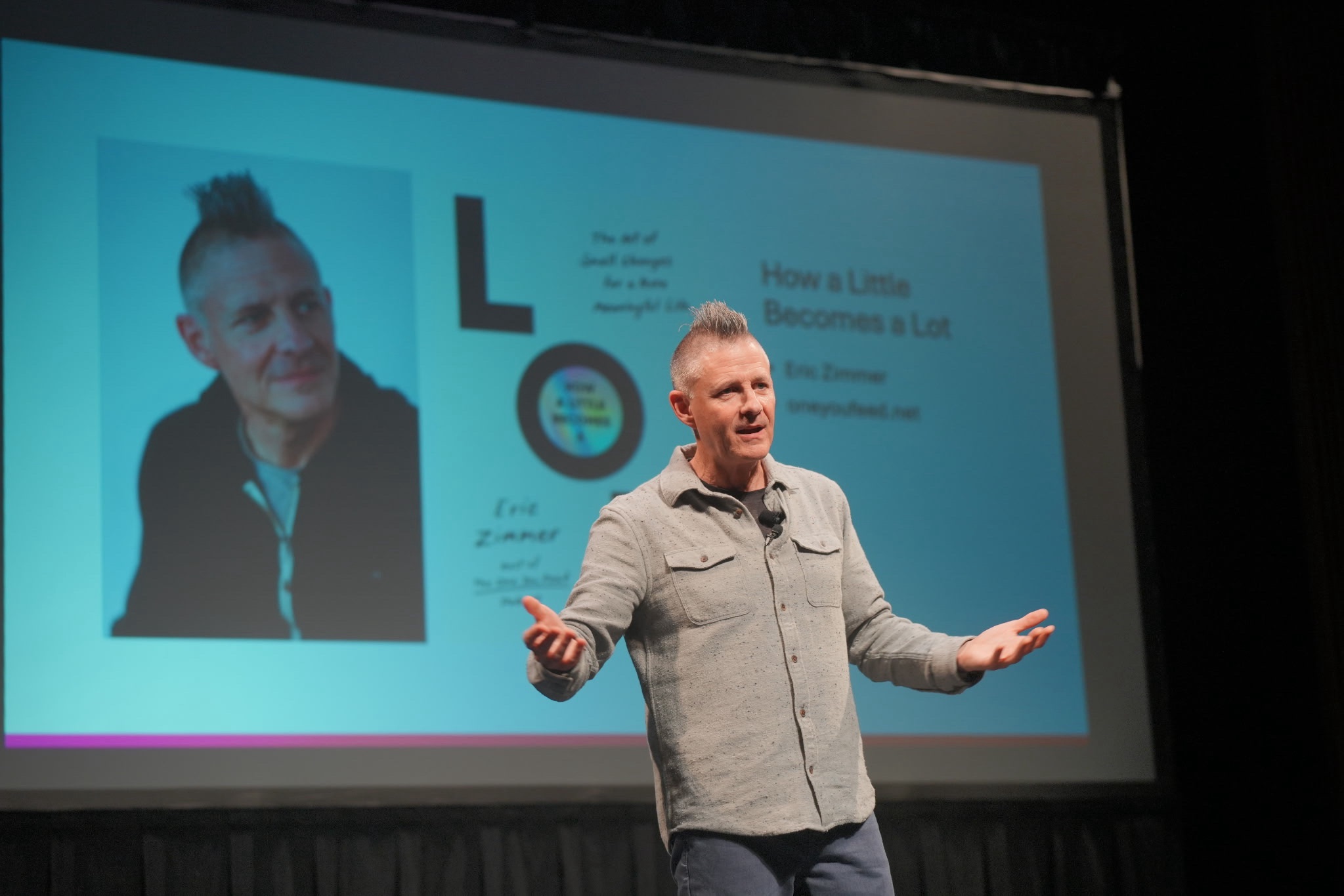
Local government professionals rarely have the luxury of a predictable day. Council meetings, budget deadlines, staffing challenges, emergencies, and constant public scrutiny can leave even the most experienced leaders feeling stretched thin. When the demands keep coming, how can leaders adapt without exhausting themselves in the process? According to Eric Zimmer, author of How a Little Becomes a Lot and host of The One You Feed podcast, the answer isn't to become a different person, it's to build the skills that make change more manageable — one small step at a time.
During his Game Changer session at the 2026 ICMA Annual Conference, "How a Little Becomes a Lot: Small Changes for a Job That Never Lets Up," Zimmer challenged local government professionals to rethink adaptability, recognize the mental habits that make difficult situations harder, and identify small changes they can put into practice immediately.
"Working with change is a skill, not a character trait. And skills can be learned, practiced and strengthened."
Stop Making Things Worse
Zimmer organized his approach to adaptability around two priorities: stop making things worse, then use the energy saved to make things better.
That first step is more important than it might sound. People spend considerable mental energy replaying past mistakes, worrying about the future, and criticizing themselves when circumstances don't go as planned. Those habits can easily turn an already difficult situation into an even more draining experience. The goal isn't to pretend challenges don't exist or to adopt an artificially positive outlook. Instead, leaders can learn to recognize when their own thoughts and reactions are adding unnecessary weight to a situation.
Zimmer illustrated this with an example from his own life. After losing a job early in his career, he spiraled into fears that he would never find comparable work, couldn't support his family, and would lose everything he had built. The facts were straightforward: He had lost his job and needed to find another one. The rest was a series of increasingly catastrophic predictions.
"The challenge for us is to learn to separate the facts from the story [we tell ourselves]."
For local government leaders, the same distinction can be useful when a council member criticizes a staff recommendation, or an unexpected organizational change creates uncertainty. A tense interaction doesn't automatically mean the council has lost confidence in the manager. A difficult meeting doesn't necessarily signal a larger crisis. Separating what is known from what is assumed creates room to respond thoughtfully rather than react to the worst-case scenario.
Challenge Your Assumptions with Three Questions
Zimmer offered a simple framework for examining the stories people tell themselves when faced with uncertainty:
- What am I making this mean? Identify the interpretation you’re adding to the facts.
- What else could it mean? Consider other explanations and possibilities.
- Which of those meanings is most useful? Choose the interpretation most likely to help you move forward.
The point isn't to convince yourself that everything will work out or to dismiss legitimate concerns. It's to recognize that an initial (oftentimes negative) interpretation isn't necessarily the only one available.
Zimmer demonstrated how this might apply when a council member says staff handled an issue poorly. A manager's immediate reaction might be to assume that the entire council is dissatisfied or that their job is at risk. But there are other possibilities: The council member may be responding to constituent concerns, may lack important context, or may disagree with the policy rather than the staff's work.
The most useful interpretations are those that "keep possibility open longer" instead of prematurely closing off potential courses of action. For local government leaders, this approach can help preserve perspective during difficult conversations, create space for constructive problem-solving, and prevent uncertainty from consuming energy better spent addressing the issue at hand.
Accuracy > Extreme Language
Another source of unnecessary stress is the language people use to describe their experiences. Words such as always, never, terrible, and everyone can amplify frustration and make a situation feel more overwhelming than the facts warrant. Zimmer emphasized that the solution isn't simply to replace negative thinking with positive thinking. It's to describe situations more accurately.
Consider the difference between telling yourself that nobody in your community understands or appreciates your department, and instead acknowledge that many people may not fully understand its work, while others do. The second statement doesn't erase the frustration, but it leaves room for a more balanced perspective. For local government leaders whose work often involves navigating competing priorities and public criticism, this small shift can help prevent isolated frustrations from becoming sweeping conclusions about their teams, their communities, or themselves.
Make Decisions Before the Moment Arrives
Even when people know what they want to change, following through can be difficult. Zimmer noted that adaptability is especially challenging for those who have either too much to do or too little structure to guide their time.
He shared an example from his own workday: A meeting ends, he checks his email, gets distracted, looks at his to-do list, and postpones a demanding assignment because he doesn't feel ready to tackle it. Before long, another meeting begins, and the opportunity to make progress disappears. The underlying problem, he explained, is trying to decide what to do and do it at the same time.
"Deciding is challenging. Doing is challenging. Doing both at the same time often doesn't work well.”
His recommendation is to separate the decision from the action. Rather than waiting for an open block of time and then deciding how to use it, identify the next priority in advance. When an unexpected 15-minute window appears, you'll already know where to direct your attention. This is particularly relevant to local government leaders, whose schedules can change with a single phone call, constituent concern, or infrastructure emergency.
Zimmer also encouraged attendees to look closely at the items that remain on their to-do lists week after week. Often, these aren't individual tasks, but larger projects disguised as single steps. Instead of writing "finish presentation," for example, identify the next concrete action: outline the key points, draft the opening, or prepare the first slide.
"Ambiguity is the enemy when it comes to getting things done.”
Breaking work into smaller steps makes it easier to begin, even when time and energy are limited. Scheduling those steps also creates a clearer commitment and a moment when a decision must be made.
Navigate the Choice Point
Knowing what to do doesn't always mean doing it. Zimmer described the moment when someone either follows through on an intention or doesn't as a "choice point." Two common obstacles at these moments are short-sightedness and self-doubt.
Short-sightedness occurs when the immediate appeal of something outweighs a longer-term goal. To counter it, Zimmer recommended asking: "Am I about to trade what I want most for what I want now?" Another technique is to "play the movie all the way through." Rather than focusing only on the immediate reward or relief, consider what happens next and how that decision affects your broader priorities.
Self-doubt, meanwhile, can make even clearly defined tasks feel impossible. Zimmer shared how he struggled with confidence while writing his book, questioning whether he was capable of producing something worthwhile. Instead of trying to eliminate those doubts through forced affirmations, he challenged their certainty. Did he really know he couldn't write a good book? Could he improve with practice? Could an editor help him strengthen his work? That shift was enough to get him started.
"[You] don't have to banish self-doubt, what [you] need to do is turn it down just enough so that in that moment [you] can get over the starting line."
For leaders facing difficult decisions or daunting projects, the lesson is straightforward: Confidence doesn't have to come first. Sometimes, taking the next small step is what makes progress possible.
Small Steps, Big Impact
Zimmer’s message was simple: meaningful change doesn’t require a complete transformation. It begins with small, intentional shifts in how we think, make decisions, and respond to challenges. By learning to recognize unhelpful patterns and move through moments of self-doubt, leaders can stop wasting energy making difficult situations harder and redirect it towards what matters most.
For local government leaders, the challenges will keep coming. Adaptability isn’t about having all the answers or handling every situation perfectly; it’s about learning to respond more skillfully when the next challenge arrives. As Zimmer’s session reinforced, small changes may not make the work easier overnight, but over time, they can change how we meet it and what we’re able to accomplish because of it.

Follow along with ICMAtv to see more from the 2026 ICMA Annual Conference!
Publish with ICMA!
We’re searching for interesting and insightful stories that can help others learn a memorable takeaway to serve their communities better.
