Rapid technological change. Communities in transition. A public weary of conflict and uncertain about the future.
These pressures feel distinctly current. But understanding how earlier generations faced them can help today's local government leaders see a way forward and recognize the impact of their own work.
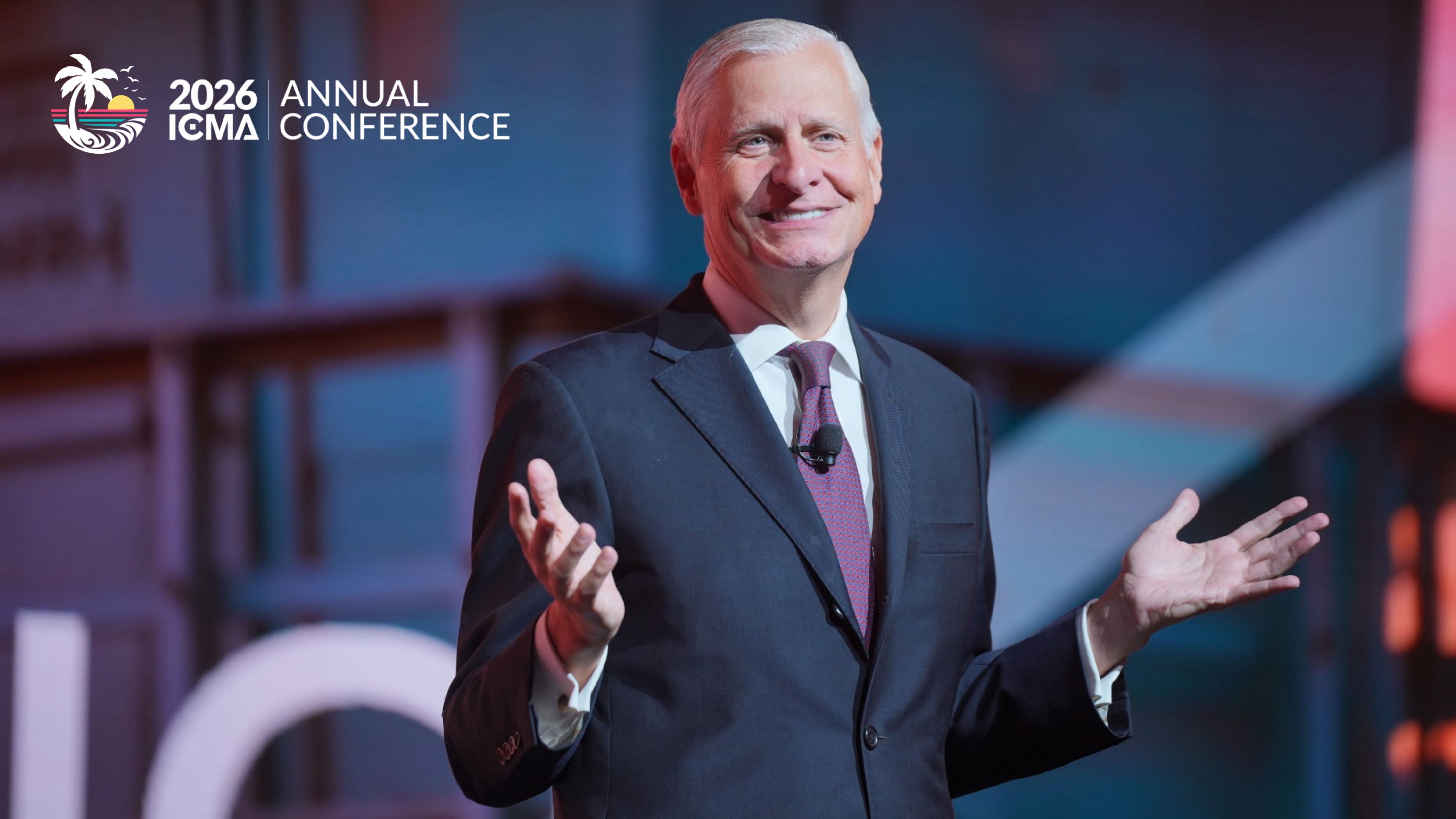
Presidential historian Jon Meacham brought that message to the 2026 ICMA Annual Conference in Long Beach, California, in his keynote, “Hope Through History: How to Survive Turbulent Times.”
A Pulitzer Prize–winning author whose books explore Abraham Lincoln, George H.W. Bush, John Lewis, and other influential American leaders, Meacham offered a historical perspective on challenges still all too familiar to city and county managers today.
Central to his message, Meacham asserts that hope grows when people see that democratic institutions can improve their daily lives. “If we want hope to prevail over fear, we have to show that hope works,” he said.
A Familiar Pattern of Change
Local government leaders are navigating uncertain times. To find an effective path forward, Meacham invites us to consider America a century ago.
The country had just experienced the Spanish Flu pandemic. People moved from farms to cities, reshaping communities and relationships. Radio was transforming how people got information, connecting them to a wider, more disruptive world.
Meacham described how those changes led to fear, exclusion, and distrust. The Great Depression put the country’s institutions to an even deeper test.
Today’s leaders face similar tests after a recent global pandemic, historic lows in public trust, evolving technology, and economic uncertainties.
For local government leaders, the connection is practical: Knowing the history can help them understand the purpose behind their daily work and inform future decisions.
“Within the system [of constitutional democracy], we have to do what we can,” Meacham explained. “[We must] understand why that system took root, why it endured, and why it’s worth defending.”
Progress Does Not Require Perfect Agreement
Americans have always disagreed. But Meacham’s historical lessons show us that disagreements are OK. He says progress doesn't depend on uniformity, but on treating one another as neighbors, even when we are opponents.
“If we can’t see each other as neighbors, it doesn’t work,” he said.
For local government leaders, that means keeping conversations open. Residents who oppose a decision today can still help solve a community problem tomorrow. Elected officials on opposite ends of a political issue can still work together for the greater good of the community.
Three Habits for the Work Ahead
Preparing for the year ahead, Meacham suggests three habits to help leaders navigate uncertainty:
1. Stay curious. Keep learning, question assumptions, and look for ways to improve.
2. Speak honestly. Drawing on Roosevelt and Winston Churchill, Meacham explained that people can face hardship when they trust their leaders to tell the truth. Explain the challenges and what you’re doing to address them.
3. Practice empathy. Treat people as neighbors, even when you disagree. Respect keeps people working together. “I’m not just asking us to be empathetic because it’s the right thing to do — it is. I’m asking us to be empathetic because it’s the practical thing to do,” Meacham said.
“You are the front line of making this experiment work,” Meacham reminded attendees.
History shows that progress takes work. And when local leaders show what we can accomplish together, they give their communities reasons for hope.

Follow along with ICMAtv to see more from the 2026 ICMA Annual Conference!
Publish with ICMA!
We’re searching for interesting and insightful stories that can help others learn a memorable takeaway to serve their communities better.
