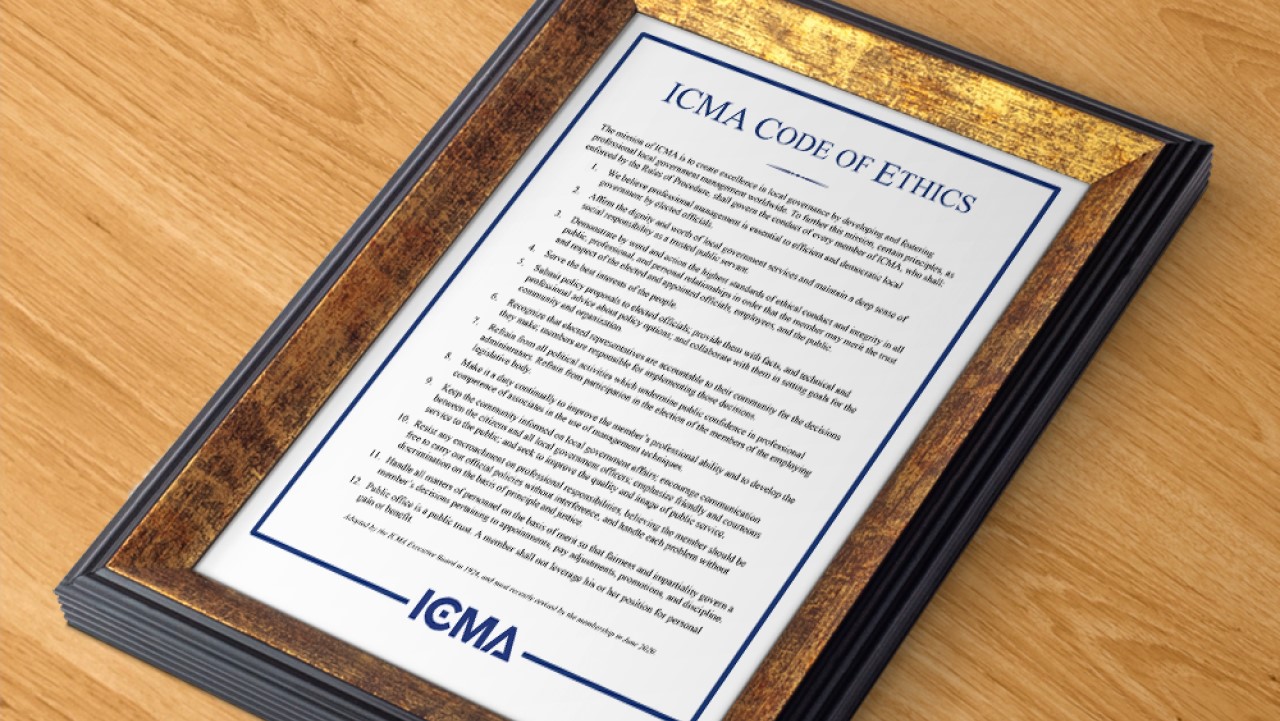
Since 1924, our membership has stood on the foundation of ICMA’s Code of Ethics. Publicly affirming a commitment to those principles requires a combination of education and training on ethical decision-making, as well as holding peers accountable to the Code’s high standards when needed.
The ICMA Executive Board’s Committee on Professional Conduct (CPC) is acutely aware that ethics complaints have become a weapon in the arsenal of an increasingly polarized society. The CPC reviews all ethics complaints submitted to ICMA (between 50 and 70 each year) that allege a member’s conduct has violated the Code. The Rules of Procedure for Enforcement of the Code of Ethics (Rules) govern the ethics review process.
It was against the backdrop of caring for our members’ well-being in an environment of incivility and polarization that the CPC explored revisions to the Rules and ultimately updated the Rules of Procedure for Enforcement in 2026.
2025–2026 Review
The CPC conducted comparative research to assess how other organizations handled who is eligible to file an ethics complaint and details about their review process before analyzing complaints filed in the past five years. Data showed that when individuals outside the local government profession filed ethics complaints, the overwhelming majority resulted in findings that the members’ conduct did not violate the Code.
Since ICMA’s ethics review process is concerned about member conduct that undermines the profession’s integrity and damages public trust, this data on the outcome of ethics reviews demonstrated the vulnerability our members experience by committing to uphold our Code of Ethics. The CPC’s review confirmed that ICMA needed to protect our members from spurious complaints.
Based on these findings, ICMA offered dedicated opportunities for member input as the CPC began revising the Rules language that was adopted by the ICMA Executive Board during its May 2026 meeting. The following is a summary of those changes:
1. Narrows who is eligible to file an ethics complaint with ICMA to these three groups:
- Current ICMA members.
- Current state/country association members.
- An individual who is not a member of ICMA and possesses the necessary first-hand knowledge of the alleged conduct, such as an employee of the member or a representative of the member’s governing body.
2. This process allows a nonmember “whistleblower” the eligibility to file a complaint only if they are aware of the conduct themselves. Individuals without the eligibility to file an ICMA complaint may choose to pursue other avenues such as their state ethics commission process.
3. Added language that ICMA will not tolerate harassing behavior or retaliation of any individual connected with the ethics review process. ICMA may engage law enforcement, the legal process, or reject a complaint when warranted.
4. Reviews are limited to conduct within five years of ICMA receiving the ethics complaint unless the member concealed the conduct.
5. Members can request reconsideration and appeals/hearings regardless of whether they retain membership during an ethics review. (In prior versions of the Rules, members waived their rights if they resigned their ICMA membership.)
6. A complaint about a member’s conduct remains strictly confidential unless the ICMA Executive Board determines public censure is the appropriate sanction. The revised confidentiality provisions clarify that:
- ICMA may choose not to process a complaint if confidentiality cannot be maintained for the benefit of the member.
- When a review results in no ethics violation, the CPC may determine whether notification of appropriate parties is warranted when confidentiality cannot be assured or when notification is not in ICMA’s best interest.
Additional Highlights
- A complaint must be electronically filed, signed, and include the submitter’s contact information for ICMA to contact the submitter with clarifying questions. Submitters can still choose to be named as a complainant or remain anonymous to the member whose conduct is alleged to have violated the Code.
- Clarified the limited circumstances when a state association fact-finding committee is required to gather the facts for an ethics complaint.
- Provided overall edits and updated language.
The Importance of Being Proactive
Members are sometimes put in difficult situations that may lead to the media incorrectly or inaccurately reporting on a potential ethics concern. Before it gets to that point, remember that ICMA provides free, confidential ethics advice to any member who may need guidance about a dilemma or may be uncertain of their obligations.
ICMA ethics staff is here to serve as a neutral third party and advisor. Reach out to ethics director Jessica Cowles at jcowles@icma.org if you want to explore an issue.

JESSICA COWLES is ethics director at ICMA (jcowles@icma.org).
Publish with ICMA!
We’re searching for interesting and insightful stories that can help others learn a memorable takeaway to serve their communities better.
