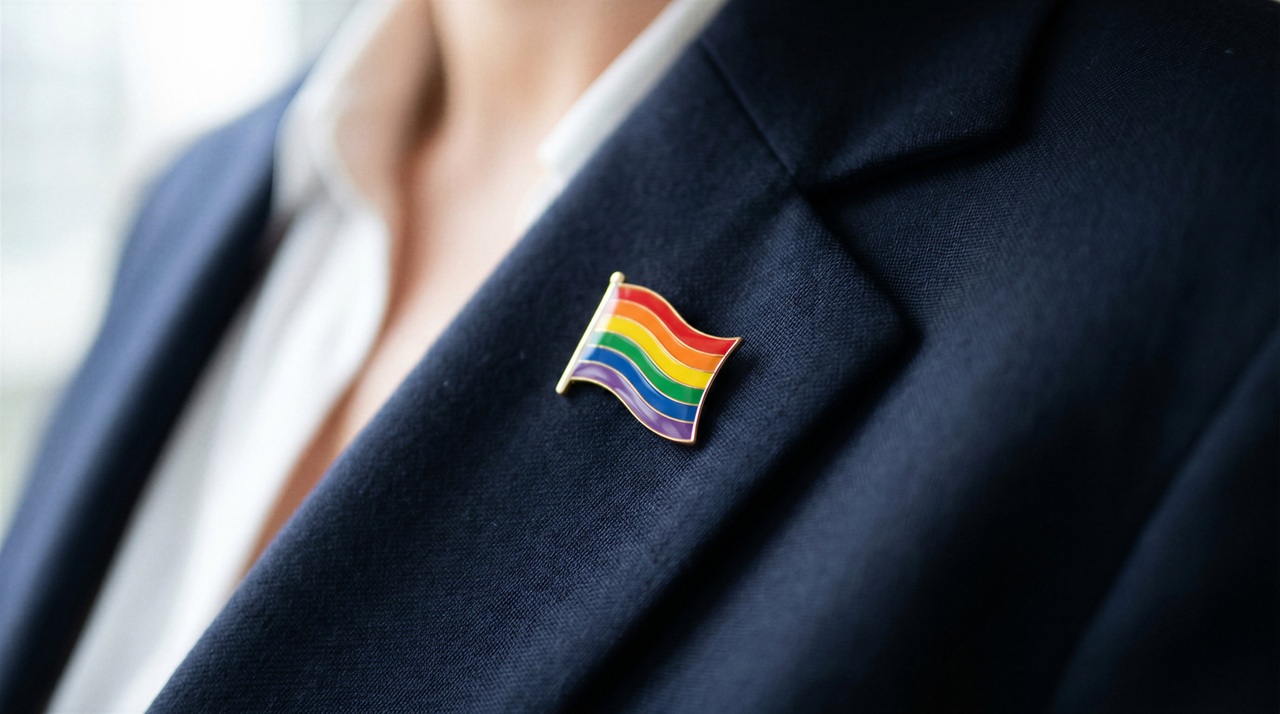
Knock, knock. Not at your office door, not on your car window at the grocery store, and certainly not at city hall. It’s coming from inside the closet.
In honor of National Coming Out Day on October 11, we share thoughts from recently-out Erica Rindfleisch, ICMA-CM, village administrator of Pleasant Prairie, Wisconsin, and explore how the act and significance of “coming out” has evolved over time.
There’s a Knock on the Closet Door.
“Everything I hold dear about my calling to be in public service has just become unimportant. My desire to serve the residents of the communities in which I am employed as public manager, my record of success, the experiences I have gained, all are not newsworthy to this blogger. But a legal proceeding to change my name and gender is a juicy bit of news. Because I am no longer a village administrator; I am now a trans village administrator…” —Erica Rindfleisch
Until the early Twentieth Century, “coming out” originally referred to an introduction for young women through debutante balls. The LGBTQ+ community later adopted “coming out” to describe entering the thriving but covert queer community of the time—a bid for connection veiled in secrecy. The Stonewall Riots of 1969 and following marked a time where “coming out” could be seen as a political tool before it evolved into the public disclosure we recognize today.
Coming out extends beyond LGBTQ+ identities and applies to the act of revealing any non-apparent identities/experiences, including disability, recovery from addiction, neurodivergence, being multiracial or racially ambiguous, and many more. Still, “coming out of the closet” is most commonly understood as a distinctly queer expression.
It Should Be a Choice
“And ultimately, [the blogger] wants to know, When did I decide to be trans? The answer to that is, of course, that I never decided to be trans. I have always been trans. More importantly, this means that I have always been a trans public manager, too… The decision to be openly trans also wasn’t really a decision, for who would decide to continue to live unhappy and filled with fear and anxiety like I was when I could be free of all that?” —Erica Rindfleisch
For many LGBTQ+ people working in public administration, the choice to come out has become more complicated. In an environment where simply being visibly queer or trans can be interpreted as partisan or political, disclosure can carry professional consequences—or at least, the reasonable fear of them.
On the other hand, being forcibly outed, whether publicly or within private circles, can be considered an act of violence as it can significantly increase the physical threat to the individual. The choice to come out, then, is based on the needs and readiness of the person sharing, involving questions like: Should I tell people? Who needs to know? Will this change how they see me? Is it safe? Will I lose opportunities? Will I feel more authentic afterward?
Public servants do not stop being queer because they work in a local government. They do not start being queer once they come out. It is an intangible part of one’s identity that has nothing to do with their qualifications, accomplishments, or abilities.
It’s inspiring to read about an openly trans person in local government leadership. It’s also very rare. For some employees, coming out is followed by newly documented “performance issues,” “negative customer feedback,” concerns about “professionalism,” or other ostensibly neutral critiques that can make bias difficult to name. Whether experienced directly or witnessed happening to others, these patterns change the calculus of disclosure. They do not eliminate the choice to come out, but they can make that choice significantly more costly, pushing some people back toward the closet and giving others, particularly those just entering the profession, good reason to question whether coming out at work is worth the risk at all.
Not Every Message Is Public
Every organization has a communications strategy, and coming out is like a press release. It’s a community announcement; considered newsworthy; it can be taken in ways that are good, bad, and unexpected; and it’s absolutely optional. Leaders decide what to communicate, when to communicate it, who needs to know, and why. Not every update requires a social media post, and not every audience needs the same information.
Amid unsupportive leadership cycles, evolving social pressures, and real threats to funding, organizations can be surprisingly queer in how they go in and out of the closet, sometimes leading loudly with their values and other times choosing a quieter operational stance. Right or wrong, visibility is often a strategic decision.
Coming out is similar. It’s a personal communication decision, not a public obligation. Every LGBTQ+ person should have the autonomy to decide if, when, how, and with whom they share that part of themselves. Some choose to be widely open. Others share only with people who need to know. All options are valid. The role of leaders isn’t to encourage people to come out; it’s to cultivate a workplace that allows for employees to make that choice, knowing they will be respected either way.
The Disappearance of Coming Out
The act of coming out is not a requirement to exist within the queer community and not coming out isn’t considered hiding. Within the queer community there are a wide range of reasons for not coming out, and a common thread of why is a desire to normalize privacy and the right to exist. If accepting people’s desire for privacy was normalized, people could be as open or closed as they wanted without major personal cost. If diversity in identity and orientation wasn’t seen as a political statement, we wouldn’t need to make big announcements about it.
Peering into a crystal ball, there may be fewer “big reveal” moments due to the way micro-disclosures are becoming embedded into our social systems: normalizing sharing our pronouns, workplace cultures where people can feel comfortable sharing about a weekend with a loved one, as well as a shift away from using labels altogether. We’re seeing this perspective growing particularly for younger generations. Ironically, this is the future many hope for—coming out disappears because disclosure loses its significance. The information would be situationally relevant but certainly not newsworthy, akin to sharing your dietary restrictions—important for a staff lunch, but not a provocative revelation.
Leaders Don’t Manage Identities, They Manage Environments
• How can I support a transitioning employee who’s not out to the rest of our team?
• Should we start normalizing pronouns even if no one in the office identifies as LGBTQ+?
• Some of my staff are consistently misgendering another person on my team, and I know it’s on purpose. The person in question doesn’t want me to address it. What should I do?
• Is “coming out” still a thing these days?
These are examples of questions we get from our CivicPRIDE members and other partners. An employee should not have to come out to access basic respect, nor should disclosure become the price of correcting inappropriate behavior. Workplace expectations around respect, professionalism, harassment, names, pronouns, and privacy can exist before any individual employee asks for them. For leaders, that means shifting the question from “What should this employee do?” to “What conditions have we created for them to make that decision?”
It also means recognizing the difference between supporting someone and speaking for them. A manager can ask an employee what support would be useful, protect information shared in confidence, establish expectations for respectful conduct, and address behavior that violates workplace standards without turning an employee’s identity into the subject of a staff meeting.
Conclusion
Hey Siri, play “I’ll Believe in Anything,” by Wolf Parade. What started as coded language for entering queer society evolved into a public rite of passage, a marker of self-acceptance, a form of resistance, and a path to solidarity. Coming out can still be all of those things. For some, it will remain an important milestone. For others, it will be a series of small disclosures made over a lifetime. For others still, it may hold little meaning at all.
Ideally, coming out will continue to lose some of its significance. Not because LGBTQ+ identities become less important, but because revealing it becomes less consequential. Erica Rindfleisch was a trans public manager before anyone wrote about her being one. She was trans when she entered public service, earned her degree, built her record, and served her community. Coming out did not change any of those things. It simply changed who had access to that information.
We do not need to usher employees out of closets, celebrate those who leave more than those who stay, or decide how much of themselves people owe their workplace. We can make sure the door belongs to them. There may always be a knock at the closet door. Our job as leaders is to build workplaces where employees aren’t afraid to decide whether they want to answer it.
CivicPRIDE is a nonprofit organization dedicated to promoting diversity and inclusion by providing a supportive networking space for LGBTQIA+ local government professionals and their allies. The organization empowers individuals to pursue leadership roles while educating agencies on creating inclusive cultures for all employees. Through advocacy and collaboration, CivicPRIDE aims to ensure queer professionals feel safe, accepted, and represented throughout the public sector. Learn more at civic-pride.org.
TAYLOR REIMANN (she/her) is the president of CivicPRIDE and circular economy senior program manager in Boulder, Colorado.
FREDI HAYES (she/they) is a CivicPRIDE board member and an ICMA MIT currently working in Vermont in regional economic development.
Publish with ICMA!
We’re searching for interesting and insightful stories that can help others learn a memorable takeaway to serve their communities better.
