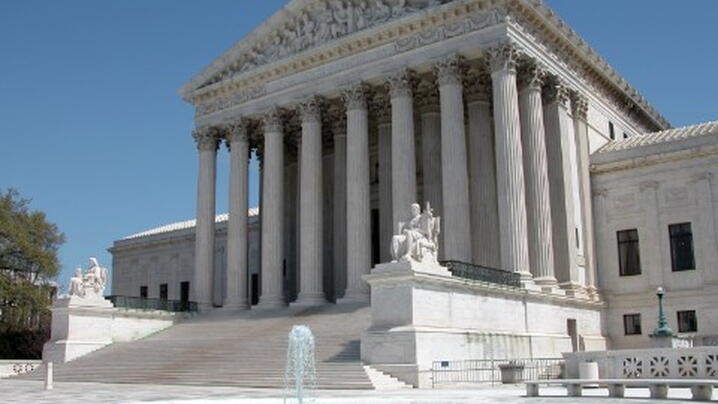
Co-authored by Amanda Karras, the executive director and general counsel for the International Municipal Lawyers Association (IMLA) and Erich Eiselt, IMLA's deputy general counsel and director of legal advocacy.
The National League of Cities, IMLA, and the National Association of Counties formed the Local Government Legal Center (LGLC) in 2023, a coalition of national local government organizations to provide education to local governments regarding the Supreme Court. ICMA joined the LGLC in 2024 as an associate member.
Members of ICMA's Governmental Affairs and Policy Committee's legal subcommittee review pending Supreme Court cases and make recommendations on which ones are appropriate for ICMA to join as an amicus, consistent with ICMA's Federal Policy Priorities.
Through its legal advocacy process, the LGLC filed amicus briefs this Term presenting arguments important to local government operations, budgets, and public safety responsibilities. Below are summaries of the the four decisions this Term in which ICMA joined the LGLC's amicus efforts: Pung v. Isabella County, Case v. Montana, Olivier v. City of Brandon, and Chatrie v. United States.
Key Takeaways
- Local governments got some good news in Pung v. Isabella County: the Court ruled that when a city or county forecloses on a home over unpaid taxes and sells it at auction, it only has to hand back what's left over after the tax debt—not the home's full market value.
- In Case v. Montana, the Court said police responding to a welfare check or emergency just need an objectively reasonable basis to believe someone's in danger before entering a home—they don't need the higher level of certainty required for a criminal investigation. That's the outcome local governments wanted.
- In Olivier v. City of Brandon, the Court sided against local governments on the main question, ruling that someone convicted of violating a local ordinance can still sue to block that ordinance going forward. The good news: the Court dodged a second, riskier question that could have opened the door to a lot more lawsuits against cities and counties.
- In Chatrie v. United States, the Court ruled that police need to treat a request for someone's phone location history—even a Google "geofence" warrant covering just a couple of hours—as a full-blown search under the Fourth Amendment. Local law enforcement agencies that use these tools should expect more scrutiny of how they're used.
Cases Decided this Term
Pung v. Isabella County, Michigan
This case asked whether the Takings Clause requires a local government to use fair market value, rather than the price obtained at a properly conducted tax auction, as the baseline for calculating the surplus owed to a foreclosed property owner. Timothy Pung's estate owed just over $2,200 in delinquent property taxes on a home assessed at $194,000. After the estate refused to pay, Isabella County foreclosed and sold the home at public auction for $76,008, returning the roughly $74,000 balance above the tax debt to the estate. Because the home resold 18 months later for close to its assessed value, the estate argued it was owed a much larger surplus based on fair market value, and separately argued the County's process violated the Eighth Amendment's Excessive Fines Clause.
In a unanimous opinion by Justice Alito, the Court rejected both arguments. It held that centuries of history and tradition—including the Court's recent decision in Tyler v. Hennepin County—support the rule that a taxpayer who fails to pay is entitled only to the auction price above the tax debt, not fair market value. The Court emphasized the practical burdens a fair-market-value requirement would impose on local tax-collection systems, and found no historical or precedential support for treating the return of only surplus proceeds as an "excessive fine." The Court left one issue for the lower courts: whether Isabella County's particular foreclosure and sale procedures were themselves conducted fairly, remanding that question to the Sixth Circuit.
This is a significant win for local governments. The decision preserves the basic architecture of tax foreclosure and public-auction systems that jurisdictions nationwide rely on to collect unpaid property taxes, without exposing them to open-ended liability for the gap between auction price and appraised value.
The LGLC—joined by ICMA and the Government Finance Officers Association (GFOA)—filed an amicus brief highlighting the range of property-tax default processes used around the country and the importance of property tax revenue to local budgets. Read the amicus brief here.
Case v. Montana
This case addressed the standard officers must meet to enter a home without a warrant under the "emergency-aid" exception recognized in Brigham City v. Stuart. Police went to William Case's home after his girlfriend called, worried that he was suicidal. Officers entered through an unlocked door, and as they tried to determine whether Case needed help, he jumped out at an officer appearing to hold a weapon; the officer shot him, and a handgun was later found nearby. Case was charged with placing the officer in reasonable apprehension of serious bodily injury. He moved to dismiss and to suppress the evidence, arguing the warrantless entry was illegal because officers lacked probable cause to believe an emergency was underway. The trial court denied both motions and a jury convicted him. The Montana Supreme Court affirmed, but on a "community caretaker" rationale—finding the entry reasonable because officers had "specific and articulable facts" to suspect Case needed help, a standard resembling the "reasonable suspicion" test used for brief investigative street stops.
In a unanimous decision authored by Justice Kagan, with separate concurrences from Justices Sotomayor and Gorsuch, the Court affirmed the judgment below—but not Montana's reasoning. The Court held that Brigham City's "objectively reasonable basis" standard is the correct and complete test, declining to import either the criminal-investigation "probable cause" standard Case urged, or the "reasonable suspicion" standard the Montana court had effectively applied. As Justice Kagan explained, probable cause "is peculiarly related to criminal investigations," and the Court saw no reason to "transplant it" into the noninvestigatory, aid-giving context of a welfare check. Brigham City's standard, she wrote, "means just what it says, with no further gloss."
This is a win for local governments. Adopting a probable-cause requirement nationwide would have increased litigation over welfare checks and community-caretaking responses, and could have discouraged officers from responding to ambiguous but urgent calls for help.
The LGLC—joined by ICMA (with NLC, NACo, and IMLA)—filed an amicus brief, authored by Nadia Sarkis and James Nikraftar of Miller Barondess LLP, urging the Court to adopt the more expansive "objectively reasonable" standard so as to preserve law enforcement's ability to assist people in need. Read the amicus brief here.
Olivier v. City of Brandon, Mississippi
This case examined the reach of Heck v. Humphrey, which generally bars a Section 1983 suit for damages if success would necessarily imply the invalidity of a prior conviction. Gabriel Olivier, a street preacher, was convicted of violating a content-neutral city ordinance restricting expressive activity near a public amphitheater. After his conviction, Olivier sought only prospective relief under Section 1983—a declaration that the ordinance was unconstitutional and an injunction against its future enforcement against him—so that he could resume preaching near the venue. The Fifth Circuit held that Heck categorically barred even this forward-looking claim.
In a unanimous opinion by Justice Kagan, the Court reversed, holding that Heck does not bar a Section 1983 suit seeking purely prospective relief, at least where the plaintiff faces a credible threat of future prosecution. The Court reasoned that a forward-looking suit does not "look back" at the facts underlying a conviction in the way Heck was concerned with, and that barring such suits would leave individuals with an untenable choice between violating the law or forgoing their constitutional rights. Notably, the Court did not resolve a second, related question—whether the Heck bar applies where a person never had access to habeas proceedings because they were never in custody—reserving that issue for another day.
This decision is a loss for local governments on the question presented, but the Court's choice not to reach the second question is, on balance, favorable. Had the Court also opened the door to Section 1983 suits by individuals who never had access to habeas relief, local governments could have faced a substantial increase in federal litigation—including exposure to attorney's fees—arising from low-level ordinance violations that never result in custody.
The LGLC—joined by ICMA—filed an amicus brief warning that expanding the exceptions to Heck as Olivier proposed would undermine federalism principles and encourage costly federal litigation against local governments. Read the amicus brief here.
Chatrie v. United States
This case asked whether law enforcement conducts a Fourth Amendment "search" when it obtains an individual's cell-phone location data through a "geofence" warrant served on Google. Investigating an armed robbery of a Virginia credit union, police obtained a warrant directing Google to disclose location history for devices within a 150-meter radius of the bank around the time of the robbery, then used a multi-step process to narrow the list of accounts before obtaining identifying information—a process that ultimately led to Okello Chatrie's arrest. The government argued that reviewing only two hours of data, and the fact that users voluntarily share location data with Google, meant no "search" occurred at all.
In a 5-4 decision authored by Justice Kagan, the Court rejected both arguments and held that the government conducted a search when it accessed the location data. Relying heavily on Carpenter v. United States, the Court found no "Fourth Amendment grace period" based on the short duration of data reviewed, and declined to apply the third-party doctrine to location history, reasoning that such data is not "shared" in the traditional voluntary sense but is instead the automatic byproduct of ordinary smartphone use. Having found a search occurred, the Court remanded the case for the lower court to determine in the first instance whether the geofence warrant itself was reasonable under the Fourth Amendment.
This decision represents a loss for law enforcement interests, extending Carpenter's Fourth Amendment protections to geofence location data and signaling that similar data-driven investigative tools will face close constitutional scrutiny going forward. At the same time, the Court's remand leaves open the possibility that appropriately tailored geofence warrants—like the one at issue here—may still satisfy the Fourth Amendment's reasonableness requirement, an issue local governments and their law enforcement agencies should watch closely on remand.
The LGLC—joined by ICMA—filed an amicus brief addressing the practical realities counties and cities face relying on data-driven investigative tools and third-party vendors, and the importance of clear, workable legal standards for law enforcement. Read the amicus brief here.
Learn More:
For more on these and other decisions from the 2025-2026 Term, join the Local Government Legal Center for a free webinar "Supreme Court Review for Local Governments: 2025-2026" on Monday, July 27, 2026 from 2-3 pm ET. Register for the webinar here: https://www.naco.org/event/supreme-court-review-local-governments-2025-2026
Publish with ICMA!
We’re searching for interesting and insightful stories that can help others learn a memorable takeaway to serve their communities better.
