
Sponsored content powered by Diversified Technology.
Local governments have invested in technology for decades. Finance has one system. Public works has another. Permitting, utilities, parks and recreation, and code enforcement all rely on separate applications designed to serve individual departments.
While these systems often perform well on their own, they rarely work together. Information becomes trapped in departmental silos, forcing employees to re-enter data, coordinate work through emails and spreadsheets, and manually move processes from one department to another. The result is unnecessary delays, duplicated effort, and limited visibility across the organization.
At a time when residents expect responsive digital services and governments face increasing demands with limited staffing, local government needs a different approach: the municipal operating system.
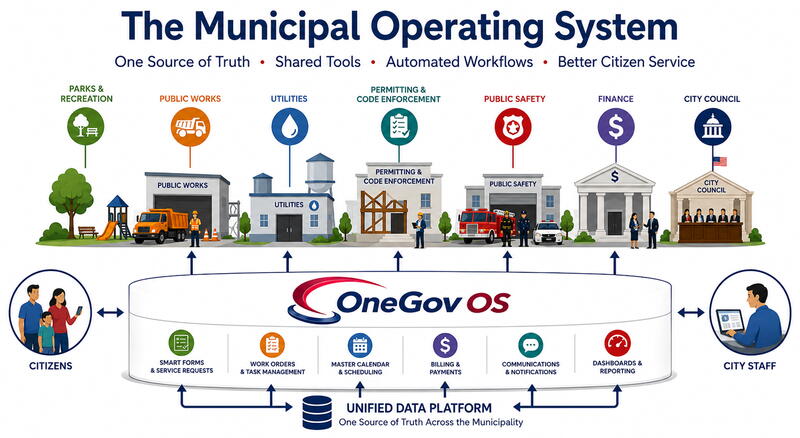
Rather than replacing every departmental application, a municipal operating system provides a common digital foundation that connects data, workflows, and resident services across the entire organization. It enables departments to operate as a single enterprise while preserving investments in existing software.
OneGov OS was designed specifically to serve as that municipal operating system.
Creating a Single Source of Truth
The first major benefit is a unified data foundation.
Today, the same property, business, or resident information often exists in multiple applications, creating inconsistencies and making it difficult to obtain a complete picture of municipal operations.
A municipal operating system establishes a single source of truth, allowing information entered once to be securely shared wherever it is needed. Staff spend less time searching for information, leaders gain better operational insight, and departments collaborate using shared, reliable data instead of competing versions of the same information.
Eliminating Friction Between Departments
The second major benefit is workflow automation.
Most government services involve multiple departments, yet many organizations still rely on manual handoffs to move work through the process.
A municipal operating system automates those workflows. Tasks are routed automatically, approvals move electronically, and information follows the process without repeated data entry. The result is faster service, fewer errors, greater accountability, and more time for employees to focus on solving problems instead of managing paperwork.
Better Service for Residents
The greatest benefit is not simply improved efficiency—it’s better service.
Residents expect government to function as one organization, not as a collection of disconnected departments. When information flows seamlessly and processes are automated, communities benefit from faster response times, improved transparency, and a more consistent customer experience.
By combining a unified data foundation with automated workflows, OneGov OS enables local governments to operate as a connected enterprise rather than a collection of isolated systems. The result is a more productive workforce, more effective operations, and better service for every resident.
Try It. Right Here. Right Now.
Visit diversifiedtechnology.com/try-it to explore a fully functional demonstration of OneGov OS from both the resident’s and municipality’s perspectives—and see how a municipal operating system can transform service delivery in your community.
Publish with ICMA!
We’re searching for interesting and insightful stories that can help others learn a memorable takeaway to serve their communities better.
